Three Deep
The building manager gave the bean teepee until morning.
He stood in the courtyard with a broom in one hand and a look that meant he had already imagined the bean vines in the compost bin.
"Sticky leaves," he said. "Bugs on the stems. If it is still like this tomorrow, it goes. The little kids touch everything."
Maya put both hands around one bamboo pole, as if the teepee might be taken that second.
Soren looked at the pale green dots gathered along the newest shoots. They were not spread evenly. They crowded at the tenderest places, where the stems were soft enough to bend with a breath.
"We can fix it," Maya said.
The building manager sighed in the way adults sighed when children had made a sentence too simple. "By morning," he said, and swept away the fallen purple blossoms as if they had done something wrong.
Two days before, there had been aphids too. Not many. Soren had counted forty-three on the whole teepee, writing the number in his notebook while Maya turned leaves with the careful speed of someone disarming a trap. They had sprayed the stems with water, wiped the worst leaves, and set the pot a little away from the nasturtiums.
On Wednesday there were not forty-three.
Soren counted one stem and stopped at thirty.
"That cannot be right," he said.
"It is right," Maya said. She was crouched so low her cheek nearly touched a bean leaf. "It is just wrong."
Soren knew what she meant. Numbers could be correct and still behave like they had broken a rule.
He checked the undersides of three leaves. No clusters of eggs. No white specks. No neat little rows hidden along the veins.
"Maybe we missed the eggs," he said.
"Where?"
He checked again because that was what his hands wanted to do when his guess began to wobble.
Maya pinched a leaf between two fingers and tilted it toward the sun. Aphids shone on the stem like bits of green glass. One of them was fatter than the others.
"Watch that one," she said.
"Which one?"
"The round one by the leaf scar. Do not blink."
Soren did blink, because not blinking made his eyes water. When his sight cleared, the fat aphid had shifted. Something pale pressed from beneath it, not like an egg dropping, not like a seed falling, but like a tiny folded animal being pushed into the day.
The pale thing came free. It unfolded six legs.
Then it stood up.
Soren forgot to write.
"No egg," Maya said.
The new aphid was almost colorless. It walked under its mother, if mother was even the right word for something smaller than a grain of rice and already busy.
Soren sat back on his heels. The courtyard wall, the watering cans, the laundry lines above them, all stayed where they were. The world did not move. It only had more inside it than it had a moment before.
"I read something," he said.
Maya did not look away from the aphid. "Good something or bad something?"
"Both. Maybe."
He flipped through his notebook. Most people thought the notebook was for homework, which was like thinking a bowl was only for peas. Soren used it for things that would not fit anywhere else.
He found the page between a sketch of a snail shell and a list of sounds made by the radiator. At the top he had written, greenfly aphids, summer. Under it, in smaller letters, born alive. Mostly daughters. No males needed for a while. Babies can already have babies forming inside them.
He had copied the lines from a library book because they sounded impossible. At the time, impossible had been enough.
Now impossible was standing on their bean plant.
Maya leaned over the notebook. Her eyes moved faster than his pencil ever could.
"Already have babies forming," she said.
"Inside them," Soren said.
She looked back at the plant. "So the one that was just born."
"May already have the next ones started."
Maya touched the bamboo pole. "And inside those?"
Soren swallowed. He had copied that part too, but had put a question mark beside it because the sentence seemed too crowded to be true.
He read it aloud. "In some aphids, the developing daughter already contains a developing embryo. Three generations are nested. Grandmother, daughter, granddaughter."
Maya made a small sound, not quite a laugh and not quite a gasp.
The bean teepee was only five poles and twine. It had been planted in a plastic tub from the laundry room. Soren looked at the fat aphid again. "The book said the population can double in two days when it is warm and there is enough food."
"It has been two days," Maya said.
"And warm."
"And bean shoots are food."
Above them, somebody opened a window. A radio voice drifted down and broke into static. The baby aphid walked to the fresh green tip and lowered its tiny mouthpart into the stem.
"People say one thing at a time," Soren said.
Maya did not answer right away. She moved one leaf aside, and underneath it three pale newborns stood among adults, each one already more than itself.
"Not here," she said.
The building manager’s broom scraped somewhere near the bins.
Maya stood up. "We are not waiting until morning."
"We cannot save every leaf," Soren said.
"We do not need every leaf. We need the plant alive and not sticky."
Soren nodded. That was a problem with edges. He could work with edges.
They made three stations. Station one was the pruning bowl, for the softest tips where the aphids were thickest. Station two was the rinse bucket, where Maya dipped leaves and rubbed stems gently under water. Station three was the check mat, an old white tray from under a flowerpot, where Soren inspected each leaf before it went back against the bamboo.
They did not use poison. Maya said poison was too much answer. Soren agreed because poison would not teach them where the aphids hid.
They cut the worst shoot first. Maya held it over the bowl. Soren paused.
"If we put that in open compost," he said, "they walk away."
Maya tied the shoot inside a scrap of clear bag, tight at the top. "Closed compost first. Dead leaves later."
They worked until the courtyard shadows climbed the wall. Their fingers smelled like crushed bean leaves. Aphids floated in the rinse water like green dust. Some escaped onto the tray, and Soren caught them with a wet paintbrush, because fingers were too large and too certain.
At one point the building manager came back and looked into the courtyard. Maya stood between him and the bean teepee with wet sleeves.
"Still bugs," he said.
"Fewer," Soren said.
"Fewer by enough?"
Maya lifted one cleaned vine. The leaves were torn in places, but they were green. New tendrils held the twine.
"Check tomorrow," she said. "Early. Before you sweep."
The building manager looked at the bowl, the bucket, the tray, the two children with knees dark from soil. He made his sigh again, but this time it had less broom in it.
"Early," he said.
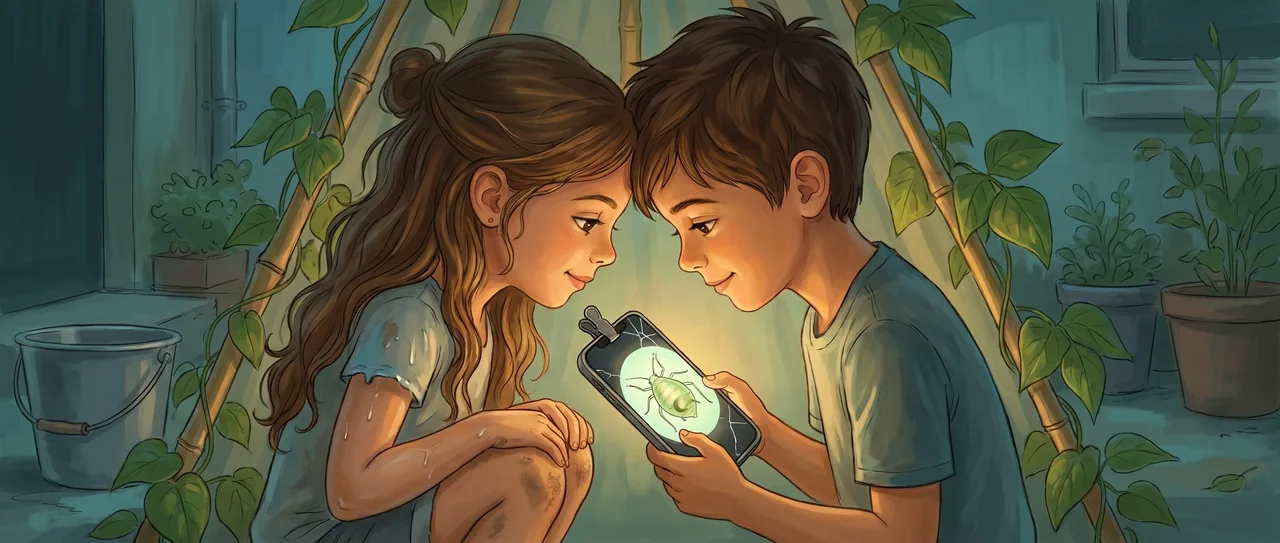
When he left, Soren took the clip-on lens from his backpack. It was meant for a phone camera, a tiny microscope with a cracked plastic rim. He had brought it for looking at pollen, before the aphids had become a multiplication problem.
Maya found one aphid on a trimmed leaf and did not brush it off.
"This one?" she asked.
"This one," Soren said.
They set the leaf on the white tray. Soren clipped the lens over the old phone Maya used for timing things and taking blurry pictures of clouds. The screen showed only green fog at first. Maya moved the phone by tiny amounts.
"Slower," Soren said.
"I am slower."
"Slower than your slower."
She breathed out through her nose and moved the phone the width of a pin.
The aphid swelled into view. Its legs were clear at the joints. Its body was not leaf-green now, but glassy, with shadows gathered in curves inside.
Maya’s hand went still.
Soren leaned closer until his forehead bumped hers. Neither of them moved away.
The aphid shifted. On the bright screen, a green body filled the glassy circle, and inside it a smaller curved body floated, and inside that, a dark speck held still.
Read the interactive version, listen to the narration, and earn a gold star →
A science-verified short story for curious kids · Curiosity Land