The Star That Wasn't a Star
Ms. Teo had three rules for library space night.
No glitter in the carpet.
No motors after six o’clock.
Nothing bright enough to make toddlers cry.
Maya thought the third rule was going to be a problem.
On the maker table lay black cardboard, silver paper, a shoebox, two coin batteries, three white LEDs, a string of blue fairy lights, Soren’s paper notebook, and the article Ms. Teo had clipped from the newspaper because the headline did not fit on one line.
Astronomers Find the Most Luminous Quasar Yet.
Under the headline was a picture that looked disappointing. Not a roaring whirlpool. Not a hole in space. Not even a proper galaxy. Just a white dot with little spikes, like every star ever drawn by someone in a hurry.
Soren had copied one sentence into his notebook, then boxed it three times.
“The quasar can outshine its entire host galaxy by a factor of ten thousand,” he read.
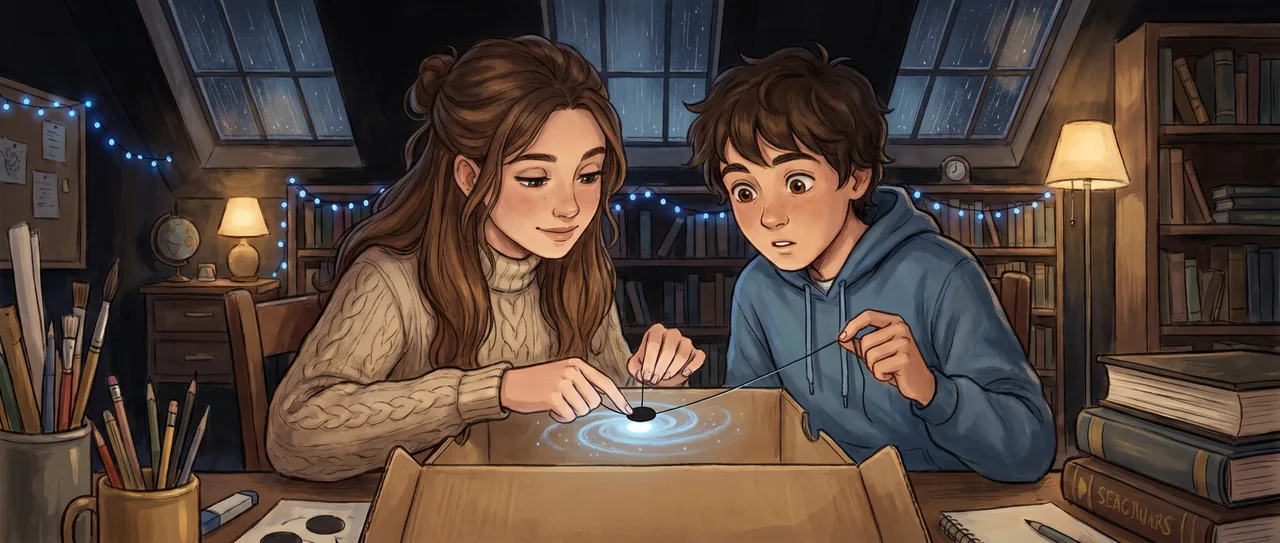
Maya looked at the shoebox stage they had made. A paper spiral galaxy curled across the back wall. The fairy lights poked through it in neat blue dots. In the center, Soren had taped a black paper circle.
“That’s wrong,” Maya said.
“It’s a black hole,” Soren said.
“It’s the brightest thing.”
“The hole isn’t bright. The stuff falling toward it is bright before it goes in.”
Maya took the black circle off with her fingernail. It left a pale scar of glue at the center of the galaxy.
Ms. Teo hurried past carrying a stack of star charts under one arm and a mug of cold tea in the other. She had a pencil stuck through her bun and a strip of tape on her sleeve.
“How are my quasar people?” she asked.
“Underpowered,” Soren said.
“Wonderful. Make the label big. Parents read labels when the children crawl under tables.”
Then she was gone, telling someone near the checkout desk that no, the inflatable Moon could not block the fire exit.
Soren counted the fairy lights. “Twenty.”
“We need ten thousand times the galaxy,” Maya said.
“If the galaxy is twenty lights, the quasar needs two hundred thousand lights.”
They both looked at the three LEDs.
One of them flickered sadly.
“We could say each LED is many lights,” Soren said, but he said it in the voice he used when he did not believe himself.
Maya picked up the article. The white dot glared from the gray page. Around it there was no galaxy at all.
“Where’s the host?” she asked.
Soren turned the page over, as if the galaxy might be hiding on the back. “It says quasars are so bright they can drown out the galaxies around them. Telescopes see the center first.”
“Drown out,” Maya said.
She took one LED and pressed its wires to a coin battery. White light burst between her fingers.
Soren blinked. “Ow.”
Maya held the LED in front of the shoebox galaxy. The blue fairy lights were still on, but the center of the box became a hard little star. The spiral arms faded. Not gone. Worse than gone. Present and ignored.
Soren leaned closer, then leaned back. “Our eyes give up.”
“Good,” Maya said.
“That is not usually good.”
“For this, it is.”
She turned the shoebox so the LED pointed outward through a pinhole in the front. The paper galaxy sat behind it, lit dimly by the fairy lights. From the front, the pinhole was a tiny white bite in the dark.
“Too small,” Soren said.
Maya grinned. “Exactly.”
He opened his notebook. “Quasars looked star-like at first. That’s where the name came from. Quasi-stellar. Like a star, but not behaving.”
“Not fitting,” Maya said.
Soren wrote quasi-stellar under his boxed sentence. His handwriting got smaller when the numbers got bigger, as if he were making room for them.
“At first people saw points of light,” he said. “Then the spectra showed they were really far away. Huge redshift. So if they looked bright from that far away...”
He did not finish.
The library sounds pressed around them. Tape ripping. Chairs scraping. A little kid making rocket noises. Rain ticking against the high windows.
Maya looked at the white pinhole. A thing that looked like almost nothing could be too bright to look around.
She grabbed a scrap of black cardboard and cut a circle no wider than her thumbnail.
“What’s that?” Soren asked.
“A not-looking tool.”
“That is a bad name.”
“A blocker.”
“Still bad.”
“A tiny eclipse.”
Soren considered this. “Better.”
Maya taped the little black circle to a thread and hung it in front of the shoebox, just loose enough to slide. When she moved it over the pinhole, the fierce white point vanished.
The spiral galaxy returned.
It was faint. Blue. Thin as breath on glass. The paper arms curled around the covered center, and the glue scar became a hidden place instead of a mistake.
Soren stared so long that Maya did not interrupt him.
Then he said, “You have to block the brightest part to see the rest.”
Maya moved the circle away. The quasar stabbed out, and the galaxy disappeared again.
She moved it back. The galaxy came softly into view.
Away. White point.
Back. Spiral.
Soren’s mouth opened a little.
“Do astronomers do that?” Maya asked.
“With stars, yes. Coronagraphs. For planets. And for bright centers, they use instruments and math to take away glare.” He tapped the article. “Maybe for quasar host galaxies too. The bright part is real, but it isn’t the only real thing.”
Maya slid the thread with one finger. “If you stare straight at the loudest part, you miss the city around it.”
“The galaxy,” Soren said.
“The city.”
“The galaxy city.”
Maya allowed this.
Ms. Teo came back, breathless and carrying a step stool. “Please tell me nothing is on fire.”
“Nothing is on fire,” Soren said.
“Excellent. Why is your beautiful galaxy invisible?”
Maya pointed to the dangling black circle. “Use the tiny eclipse.”
Ms. Teo bent down. She moved the circle away and flinched at the white point. She moved it back and found the blue spiral. For once, she did not say anything about labels.
Then she glanced at the clock. “You have four minutes before the doors open.”
“We need a sign,” Soren said.
“Big,” Ms. Teo said, and hurried away.
Soren tore a clean strip from the bottom of a poster. He wrote slowly so the letters would not crowd each other.
This dot is not a star.
Maya watched him, then shook her head.
“Wrong first line,” she said.
Soren handed her the marker.
She crossed out nothing. She turned the paper over.
On the blank side, she wrote:
Try to find the galaxy.
Under that, Soren added:
The center is ten thousand times brighter.
They taped the sign beside the shoebox. The LED shone through the pinhole, sharp and white. The galaxy waited behind it, impossible to see unless someone’s hand moved the little circle into exactly the wrong place for looking at the brightest thing.
The doors opened. Wet shoes squeaked on the library floor. Children poured toward the Moon in the fire-safe corner, toward the meteorites, toward the table where someone had made cookies shaped like Saturn.
A girl in a yellow raincoat stopped at their shoebox.
“What do I do?” she asked.
“Find the galaxy,” Maya said.
The girl put one eye to the viewing hole. “I just see a dot.”
Soren held up the thread. “Try making the dot disappear.”
The girl slid the black circle. Her shoulders went still.
“There’s something around it,” she whispered.
More children came. One tried to peek around the side. One asked if the black hole was a lamp. One said the tiny eclipse looked like a bug. Ms. Teo stood across the room with her cold tea, watching the line form at the dimmest display in the library.
Soren did not open his notebook. Maya did not touch the sign.
Maya slid the black circle across its thread until it covered the white point, and the paper spiral bloomed, faint and blue, around her hands.
Read the interactive version, listen to the narration, and earn a gold star →
A science-verified short story for curious kids · Curiosity Land