The Red Pieces
The library looked different after everyone left.
The folding chairs stood in crooked herds. Paper cups leaned on their sides. Someone had dropped a cookie under the table where the family-tree stickers had been, and the ants had found it before the janitor did.
Maya was supposed to be stacking markers by color. She had made three piles, then stopped.
Soren noticed because the orange markers were mixed with the brown ones, which Maya never allowed.
“What is it?” he asked.
Maya pointed with a capped marker.
On the bulletin board, under a cardboard title that said OUR HUMAN FAMILY, there were three paper doors. One was labeled US. One was labeled NEANDERTHALS. One was labeled DENISOVANS. The Neanderthal door had a black ribbon across it and a smaller sign that said EXTINCT.
On the table below it, beside a plate of carrot sticks no one had eaten, lay a handout from the evening talk. Soren had already folded one copy into his pocket because it had a photograph of a tiny bone from a cave and a diagram of DNA letters.
Maya tapped the last paragraph.
Soren read it aloud softly. “Many people whose ancestors lived outside Africa carry about one to four percent Neanderthal DNA.”
He looked up at the bulletin board.
The black ribbon looked too neat.
Ms. Vela, the children’s librarian, came out of the supply closet carrying a tower of empty tape dispensers. She was small and quick and had the fierce face of someone who had been asked where the bathroom was one thousand times.
“Do not tell me the projector is still on,” she said.
“The projector is off,” Soren said.
“The board is wrong,” Maya said.
Ms. Vela shut her eyes for half a second. “The board is simplified.”
“That is a different thing,” Maya said.
“It is nine minutes past closing. Simplified is my favorite kind of true.”
Soren picked up the handout. “It says Neanderthal DNA is in living people.”
“And the board says Neanderthals are extinct,” Maya said. “Both cannot sit like that.”
Ms. Vela put the tape dispensers into a box. “They disappeared as a separate group roughly forty thousand years ago. That is what extinct means here.”
Maya looked at the ribbon again. “Then the ribbon is lying with style.”
Ms. Vela laughed before she could stop herself. Then she pointed at the mess. “You have until I finish the lost-and-found cart. If you can make it clearer without making it impossible to read, do it. No glitter. No asking people for their private DNA. No starting a new civilization in the meeting room.”
She rolled the cart away, muttering at a single mitten.
Soren emptied his pocket. His handout had soft fold lines already. “We need a model.”
Maya was already opening drawers behind the craft table. “String, index cards, red pencils, clear plastic sheets, three dead glue sticks, one alive glue stick.”
“Hundred squares,” Soren said.
“For percent?”
“Yes.”
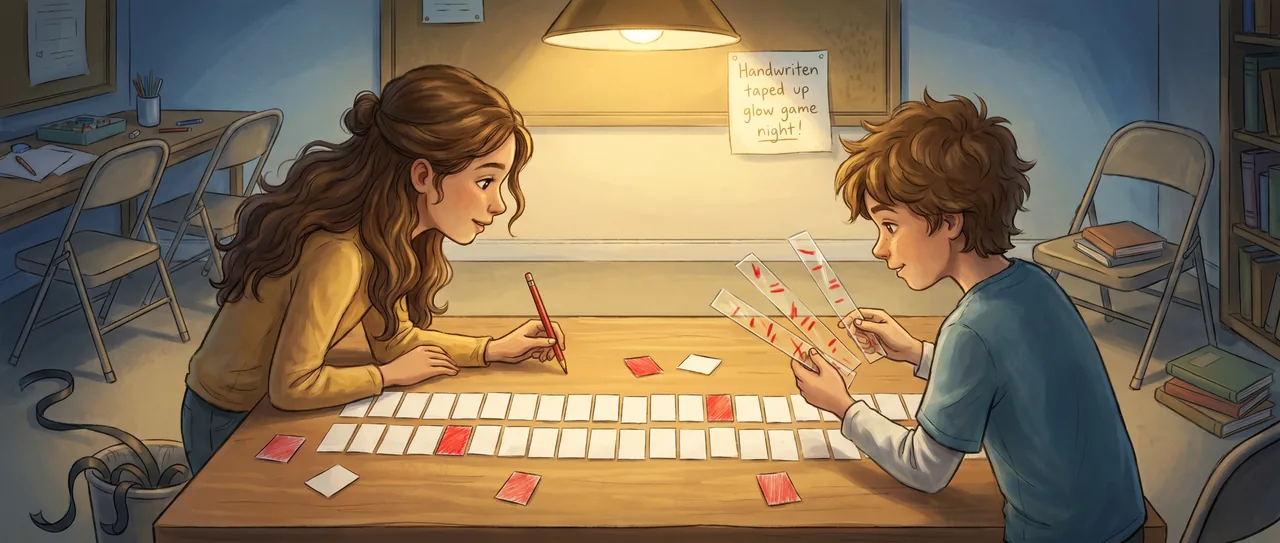
They cut an old poster into one hundred small rectangles. Soren counted them in rows of ten, moving each row aside with the edge of his hand. Maya colored four pieces red so fast the pencil squeaked.
“One to four percent,” Soren said. “So four is the high end.”
Maya dropped the red pieces among the white ones. Four red flecks sat in a snowfield.
“That looks tiny,” she said.
“It is tiny.” Soren looked back at the handout. “But the human genome has about three billion DNA letters.”
Maya froze with her hand in the paper pile.
Soren reached for a scrap envelope and wrote thirty million in words because Ms. Vela’s marker had gone dry halfway through the zeros. “One percent is about thirty million letters.”
Maya picked up one red paper piece and held it close to her eye. “That is a tiny that is not tiny.”
The room went very quiet around them. The cookie ants had made a black moving comma on the floor. The bulletin board doors waited.
Soren spread the pieces into a long strip across the table. “It is not like one whole Neanderthal grandparent. It is scattered pieces. Different people have different pieces.”
Maya put the red piece down, not where it had been, but between two white pieces near the middle. “So the black ribbon is for a people.”
Soren moved another red piece near the far end. “And the red pieces are for DNA that kept going.”
Maya said, “A door can close and still have footprints coming out from under it.”
Soren looked at her.
“What?” she asked.
“That is not a display sentence.”
“No,” Maya said. “It is a ceiling sentence.”
They made three clear plastic strips. Soren labeled them one person, another person, and another person. Maya drew red marks on each, never in quite the same places. On the first strip, the red was near the beginning. On the second, it broke into two marks. Soren held the strips over the paper genome. The red marks did not line up.
“That matters,” he said.
Maya leaned closer. “Why?”
“Because if everyone had exactly the same red piece, that would be one story. But different pieces means the old pieces got shuffled through families. Inherited. Recombined.”
Maya slid the strips on top of each other. The red marks became a scattered trail.
“Like nobody has the whole old song,” she said.
“But different people remember different notes.”
They both went still.
From the lost-and-found cart, Ms. Vela called, “If that was a glitter idea, abandon it.”
“It is a no-glitter idea,” Soren called back.
“It is worse,” Maya said. “It uses tape.”
They took down the black ribbon. Maya did it carefully, peeling from the corners so it would not tear the cardboard door. Soren wrote a new sign on the back of an unused flyer.
NEANDERTHALS DISAPPEARED AS A SEPARATE PEOPLE ABOUT FORTY THOUSAND YEARS AGO.
Maya read over his shoulder. “Good. Now the other half.”
Soren added:
SOME OF THEIR DNA STILL TRAVELS IN LIVING HUMANS.
Maya took the pencil. Underneath, smaller, she wrote:
NOT GONE THE WAY SMOKE IS GONE.
Soren looked at it for a long time. “Ms. Vela might say that is not official.”
“It can be the part for people who read the small words.”
He taped it up.
Ms. Vela rolled the cart back and stood behind them. One mitten, three scarves, and a plastic dinosaur leaned out of the top basket.
She read the new sign. Her mouth made the shape adults made when they were deciding whether a thing was trouble.
“No glitter,” Maya said.
“No private DNA,” Soren said.
“No new civilization,” Maya added.
Ms. Vela reached out and straightened the sign by the width of a fingernail. “The small words stay.”
Maya grinned.
Soren picked up the handout again. “It says scientists found this by comparing ancient DNA from bones with DNA from living people.”
“From bones,” Maya said.
“Tiny amounts. Very old. Damaged. They had to read broken pieces.”
Maya looked at the plastic strips, the red marks, the white paper squares. “Someone built tools that can listen to bones.”
Ms. Vela’s keys jingled in her hand. “That sentence is going to follow me home, and I have filing to do.”
She turned off the meeting room lights except for the lamp above the bulletin board. The rest of the library became shelves and shadows.
Under the lamp, the three paper doors glowed softly. US. NEANDERTHALS. DENISOVANS.
The black ribbon lay curled in the trash can.
Soren gathered the leftover clear strips. “We could make more.”
Maya took one and held it against the light. It vanished except for its edges.
“Not tonight,” Ms. Vela said, but not sharply.
Maya laid the strip on the table. Soren held the corners flat.
Maya picked up the red pencil and drew one small mark near the middle of the clear plastic.
Read the interactive version, listen to the narration, and earn a gold star →
A science-verified short story for curious kids · Curiosity Land