The Other Half of the Portrait
The homework was impossible on purpose.
Make a self-portrait without using your face, your name, or anything you own.
Soren had written the sentence at the top of a page in his notebook and underlined without, because that was where the trap lived.
“My genome,” he said.
Maya, who was upside down on one of his kitchen chairs with her feet on the wall, said, “Too easy.”
“It is not easy. It is three billion letters.”
“It is still the first answer. First answers are usually just doors with paint on them.”
Soren looked at the page again. “Your genome is you.”
“My genome is also almost the same in every cell. That sounds like copying.”
On the counter, Soren’s father dropped a small cardboard box into the place where the fruit bowl usually went. The box had a blue stripe, a barcode, and a picture of a smiling intestine made of dots.
“Do not open that,” his father said.
Maya’s feet came off the wall.
Soren said, “What is it?”
“Research kit,” his father said. He was chopping carrots too quickly and wearing one earbud. “Microbiome study. Adults only. No touching the tube. No touching anything that says sample. No discussing samples while I am making soup.”
“What kind of sample?” Maya asked.
Soren’s father pointed the knife at both of them. “Exactly the kind we are not discussing while I am making soup.”
Then his earbud made a tiny sound, and he said, “Yes, I’m here,” to someone who was not in the room.
Maya slid off the chair and stood near the counter with her hands behind her back.
“I am not touching,” she said.
Soren stood beside her. The box had a folded paper tucked under its lid, not inside, so the lid was still closed. He read the largest line.
Your gut is home to roughly thirty-eight trillion bacteria.
Below it, in smaller letters, the paper said that this was about the same order as the number of human cells in the body.
Soren stopped reading.
Maya said, “Say that again.”
“I didn’t say it.”
“Then read it again.”
He did.
His father, from the stove, said, “Please do not make the soup weird.”
Maya took two steps backward, as if the box had become larger without moving.
“Thirty-eight trillion,” she said.
“Bacteria,” Soren said.
“In you.”
“In the gut mostly. It says gut.”
Maya looked at Soren’s middle, then at her own, then at the soup pot. “That is too many for a place that gets told not at the table.”
Soren knew exactly what she meant. He had asked, once, how long dinner stayed dinner after you swallowed it. His aunt had said, “Not at the table.” He had asked whether hiccups began above or below the lungs. “Not at the table.” He had asked whether his stomach was a bag or more like a moving cave. “Soren.”
Now the not-at-the-table place had a population.
He pulled his notebook closer, then pushed it away. The page suddenly felt too flat.
Maya said, “Self-portrait.”
“No,” Soren said. “Bacteria are not human.”
“Neither is your lunch, until it is.”
“That is different.”
“How?”
He opened his mouth. He closed it.
On the paper, a drawing showed tiny colored dots in a looped tube. The words under it said that many gut bacteria help break down parts of food human bodies cannot digest by themselves. Another line said the lab would read DNA fragments from the sample to identify bacteria.
“They have their own DNA,” Soren said.
“So they are not you,” Maya said.
“Right.”
“But they are in you.”
“Right.”
“And doing jobs.”
Soren pressed both palms on the table. “That is the problem.”
Maya grinned. “That is the portrait.”
They did not touch the box. They raided the pantry instead.
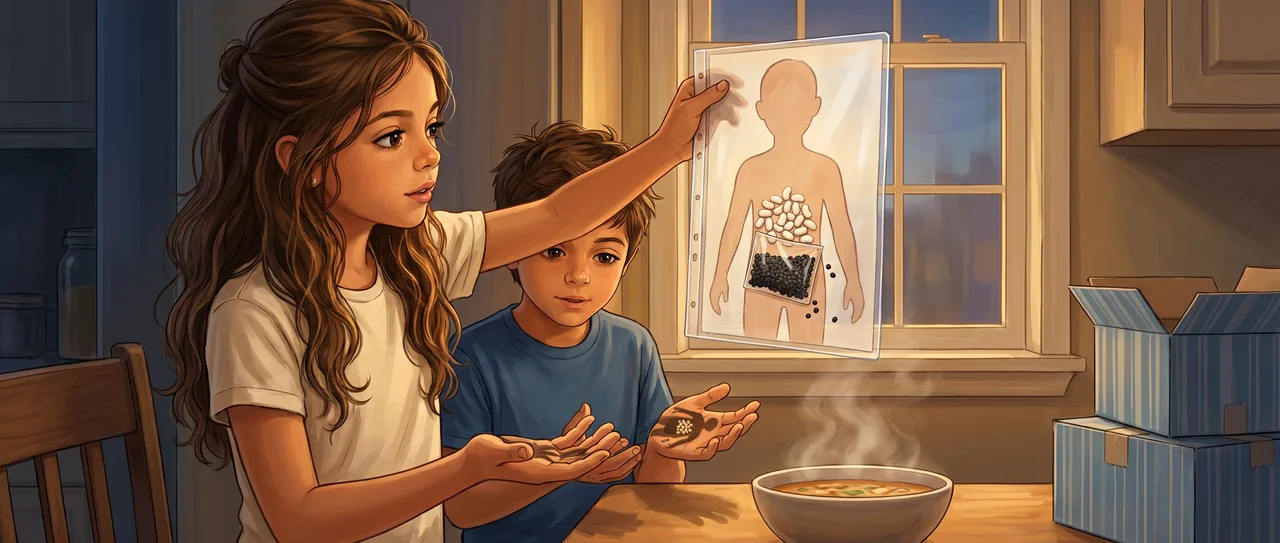
Soren found a bag of white beans and a jar of black lentils. Maya found a clear plastic report cover from last year’s volcano project, three rubber bands, masking tape, and a marker that smelled like plums.
“If one bean equals one trillion human cells,” Soren said, counting, “we need about thirty beans. Maybe a little more, depending on the estimate.”
“The paper says the bacteria are roughly thirty-eight trillion,” Maya said.
“Roughly matters.”
“Roughly is allowed to have elbows.”
They made two piles, white beans for human cells, black lentils for bacteria. Soren counted the black lentils twice. Maya counted the white beans once and then moved one back.
“You can’t just remove a trillion cells,” Soren said.
“I didn’t. I removed pretending we know exactly.”
Soren considered this. Then he nodded and took one black lentil out too.
They taped the clear report cover on three sides. Maya drew the outline of a body on the front, no face, no hair, no name. Soren drew a long curled path inside the belly, because the paper said most gut bacteria lived in the large intestine, and he would rather draw the place than pretend it was everywhere.
When they poured in the beans and lentils, the whole portrait failed.
The white beans sank to the bottom. The black lentils slipped between them. The body outline looked like a spilled dinner.
Maya held it up to the light. “Wrong kind of true.”
Soren liked that. He hated it too.
He shook the cover carefully. The lentils scattered through the body like pepper.
“They are not in your toes,” he said.
“Some bacteria live on skin.”
“Not these ones. Gut ones.”
He cut a narrow strip from another plastic sleeve and taped it inside the belly, making a clear pocket shaped like a crooked river. Maya poured the black lentils into that pocket. The white beans stayed around it.
Now the body had two kinds of crowd. Maya tapped the belly pocket. “Half the count, hidden in one room.”
“Not half exactly.”
“Almost half.”
“By number. Not by weight. Human cells are bigger.”
“Good. Put that in.”
Soren wrote on a scrap of tape: COUNT, NOT SIZE. He stuck it along one edge of the report cover.
His father came by with three bowls of soup and stopped. “Is that my report cover?”
“Last year’s,” Soren said.
“Is that food in it?”
“Dry food,” Maya said.
“Is it about the box I told you not to touch?”
“We did not touch the box,” Soren said.
His father looked at the portrait, at the taped gut pocket, at the two piles of beans left on the table. His meeting voice had gone away.
“That is a very strange self-portrait,” he said.
Maya said, “It’s Soren.”
Soren said, “It might also be everyone.”
His father set down the soup. “The lab will send a chart. Bacterial groups, mostly. Not every single one has a neat name.”
“Why not?” Soren asked.
The earbud chirped again. His father sighed. “Because living things got here before our labels did.”
He went back to the stove.
Maya picked up three uncounted lentils and placed them beside the plastic body, not inside it.
“What are those?” Soren asked.
“The ones nobody has named neatly.”
“That makes the number wrong.”
“The number was already roughly.”
Soren looked at the portrait. White beans. Black lentils. A body without a face. A crowd with borders that were not walls. The assignment had asked for no belongings, but this was not something he owned. It was something carrying him while he carried it.
Maya slid one of the unnamed lentils into the gut pocket.
Soren did not stop her.
After dinner, they strengthened the tape and punched two holes at the top so it could hang in class. The beans clicked softly whenever the plastic moved. Soren wrote nothing else on it, not even his initials.
Maya lifted the portrait to the window, and the white beans and black lentils threw one tangled shadow across Soren’s hands.
Read the interactive version, listen to the narration, and earn a gold star →
A science-verified short story for curious kids · Curiosity Land