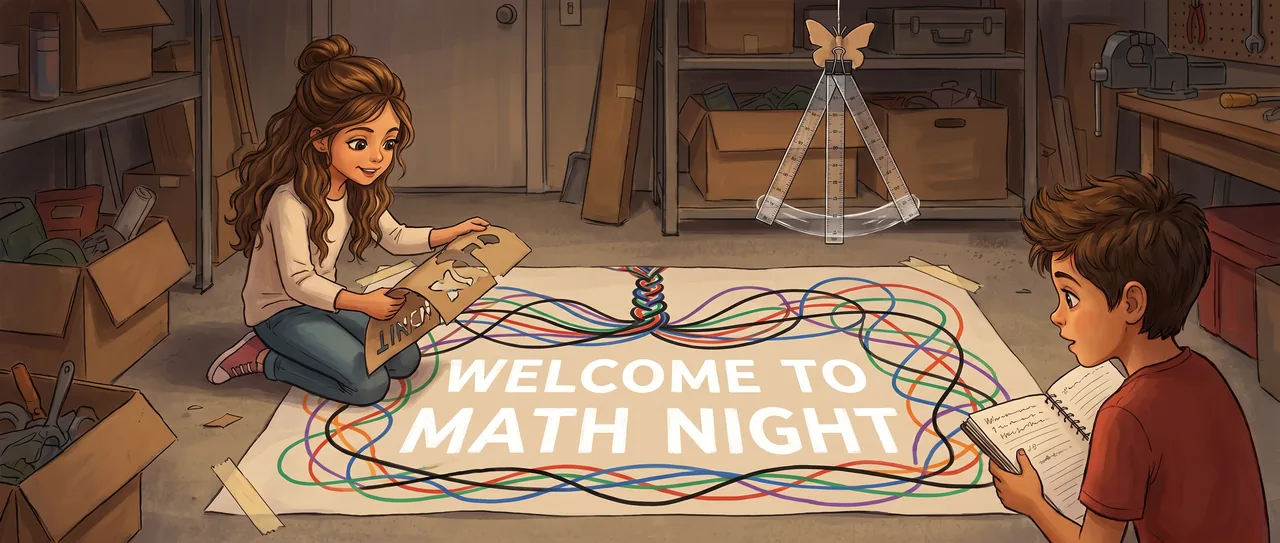
The Machine That Would Not Draw Twice
The drawing machine was supposed to make one clean loop around each letter.
That was the plan.
Maya had cut the letters from cereal boxes and taped them to a sheet of white paper on the garage floor. Soren had built the machine from two clear rulers, three bolts, four washers, and a black marker taped to the end. The first ruler swung from a hook screwed into a shelf. The second ruler swung from the first. The marker hung at the bottom like a tiny foot.
If they pulled the top ruler back to the pencil mark and let go, the marker would swing. If the machine was good, it would swing the same way every time.
The banner would say WELCOME TO MATH NIGHT, except right now it said WELCOME TO MATH NIGH because the T had been attacked by a scribble that looked like a frightened squid.
Soren crouched beside it. His paper notebook was open on his knee. He had written Run one, then crossed it out after the marker drew over the E. He had written Run two, then put three question marks beside it.
“The bolt is loose,” he said.
Maya put her eye level with the lower hinge. “Maybe.”
“You said maybe like you mean no.”
“I mean it starts right.”
Soren looked at the black loops. At the top, near the release point, the lines lay almost together. Then, halfway down the page, they separated as if one of them had changed its mind.
Maya's father leaned in from the driveway with a box of folded chairs under one arm. He was in charge of setting up the cafeteria, and he had been in charge of it since breakfast, which meant he kept entering rooms without really being in them.
“Looks energetic,” he said.
“It’s wrong,” Maya said.
“Art is forgiving.”
“Math Night isn’t.”
He smiled, missed the problem completely, and carried the chairs to the car.
Soren tightened the bolt until the rulers squeaked.
They tried again.
Maya lifted the top ruler until its edge touched the pencil mark on the shelf. Soren held the paper flat with both hands. The marker trembled. Maya let go.
The upper ruler fell. The lower ruler whipped after it, lagged, flipped, and snapped around. The marker drew a loop, a hook, a nearly perfect circle, then a slash through the H.
Soren wrote, Not loose.
“Wind,” he said.
They shut the garage door. The air went still and warm. The smell of cardboard, old grass clippings, and marker ink stayed with them.
They tried again.
This time the line avoided the H and ruined the I.
“Table slope,” Soren said.
“It’s on the floor.”
“Floor slope.”
They slid a marble across the concrete. It rolled slowly toward the washing machine.
“Aha,” Soren said.
They stacked two magazines under one corner of the paper until the marble stayed still.
They tried again.
The marker made a fat black knot in the space between G and H, then wandered off the bottom of the paper entirely.
Maya lay on her stomach with her chin on her hands. “It wants something.”
“It does not want.”
“You know what I mean.”
“I don’t yet.”
Maya reached up and moved the ruler back to the pencil mark. She did not let go. “It starts together. Then it doesn’t.”
Soren tore three sheets of tracing paper from his notebook and taped them over the ruined banner. He changed the marker to blue.
“Again,” he said.
Maya released the ruler. Blue line.
They taped down another tracing sheet. Red marker.
Again.
Green marker.
Again.
The first parts of the lines braided tightly, blue, red, green, almost one path. Then the braid burst. Blue curled left. Red looped under. Green snapped into a shape like a fishhook.
Soren did not write for a while.
Maya watched his face. She liked the moment before Soren spoke, when his eyes were not slow, only busy.
“There’s no coin toss,” he said.
“No dice,” Maya said.
“No computer picking numbers.”
“No one breathing on it.”
“Gravity is doing gravity. The rulers are doing ruler things. The hinges are doing hinge things.”
“And still.”
“And still.”
Maya lifted the ruler again, more carefully this time. “Same place.”
“Almost same place.”
She froze.
Soren leaned close. “Your hand covers the mark.”
Maya moved her finger. The ruler's edge was on the pencil line. Or touching the fuzzy left side of the pencil line. Or maybe the right. The pencil line was not a line from close up. It was a gray road with crumbs.
“That’s too small,” Maya said.
The lower ruler bumped her wrist.
She looked at the taped marker. She looked at the hinge. She looked at the braided lines that had flown apart.
“That’s not too small,” she said.
They made the release better.
Soren found a binder clip. Maya found a toothpick. They clipped the top ruler against the shelf, pinned it with the toothpick, and tied dental floss to the toothpick so Maya could pull without touching the ruler.
They both backed away.
“Run one with pin release,” Soren said.
Maya pulled the floss.
The ruler dropped. The marker drew a long black curve, a loop, a sudden double loop, and a tidy comma near the bottom.
They reset it.
“Run two with pin release,” Soren said.
Maya pulled the floss.
For one breath the second line followed the first. Then it climbed away and cut between two letters where the first line had never gone.
Soren stared at the toothpick.
“The pin rubs,” Maya said.
“It rubs which side?”
“Not the same side.”
Soren wrote, left edge of pin? right edge of pin? He underlined edge twice.
At school, people sometimes laughed when Maya objected to a poster being almost centered or a rhythm being almost even. They said almost was the same as done. Here was a machine made of gravity and rulers, and almost was not the same as anything.
Soren tapped the page with his pencil. “If this much matters here, then for weather...”
Maya looked toward the closed garage door. Rain was supposed to come after dinner. The forecast had said probably, which adults used when they wanted to sound certain and uncertain at once.
“My uncle told me about this,” Soren said. “A weather person put a number into a computer with fewer decimal places. The weather came out different.”
“Because the missing decimals were secretly enormous.”
“They weren’t enormous.”
Maya grinned. “They became enormous.”
Soren shut his notebook partway, then opened it again. “We can’t make it draw the same loop.”
“No.”
“We still need a banner.”
“Yes.”
The ruined letters lay under loops of black, blue, red, and green. Maya lifted one cardboard E. Under it, the paper was still clean.
“Oh,” she said.
Soren followed her eyes.
They did not need the machine to avoid the letters. They needed the letters to protect themselves.
They cut better stencils from the cereal boxes, heavier ones, and taped them down hard. They moved the paper so all the letters sat inside the widest reach of the swinging marker. Soren drew a circle around the whole area, as far as the marker could possibly go.
“It can be wild in here,” he said.
“Not outside.”
“Probably not outside.”
Maya gave him a look.
“Because the arms are only this long,” he said, and stretched the rulers to their limit.
They ran the machine again and again. Purple, orange, green, black. The double pendulum kicked and curled and spun. Sometimes the lower ruler flipped all the way over the top one. Sometimes it hesitated, as if listening to something too quiet for the garage. The lines filled the space around the cardboard letters, never repeating, never leaving the circle.
When they peeled the stencils away, WELCOME TO MATH NIGHT appeared in clean white letters surrounded by a storm of colored paths.
Maya's father came back for the tape dispenser and stopped at the doorway.
“That,” he said, “is better than clean loops.”
“We couldn’t make clean loops,” Soren said.
“So we stopped asking for them,” Maya said. Soren picked up a scrap of cereal box shaped like two wings joined in the middle. He held it against the binder clip.
“Butterfly,” he said.
Maya tore a small piece of tape with her teeth and stuck the cardboard wings to the release clamp. The garage roof ticked once. Then twice. Rain began softly, without waiting for anyone to be ready.
Maya raised the ruler to the gray pencil mark. Soren pinched the floss between two fingers. The cardboard butterfly shook on the clamp.
Read the interactive version, listen to the narration, and earn a gold star →
A science-verified short story for curious kids · Curiosity Land