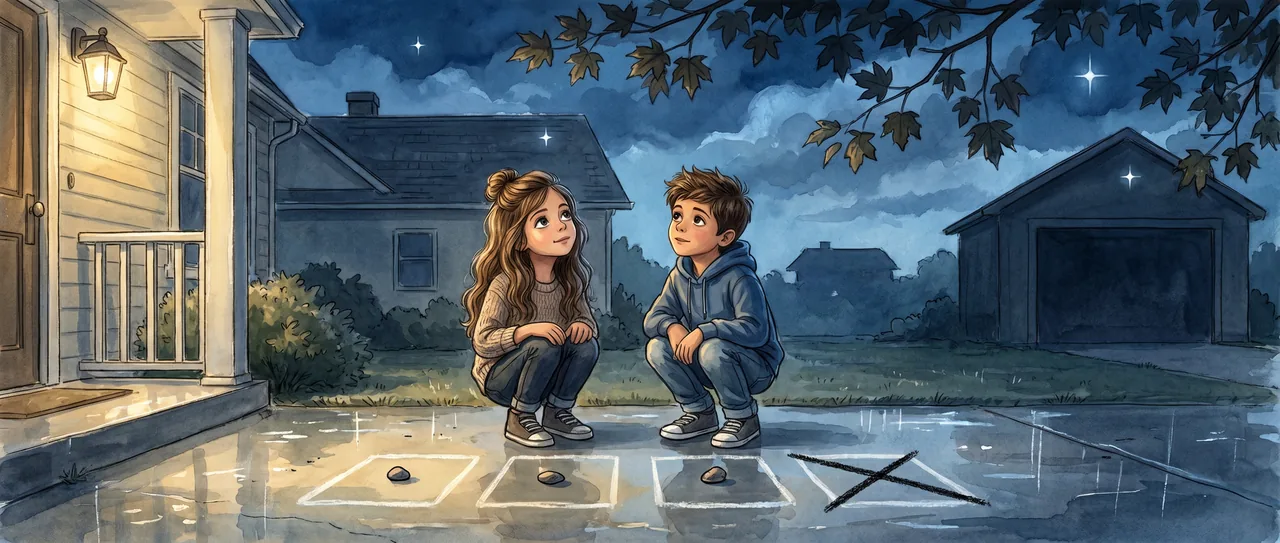
The Fourth Square
Mrs. Alva wrote the debate question across the board in block letters.
Was Einstein right to doubt quantum entanglement?
Then she underlined Einstein twice.
"No fog," she said. "No saying both sides are interesting. Pick a side and defend it. Also, no glitter. Last year's volcano is still in the floor cracks."
Maya copied none of this. She was looking at the handout photograph. Einstein's hair went everywhere, as if each strand had chosen its own direction and refused to apologize.
Soren read the first paragraph with his finger under the line.
"Spooky action at a distance," he said.
Mrs. Alva heard him. "Einstein's phrase. He did not mean it as a compliment."
Soren kept reading after the bell rang. In the hallway, people moved around him like water around a stone.
"It says two particles can be far apart and still give linked answers when measured," he said. "Instantly."
"Not messages," Maya said.
"Still," Soren said.
"Still," Maya agreed.
They chose Einstein's side before they reached the bike rack. It was not because they thought he was safe. It was because he sounded bothered in the right way.
At Soren's kitchen table, they tried to make the universe behave properly.
Soren cut index cards into neat halves. Maya found four bottle caps, two blue and two white, and stole a cookie from the cooling rack before Soren's mother could say they were for later.
His mother was at the sink wearing one gardening glove and one rubber glove, because she had started repotting basil, remembered the dishes, and refused to admit either job had won.
"Are you doing homework or gambling?" she asked.
"Arguing with quantum mechanics," Soren said.
"Use coasters," she said, and went back to the basil.
The handout said a physicist named John Bell had turned Einstein's worry into a test. If particles carried hidden instructions, like tiny sealed cards telling them what answer to give, then the results had to stay under a certain limit. Real entangled particles went past the limit.
Maya tapped the word real.
"That word is rude," she said.
Soren made a box for the hidden instructions. He labeled the left side detector A and B. He labeled the right side detector A and B. For every pair, he wrote what each detector would answer if asked A or B. Blue or white. Four answers, already packed before anything happened.
"There," he said. "No spooky anything. Just instructions."
Maya put one cookie crumb on the table and another far away by the salt. "Separated."
"Crumbs are not particles."
"They are now."
Soren drew four squares on paper.
"Bell game," he said. "The two detectors get settings. A or B on the left. A or B on the right. The rule is, for three squares, the answers should match. For the fourth square, B and B, the answers should be different."
"Why those rules?"
"Because this is the simple version of the test. Not the whole laboratory version. The logic version."
Maya leaned over the paper. "So the packed cards have to win all four?"
"If hidden instructions explain everything, they should be able to."
He made the first instruction list.
Left A, blue.
Left B, blue.
Right A, blue.
Right B, blue.
The first three squares matched. The fourth square matched too.
"Bad," Maya said.
"For the fourth square," Soren said.
He changed Right B to white. Now the fourth square worked. But the square where Left A met Right B failed.
Maya smiled a little.
"It's a blanket," she said.
"What?"
"You pull it over one foot, the other foot gets cold."
Soren did not smile yet. He made another list. Then another. Maya stopped stealing cookies and started sorting. They made piles. Win three. Win two. Win one. Never win four.
Soren filled a page in his notebook with sixteen possible instruction lists. Maya did not wait for him to finish the last two.
"The first three force the fourth," she said.
"Let me see."
She pointed to the four squares. "If Left A matches Right A, and Left A matches Right B, then Right A and Right B are the same. If Left B also matches Right A, then Left B is the same too. So Left B and Right B have to match. But the fourth square wants different. It can't have it."
Soren's pencil stopped with its point pressed into the paper.
Outside, a truck passed, carrying metal pipes that rang against one another like bells.
"So packed answers lose at least one square," he said.
"Every time."
"But real particles don't win every time either." Soren grabbed the handout. "It says they win more often than packed answers can. About eighty-five percent in the best version of the game. Not one hundred."
"That is worse," Maya said.
Soren looked up.
"Because if they won one hundred, we would have the wrong game," she said. "If they win just too much, the universe is being careful."
His mother came to collect the cookie tray and glanced at the paper.
"I hope one of you understands that," she said.
"No," Soren said.
"Good," she said. "Then it is probably worth doing."
She left with the cookies.
Maya read the next page of the printout. The words were crowded and too small, which always made adults think they were being serious.
"Listen," she said. "Some experiments put the detectors far apart. Some choose the settings after the particles are already on their way."
"So the particles can't just check which question is coming."
"And this part," Maya said.
She turned the page toward him.
Soren read it twice.
Some Bell tests had used light from distant stars, even galaxies, to help choose the detector settings.
He sat very still. "They asked stars to help decide the questions," he said.
"Not asked. Used the light."
"Light that had been traveling for years."
"Some much longer."
Soren looked at their paper squares. The card game seemed suddenly small, but not useless. Small like a key was small.
"Einstein thought maybe the particles had instructions," he said.
"Or that something was missing."
"And Bell made a trap for missing things."
Maya slid the fourth square closer to him. "A trap with one corner that won't lie down."
Soren had been called picky by three teachers, two cousins, and one dentist who did not appreciate questions about suction tubes. Maya had been told to let people finish sentences before chasing the wrong word out of them. But the handout did not treat the bothered part like a problem. The bothered part had built the test.
Soren turned to a clean notebook page, then stopped.
"Mrs. Alva said pick a side," he said.
"We can."
"Which?"
Maya gathered the bottle caps into the four squares. Blue, blue, blue, empty.
"Einstein was right to doubt," she said. "And the experiments were right to answer."
"She said no fog."
"Then we won't fog. We'll make her try to pack the answers."
Soren began cutting more cards. Maya made a sign for the fourth square, not with words, just a black X so nobody could pretend it was the same as the others.
They practiced in the hallway after dinner, back to back, calling out A and B while Soren's mother stepped around them with a laundry basket.
"A," Maya called.
"B," Soren answered.
They flipped their cards. Match.
"B," Maya called.
"B," Soren answered.
They flipped their cards. Match.
"Lose," Maya said.
"Every packed universe loses somewhere," Soren said.
"Don't say packed universe tomorrow."
"Why not?"
"Because then Mrs. Alva will write it on the board and ask if it is on the test."
Soren wrote Bell limit on the top card. Under it he wrote, real experiments cross this line. Then he crossed out real, thought for a moment, and wrote, nature.
Maya opened the back door.
The rain had stopped. The driveway shone under the porch light. Clouds moved apart in ragged pieces.
"Bring chalk," she said.
They went out to the driveway because the kitchen table was too small. Maya drew four squares on the wet concrete. Soren placed a pebble in each of the first three squares and left the fourth bare. Above the garage, one bright star showed through the maple branches; on the other side of the roof, another star blinked in a patch of clear sky.
Read the interactive version, listen to the narration, and earn a gold star →
A science-verified short story for curious kids · Curiosity Land