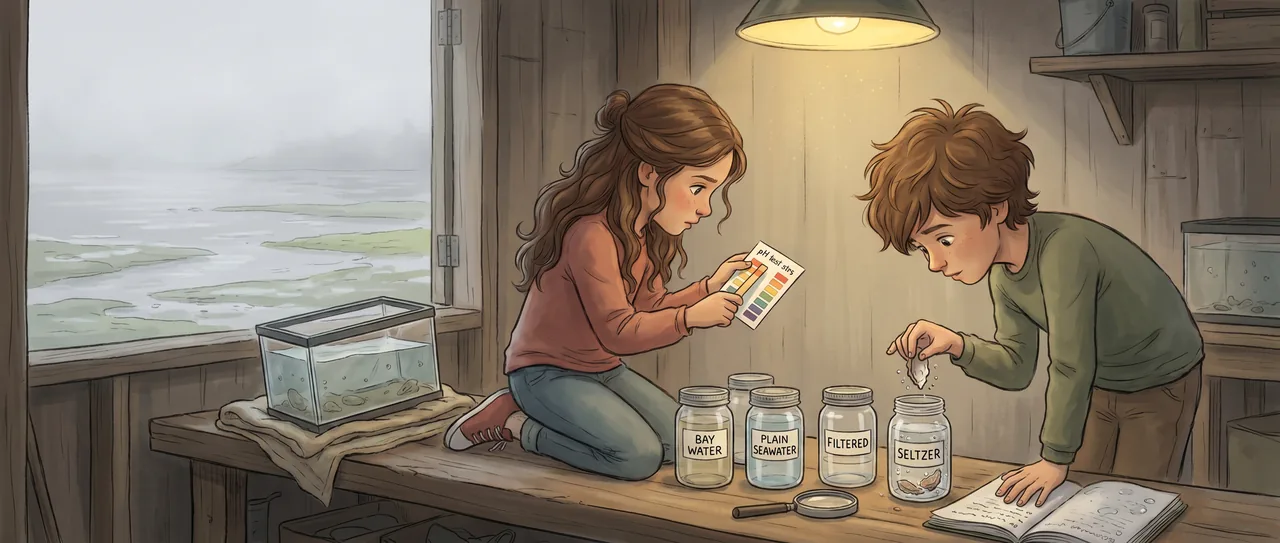
The First Floor
The baby oysters were supposed to look like pepper dust.
That was what Aunt Lina had said when she handed Maya the magnifying glass. Alive ones would be specks with edges. Hungry specks. Busy specks. A whole future crop, smaller than freckles, clinging to pale plastic cups in the warm water trays.
These looked like flour after rain.
Maya did not say that. Aunt Lina already had both arms inside the pump cabinet, a screwdriver between her teeth and a streak of grease across her cheek.
“Bad motor,” Aunt Lina said. “Or bad luck. Or both, which is rude.”
Soren stood beside the trays with his notebook open. The pages had gone soft from the fog. He had drawn six little rectangles for the six nursery tanks. In the first five, he wrote failed. In the last one, he wrote cloudy, moving?
Maya leaned closer to the last tank.
“Not the motor,” she said.
Aunt Lina’s voice came from inside the cabinet. “The motor is making a sound like a goat in a bucket.”
“That tank has the same motor water,” Maya said. “But it is less dead.”
Soren looked at the pipes. Each tank had a clear tube coming in from the same blue drum. Each tank had a drain. The sixth tank sat crooked, propped up on a folded towel because one leg had cracked.
“It fills slower,” he said.
Maya touched the tube with one finger. The water inside pulsed gently. “Slower might matter.”
Aunt Lina backed out of the cabinet and spat the screwdriver into her hand. “Slower does not pay the fuel bill. Slower does not explain why one batch of larvae quit making shells overnight.”
Soren stopped writing.
“Quit making shells?” he asked.
“They are oysters,” Aunt Lina said. “That is their main hobby.” She rubbed her forehead with the clean part of her wrist. “The hatchery sent them yesterday. They were fine. This morning, mush.”
On the shelf above the sink was a newspaper clipping held up by a magnet shaped like a crab. Soren had read it while eating a granola bar before the fog lifted. The headline said, Faster Than Stone Remembers. The article said seawater was absorbing carbon dioxide from the air. It said the ocean was still not sour like vinegar, not even close, but it was shifting. It said shellfish, corals, and tiny plankton needed carbonate to make calcium carbonate shells, and extra dissolved carbon dioxide made that work harder. It said the change was happening ten times faster than any natural acidification found in the geological record.
Soren had copied that last part and underlined geological record twice.
Maya had not read the whole article. She had read the headline and the picture caption under a clear, delicate creature called a pteropod, which looked like a glass seed with wings.
Now she was looking at the sixth tank.
“Where did yesterday’s water come from?” she asked.
“The bay,” Aunt Lina said. “Same as every day.”
“No,” Maya said. “Not same. Which bay water?”
Aunt Lina blinked at her.
Maya pointed to the wall by the door. Aunt Lina kept a tide calendar there, because the bay was not one thing. It breathed in and out between mudflats and deep green channels. Yesterday’s square had a circle around the morning tide. Beside it Aunt Lina had written deep pull, good flow.
Soren flipped back in his notebook. “The article mentioned upwelling.”
“Deep water coming up,” Maya said.
“With more dissolved carbon dioxide sometimes,” Soren said. “Because deep water can hold carbon from respiration and decomposition.”
Aunt Lina looked from one of them to the other. “This is a farm,” she said. “Not a space station.”
“Space stations also have farms,” Soren said.
Maya had already opened the supply drawer. It held rubber bands, hose clamps, a cracked flashlight, three pencils with no points, and a bottle of aquarium pH test strips.
Aunt Lina said, “Those are old.”
“Old enough to compare?” Maya asked.
Aunt Lina looked at the dead tanks. Then at the crooked sixth. Then at the pump cabinet, which bleated once.
“Do not drink anything,” she said, and went back to the motor.
Maya set out four clean jars. Soren labeled them with tape. Intake now. Blue drum. Tank six. Dock rain bucket.
“Rain bucket is not seawater,” Maya said.
“I want a wrong thing,” Soren said. “So I know what wrong looks like.”
They dipped strips. They waited the number of breaths printed on the bottle. The rain bucket turned a color Soren expected, sharper and lower. The blue drum changed a little. The intake strip changed more. Not dramatic. Not movie-acid green. Just enough that the square looked like it belonged to a different sentence.
Maya held the strip against the color chart. “The bay is lower.”
“Less basic,” Soren said. “Not acid like juice. Just lower.”
“Lower enough?”
Soren did not answer right away. He took a shell from the bucket of broken oyster halves by the door. Aunt Lina used them to weigh tarps. He dropped a piece into a jar of plain seawater. It sat there, white and stubborn. Then he opened his lunch can, took out the bottle of seltzer his mother kept giving him because she thought bubbles were more interesting than still water, and poured some into another jar.
Maya made a face. “That is not the ocean.”
“No,” Soren said. “It is the direction.”
He dropped in another shell chip. Tiny bubbles gathered along the broken edge. They clung there, bright as beads.
“That is too much carbon dioxide,” Maya said.
“Yes,” Soren said. “But the shell notices.”
Maya looked back at the trays. The living things in them were smaller than the point of a pencil. Too small for anyone at school to put on a poster unless the poster was about whales eating something bigger eating something smaller eating them.
She walked to the open shed door.
The bay had pulled itself low. Mud shone in long brown ribs. Gulls stepped around eelgrass. Farther out, the channel water was a darker stripe, sliding in from beyond the sandbar.
Everybody said the ocean as if it were one enormous bowl.
Soren came beside her with the strips lined up on a paper towel. “If the larvae got the intake water all at once, right when it was like this, they had to start shells in harder water.”
“Tank six filled slower,” Maya said. “It got mixed with the drum water longer.”
“The old water had time to lose some carbon dioxide to the air,” Soren said. “Maybe. Or it was from a different tide.”
Maya turned around. “Can we stop the intake?”
Aunt Lina made a muffled noise from the cabinet. It might have been no. It might have been a screw falling into a place screws were not meant to go.
The pump switch was not locked. It was red and square and labeled intake. Beside it was another switch labeled drum circulation.
Soren read the labels twice. Maya waited exactly as long as she could.
“The living tank has enough water for a while,” Soren said. “The drum can circulate.”
Maya pressed the red switch down.
The goat-in-a-bucket sound stopped.
Aunt Lina’s head rose slowly from behind the cabinet door.
Maya held up the four strips before Aunt Lina could speak. Soren held up the notebook, open to the tide calendar copied in small boxes, with yesterday’s circled deep pull matched to the failed trays.
Aunt Lina stared at the colors.
Then she went very still.
She took the strip marked intake now and laid it beside the strip marked tank six. Her thumb was cracked from salt. There was grease under one nail.
“Not bad luck,” she said.
“No,” Maya said.
Aunt Lina reached past them and turned the drum circulation switch on. The water in the blue drum began to hum. “There is a buffering kit in the locked cabinet. I will use it, not you. We will call the hatchery. We will tell them the tide time. We will test before we pump.”
Soren wrote that down, then stopped halfway through the sentence.
On the newspaper clipping, the pteropod’s shell was thinner than an eyelash. Under its picture were words about plankton at the base of marine food webs. Base sounded boring until the floor moved.
Maya tapped the picture. “That thing is not decoration.”
“No,” Soren said. “It is holding up dinner.”
Aunt Lina gave a short laugh, but it came out rough. “Dinner for everything.”
They spent the afternoon making a tide board. Not a pretty one. A useful one. Maya drew the bay as three stripes, mudflat, channel, beyond. Soren taped test strips in rows until Aunt Lina told him humidity would ruin them, so he taped empty spaces where future strips would go. Aunt Lina found a small handheld meter in a box she had bought last year and never learned to calibrate. She frowned at the instructions as if they had personally insulted her.
By late day, the sixth tank had cleared. Under the magnifying glass, some specks still clung to the plastic cup. Their edges caught the light.
Maya did not cheer. The tank was too small for that. So was the rescue. Outside the shed, the bay was breathing another tide into itself, and every breath had a history in it, air from cars and forests and factories and lungs, deep water from dark places, rain from roofs, river water from mountains, all arriving without labels.
Soren carried the jars to the dock. Maya carried the test strips. Aunt Lina stayed inside with the meter, arguing with the calibration packet.
At the end of the dock, Maya knelt and dipped the first strip into the incoming water while Soren held the paper towel flat against the boards.
Read the interactive version, listen to the narration, and earn a gold star →
A science-verified short story for curious kids · Curiosity Land