The Empty Recipe Card
The salon smelled like raincoats, lemon shampoo, and the sharp little sting of hair dye.
Maya sat cross-legged under the front window with a pile of old magazines on one side and a stack of blank display cards on the other. Her mother had asked for a waiting-room exhibit called Chemistry Is Everywhere, because the salon was hosting school groups on Saturday and because, her mother said, “People trust science more when it has nice lettering.”
Maya had written three cards already.
Hair dye changes molecules.
Bleach breaks color apart.
Conditioner makes rough strands lie flatter.
Then Soren pulled a cracked plastic video case from the bottom of a cardboard box.
“Someone taped a science show over a wedding,” he said.
The label was peeling. In blue pen, someone had written: Fireproof Plastic? Egg Test.
Maya took the case from him. “Egg test sounds fake.”
“Or excellent,” Soren said.
Maya’s mother leaned out from the back room with a towel over one shoulder. “If that machine still works, keep the volume low. I have color setting in my hair and tax forms open. Neither one is going well.”
The old television in the corner had a built-in player and a screen with a greenish patch near the bottom. It swallowed the tape with a clunk.
Snow filled the screen. Then a man in a studio held up an egg. Another man brought a blowtorch close to it. Blue flame roared against the shell.
The flame went on and on.
Soren stopped chewing the end of his pencil.
The presenter cracked the egg afterward. Inside, it looked raw.
Maya leaned forward until her forehead nearly touched the screen.
The word on the show was Starlite.
The inventor was Maurice Ward, a hairdresser and amateur chemist from England. The material was said to resist enormous heat. Reports said tests pushed it beyond ten thousand degrees Celsius, hotter than the surface of the sun. People from serious places wanted it. Ward would not give away the formula. He wanted control over it. He died without making the recipe public.
The tape crackled. The wedding appeared for three seconds, a woman laughing under a paper arch, then the science show returned.
Maya’s mother came in carrying a mug and one half-finished tax form. She watched just long enough to see the egg.
“No,” she said.
“That’s not an explanation,” Maya said.
“It is when you have seen what a curling iron can do to bangs.” Her mother pointed at the screen. “If somebody made sun-proof goop in the nineteen nineties, we would have oven mitts made of it by now. Also spacecraft. Also every pan in my kitchen.”
She disappeared into the back again.
Maya looked at Soren.
Soren had already opened his notebook, but he was not writing. He was staring at the frozen face of Maurice Ward on the screen.
“If it was fake,” Maya said, “why did they keep talking to him?”
“If it was real,” Soren said, “why don’t we have it?”
They searched on Maya’s mother’s old salon computer, the one with a keyboard full of glitter dust. There were articles. There were old clips. There were arguments. There were people who called Starlite a miracle, people who called it impossible, and people who sounded angry that it had not become either one properly.
The clean facts were small and hard.
Maurice Ward had invented it. He had shown it. He had guarded the formula. Some testing was reported, with astonishing heat. He had died in two thousand eleven. The exact recipe was still not public.
Maya took the display card that said Chemistry Is Everywhere and turned it over.
“Maybe it belongs in the exhibit,” she said.
Soren frowned. “As what?”
“The strangest conditioner ever.”
“No.”
“The egg survived.”
“On a television show.”
“And people tested it.”
“Some people tested something. We don’t know what was in it. We don’t know how to make it. We don’t know if anyone else could make the same batch.”
Maya tapped the blank card. “So it’s not science?”
Soren looked annoyed, which meant he was building something inside his head. “It’s not nothing.”
That was better than yes. Maya waited.
He drew three boxes on scrap paper.
In the first he wrote: What was shown.
In the second: What was measured.
In the third: What is missing.
Maya liked the third box immediately. It was the only honest shape in the room.
Her mother came out again and looked at the paper. “You two are making this too complicated.”
“It is too complicated,” Maya said.
“That is not what a customer wants to read while getting highlights.”
“Then they can read the conditioner card first.”
Her mother sighed, but she was smiling. “No flames in my salon.”
“We do not have sun fire,” Soren said.
“Good. Keep it that way.”
When she went back, Maya stood up and turned slowly in the middle of the salon.
There were jars of powder that changed hair color. Bottles that smelled dangerous until measured. Foil squares. Nitrile gloves. A flat iron. Plastic capes. A jar of blue combs floating in disinfectant. A heater humming under the window.
Starlite had been invented by someone who did not belong to the place people expected inventions to come from. Not a giant white laboratory. Not a university building with locked doors. A person who knew chemicals could live beside shampoo bottles and appointment books.
The salon did not look smaller because of that.
It looked crowded with doors.
Maya picked up a blank recipe card from the box her mother used for appointment reminders.
“Put nothing on it,” she said.
Soren blinked. “For the formula?”
“For the formula.”
“That is going to bother people.”
“Yes.”
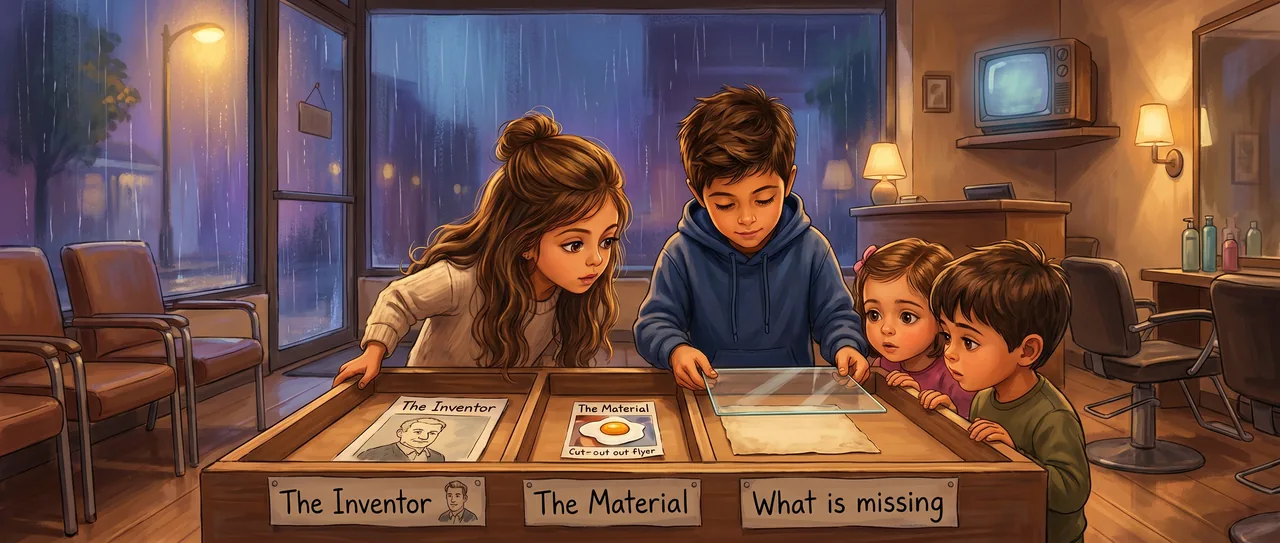
They built the display on the low table by the window. Soren made the three boxes neat. Maya cut a photograph of a white egg from a grocery flyer and taped it under What was shown. They printed a short line about the reported heat tests and put it under What was measured. Under What is missing, they placed the blank recipe card.
Then Soren added a question at the bottom.
What would you need to trust this material on a spacecraft?
Maya read it twice. “Not ‘Is it real?’”
“That question gets stuck,” Soren said. “This one has work inside it.”
Maya grinned. “Your questions have gears.”
“Yours have teeth.”
By the time the display was done, the rain had stopped. The streetlights made long yellow ladders on the wet sidewalk. Maya’s mother locked the cash drawer and came to inspect the table.
She read the cards. Her mouth did the shape it made when she wanted to correct spelling, furniture placement, and possibly history.
At last she said, “A hairdresser made this?”
“An amateur chemist,” Soren said.
“Who was also a hairdresser,” Maya said.
Her mother looked around her salon, at the bottles and bowls and gloves, at the little sink where color rinsed away in bright temporary rivers.
“Huh,” she said.
Saturday came bright and windy. Children crowded the waiting room with damp sneakers and loud whispers. Most stopped at the cards about hair dye. One boy read the Starlite display and said, “So what was in it?”
Nobody answered him right away.
He bent closer to the blank card.
A girl beside him said, “Maybe somebody should try again.”
Soren looked at Maya across the table.
Maya slid the blank card into the center of the display, and Soren lowered the glass over it.
Read the interactive version, listen to the narration, and earn a gold star →
A science-verified short story for curious kids · Curiosity Land