The Door No One Wanted
The video stopped on the exact frame everyone would laugh at.
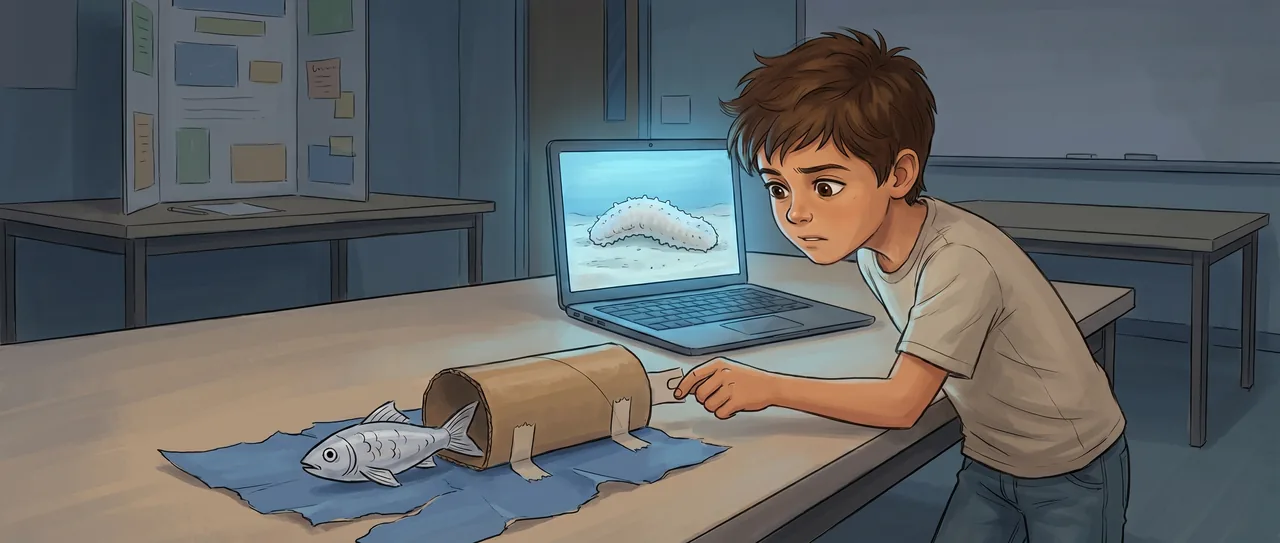
Soren stood in the empty classroom with one finger on the space bar. On the screen, a pale sea cucumber lay on sand like a dropped sock. Beside it hovered a fish no longer than Soren’s pencil, thin and silver, with a face that looked almost surprised to exist.
The fish was pointed the wrong way.
Tail first.
Soren had paused it there because the next part mattered, and because the next part was the part the teacher had warned him about.
The teacher had said, while carrying three stacks of permission slips and a roll of blue tape, “Use the scientific term if you must. Do not make it a joke.”
Then she had added, without looking up, “If you cannot keep the room from turning silly, choose another animal.”
Soren had not chosen another animal.
Now his display board stood on the back table, half finished. Across the top he had printed, in neat block letters, WHERE DOES A FISH LIVE? Under it were three boxes made of cardboard.
A reef.
A burrow.
Another animal.
The pearlfish card would not stay in one box.
Soren had tried reef first. Pearlfish lived on reefs, at least some of them did, in warm shallow seas where sea cucumbers moved slowly over the bottom, swallowing sand and sorting food from it.
Then he moved the card to burrow. The fish used a hiding place. It disappeared into shelter, the way a goby disappeared into a shrimp hole.
Then he moved it to another animal, because the shelter was alive.
The card looked wrong in every place and right in every place. The hallway outside smelled like floor polish. Somewhere, a custodian rolled a trash bin with a soft plastic thunder.
Soren pressed play.
On the screen, the pearlfish backed toward the sea cucumber’s rear opening. The fish’s tail touched the rim. It did not force its way in. It held there, gripping and waiting.
The sea cucumber pulsed.
Soren knew the sentence from three different sources now. Many sea cucumbers pump seawater through the rear opening into branching breathing tubes inside their bodies.
He had written that sentence on a card, then crossed out rear opening and written cloaca above it. Then he had crossed out cloaca and written both.
Cloaca, rear opening.
Anus, if somebody asked.
On the screen, the opening loosened.
The pearlfish vanished tail first.
For a moment there was only the sea cucumber, still and lumpy on the sand.
Soren played it again.
The fish waited. The sea cucumber pulsed. The tail disappeared, then the body, then the small startled face.
It was not funny when no one was laughing.
It was worse than funny. It made the room feel too small.
Soren went back to his table. He took the pearlfish card out of the cardboard box labeled another animal. The card was already soft at the corners from being moved.
He read what he had written on the back.
Some pearlfish use sea cucumbers for shelter and leave to feed, often at night.
He turned the card over.
Some species feed inside the host, including on the sea cucumber’s gonads.
That was the other problem.
The teacher’s categories were friendly enough. Predator. Prey. Partner. Parasite. She had drawn them on the board in green marker during lunch, speaking quickly because the printer had jammed and the sixth grade needed the room.
Soren had copied the words. Then he had stared at them until the letters looked like pieces from different puzzles.
If a pearlfish slipped inside a sea cucumber and only used it as shelter, was it a guest?
If another pearlfish ate the sea cucumber’s reproductive organs from inside, was it a thief?
If both were called pearlfish, did the name tell you enough?
He did not write those questions down. His notebook was in his backpack, but the table was already crowded with scissors, tape, and three failed labels.
He cut a new strip of blue paper.
The scissors made a small chewing sound.
At the top of the strip he wrote, SAME DOOR, DIFFERENT LIVES.
He taped it under the title.
Then he took the three boxes off the board.
The cardboard tore at the corners and left white scars in the blue paper. Soren did not cover them. He turned the boxes sideways and taped them so they overlapped, reef over burrow, burrow over another animal, each one open at both ends.
A tunnel instead of a choice.
He placed the pearlfish card at the entrance.
It still did not work.
The fish in the video had not gone in head first. It had backed in, which meant the first part of the animal to trust the dark was not the eyes.
Soren took the card away and drew a tiny silver fish on a scrap of paper. He drew it facing outward, tail toward the tunnel.
Then he stopped.
The fish was not trusting the dark. It was doing something exact. It gripped. It waited. It used the sea cucumber’s own rhythm.
He cut the fish out carefully, leaving a paper tab under its belly. He slid the tab through a slit at the mouth of the tunnel so the fish could move backward and disappear.
When he pulled the tab from behind the board, the paper fish backed in tail first and was gone.
The classroom door opened.
The teacher came in with a box of extension cords pressed against her hip. Her hair had escaped its clip on one side.
“Soren,” she said. “You are still here.”
“Yes,” Soren said.
She looked at the board. Her eyes paused on the words cloaca and anus. Her mouth made the shape adults made when they were choosing between three different warnings.
Soren pulled the paper tab.
The little fish waited at the edge of the tunnel.
“It doesn’t shove in,” he said. “It waits until the sea cucumber relaxes the opening. Some sea cucumbers pump water there to breathe. The fish uses that.”
The teacher put the extension cords on a desk.
Soren pulled the tab farther. The fish slipped backward out of sight.
“It leaves to feed,” he said. “Some kinds come back to the same cucumber. But some kinds eat parts inside the cucumber. So I can’t put it in one box.”
The teacher walked closer. She did not smile. That helped.
“What will you say if they laugh?” she asked.
Soren pushed the tab until the fish emerged again, face first this time, as if leaving for the night.
“I’ll run the video,” he said.
The teacher looked at the frozen sea cucumber on the laptop screen, at the paper tunnel, at the torn places where the old boxes had been.
Then she picked up one extension cord and said, “The outlet by the windows works.”
She left the room carrying the rest of the cords.
Soren stood still until her footsteps faded.
Then he changed the board again.
He added a fourth space beside the tunnel. Not a box. Just a square of blue paper with no border.
At the science night, the first laugh came from a grown-up.
It was small and surprised, the kind of laugh that tried to hide inside a cough. Three children near the front heard it and began to giggle. One of them said, “Wait, it goes where?”
Soren did not answer right away.
He played the video.
The classroom noise thinned.
On the screen, the pearlfish hovered in the water, tail aimed at the sea cucumber’s rear opening. It touched. It held. The sea cucumber’s body moved with its slow hidden pumping.
The fish waited longer than anyone expected.
No one giggled during the waiting.
When the opening relaxed, the fish slid backward into the living shelter and disappeared completely.
A younger child stepped closer until his forehead nearly touched the table.
“Is the cucumber dead?” he asked.
“No,” Soren said. “It’s alive.”
“Does it know?” the child asked.
Soren looked at the sea cucumber on the screen, unchanged except for the fish inside it.
“I don’t know,” he said.
The child nodded as if that answer had weight.
Soren moved the paper fish out again, face first into the drawn reef. Then he backed it into the tunnel, tail first. Then out. Then in.
A girl pointed at the fourth blue square.
“What goes there?” she asked.
Soren picked up the extra card he had cut but not labeled.
He set the pearlfish card across all three boxes, left the fourth card blank, and pushed a silver pin through its empty center.
Read the interactive version, listen to the narration, and earn a gold star →
A science-verified short story for curious kids · Curiosity Land