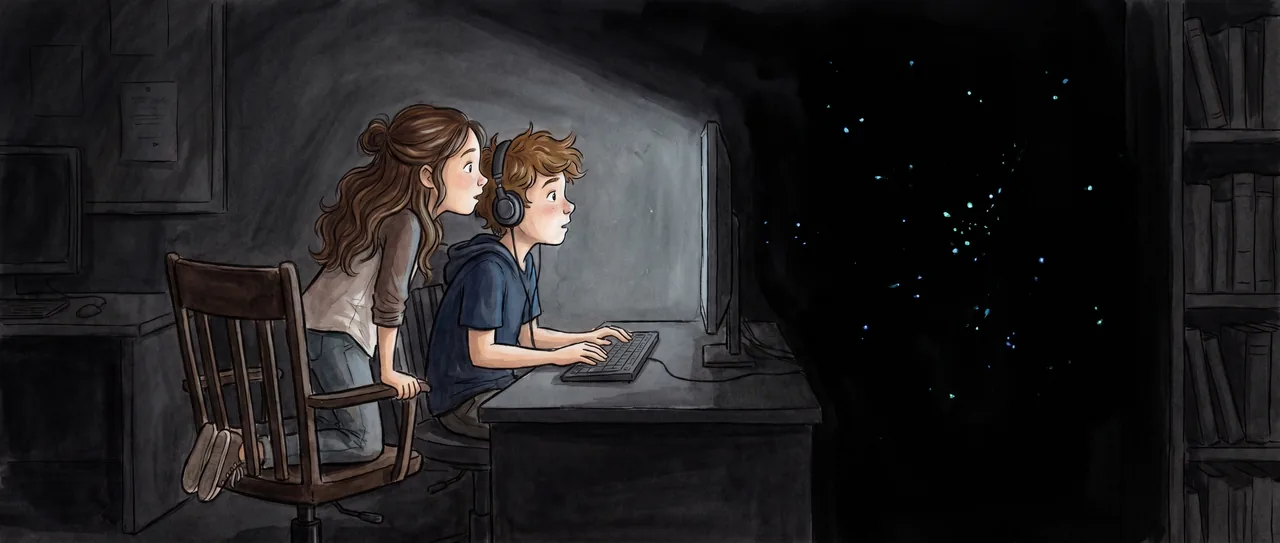
The Dark Was Crowded
The screen was black, except it was arguing.
Maya stood with one knee on the rolling chair and one foot on the floor, squinting at the frozen video. Soren sat beside the keyboard with the headphones crooked over one ear. The media room smelled like warm plastic, dust, and the lemon wipes Mrs. Pell used on everything except the mouse.
On the monitor, a blue dot hung in the dark.
Then it vanished.
Then, lower down, another dot blinked.
Soren dragged the video back three seconds. The first dot blinked. The second answered. Maybe answered. Maybe did not.
Mrs. Pell had said, “Just cut out the empty parts. Five minutes for assembly. Bright bits only.”
She had been holding a stack of permission slips in her teeth at the time, so empty had come out sounding like emty. Then the bell rang, and she left Maya and Soren with the thumb drive from her cousin, who worked on a research ship somewhere above a trench.
The file name was ROV_DIVE_634_NIGHTLIFE.
Maya said, “It is not empty.”
“It is mostly black,” Soren said.
“That is not the same.”
He wrote the time stamp on the corner of a lunch napkin because he had forgotten his notebook in math. Twelve minutes, fourteen seconds. Two flashes. Three seconds apart.
“They wanted bright,” he said.
“They wanted wrong,” Maya said, and reached for the mouse.
The school assembly video was supposed to be simple. Ocean Week had whales, coral reefs, plastic cleanup, and one deep sea clip to make everyone go ooooh before the fifth graders sang about kelp. The other groups had colorful footage. Parrotfish. Sea turtles. A shark turning like a silver knife.
Maya and Soren had black.
They cut the black away.
The video became twelve seconds long.
A pale fish drifted across the screen. A string of blue beads shimmered and disappeared. Something with long legs touched the mud and folded itself into shadow. Then nothing.
Soren played it again.
“It looks like we made a mistake,” he said.
“We did,” Maya said.
She pulled the first cut back out. The timeline filled with long dark blocks. On the audio track there was only the hush of the robot’s motors and tiny clicks from the room where the video had been recorded, far away on a ship.
Soren clicked on the information file. A plain document opened.
Depth: seven hundred eighty meters.
Location: continental slope.
External lights: low.
Notes: high bioluminescent activity.
Below two hundred meters, sunlight drops away quickly. In the deep ocean, living light is the main light. In surveys of deep-sea animals, about seventy-six percent are bioluminescent.
Soren stopped reading aloud.
Maya looked at the black blocks on the timeline. “Seventy-six percent?”
“That does not mean the whole ocean glows,” Soren said.
“I know.”
“If three out of four people in the cafeteria had flashlights, the cafeteria would be bright.”
“No,” Maya said. “Not if they only flashed them when they had something to say.”
Soren stared at the screen, then at the ceiling, then at the screen again.
Maya turned off the media room lights.
The room changed at once. The posters vanished first. Then the cabinets. Then the table edges. The monitor floated by itself, a square of dim gray.
Soren said, “We are not supposed to sit in here with the lights off.”
“We are watching the dark,” Maya said.
She restarted the uncut video.
At first, nothing happened.
Then the first blue dot blinked.
In the dark room it was not a dot. It was a pinprick in a whole country of black. A second blink came from lower left. A third, very faint, pulsed near the bottom of the frame. Then a small animal burst into green sparks and was gone.
Soren leaned forward so slowly the chair did not squeak.
Maya did not move.
The ROV slid over pale mud. The robot’s own lamps made a weak circle, but beyond it, things lit themselves and vanished before the eye could catch their shapes. A comb of tiny points rippled along a body like a secret being zipped shut. A fish hung still with a glowing spot near its mouth, a small lantern waiting in front of teeth. Farther back, a scatter of blue flashes appeared all at once, as if something had shaken stars out of a pocket.
“Lure,” Soren said when the fish moved.
Maya nodded.
“Warning,” he said when the green sparks erupted again, brighter this time, from something small and soft that darted away.
“Maybe,” Maya said.
“Communication,” Soren said, but more quietly.
On the screen, two pale pulses crossed each other and vanished.
The media room door opened.
Light from the hallway spilled over the floor.
Mrs. Pell stuck her head in. “Why is it dark in here?”
Soren slapped the pause button too hard. The blue dots froze.
Maya said, “Because the ocean is.”
Mrs. Pell blinked. She had marker on her wrist and a paperclip in her hair. “How much do you have?”
“Twelve seconds if we cut it the way you said,” Soren said.
Mrs. Pell looked relieved. “Great.”
“No,” Maya said.
Mrs. Pell’s face changed the way adult faces changed when they had already spent all their patience on photocopiers.
Maya pointed at the screen. “If we cut out the dark, we cut out the speaking.”
Soren turned the lights off again before Mrs. Pell could answer.
For one second nobody talked.
The paused screen held its two blue points in the dark.
Mrs. Pell “You have until the custodian locks the hallway. Make it five minutes. I cannot explain to the principal why the assembly is twelve minutes of black water.”
Then she shut the door.
Soren let out a breath. “She is not wrong.”
Maya said, “Neither are we.”
They made rules.
No music. Music would tell people how to feel before the ocean did.
No voice-over during the flashes. Talking would cover them, even though the flashes made no sound.
No brightening the whole screen until the dark turned gray. Soren tried it once. The black filled with digital snow and the flashes became ordinary, like stickers.
Maya dragged the brightness back down. “It hates that.”
“The file does not hate things,” Soren said.
“The file is being misread.”
He accepted that.
They kept the first twenty seconds almost empty. Just the hum of the machine and a small caption at the bottom.
Seven hundred eighty meters down.
Then black.
Then one flash.
They argued about the next caption.
Soren typed: Most deep-sea animals make light.
Maya said, “Too much.”
He typed: Down here, most light is alive.
Maya leaned closer. “That one.”
They added: Some lights lure. Some warn. Some signal.
Then they removed even that until later, after the fish with the glowing spot, after the green sparks, after the crossing pulses. Let people need the words first. Let them be a little lost.
The custodian’s keys jingled once in the hallway, passed the door, and kept going.
By the time they finished, the video was five minutes and eight seconds long. Soren trimmed eight seconds from the opening title, not from the dark.
The next morning, the auditorium was loud until the screen went black.
At first, people laughed.
Someone whispered, “The projector broke.”
Maya stood beside the laptop on the little table near the stage stairs. Soren stood on the other side with one finger ready above the space bar, though there was nothing to fix.
The first blue dot appeared.
The auditorium quieted by one layer.
The second dot blinked lower down.
Another layer.
When the fish drifted in with its small lantern, no one laughed. When the green sparks burst and vanished, someone in the front row breathed in sharply. When the caption finally appeared, Down here, most light is alive, the words sat at the bottom of the screen like they had been waiting for permission.
Maya did not look at the rows of students. She watched the edges of the screen, where the ROV lights failed and the other lights began.
The five minutes ended.
The screen did not switch to the fifth graders yet. Soren had left three seconds of black at the end because the cut had felt too sudden.
In those three seconds, at the far right edge, where neither of them had seen it before, one tiny blue point blinked twice.
Read the interactive version, listen to the narration, and earn a gold star →
A science-verified short story for curious kids · Curiosity Land