Place of Origin
Soren brought the tooth in a little glass bottle that had once held vanilla.
It clicked when he set it on Maya's kitchen table.
Maya stopped cutting the apple slices. She looked at the bottle. She looked at Soren. Then she looked at the paper beside it, the form for the neighborhood time capsule.
The first line said: Object.
The second line said: Place of origin.
Maya said, "Your mouth is not a place of origin."
"It is for the tooth," Soren said.
"Barely."
Maya's father was at the stove making soup and answering work messages on his phone with one thumb. He had a streak of flour on his sleeve and one sock inside out.
"Everything in you came from stars," he said, without looking up. "Write that. Very poetic. Also true. Mostly. Do not put apple seeds in the garbage disposal."
Maya put the knife down.
"Mostly," she said.
Soren heard it too. Mostly was a trapdoor word.
Maya's father stirred the soup too hard and splashed orange dots on the stove. "I am not available for follow-up questions," he said. "The onions are at a delicate stage."
Maya slid the bottle closer. The tooth was small and white and not smooth, with a ragged root end like a torn moon. Soren had lost it in September, eating corn on the cob. His mother had wanted to throw it away. Soren had kept it because throwing away a former part of yourself seemed like something you should do carefully.
"Calcium," Maya said.
"Mostly calcium phosphate," Soren said. "And other things."
"Bones too."
"Teeth are not bones."
"I know teeth are not bones. I was taking a shortcut."
"Your shortcuts have cliffs."
Maya grinned. Then she opened the junk drawer and pulled out the laminated periodic table placemat Soren had given her for her birthday, because she had asked why gold was gold and he had taken the question seriously.
The placemat had jam on actinium.
Maya wiped it with her sleeve and put the tooth bottle in the middle.
"If we write stars, future people will think we mean all of it," she said.
Soren uncapped the bottle and tipped the tooth into his palm. It was heavier than it looked, which was not saying much. It sat in the crease of his skin, pale against the lines.
"Calcium is heavier than carbon," he said. "Stars can make carbon. Oxygen too. Big stars make heavier stuff. Up to iron in their cores. Then exploding stars scatter it. Calcium can be made in those explosions."
Maya took one apple slice and held it near the tooth. "Carbon in this. Oxygen in this. Calcium in that. Iron in blood."
"Iron is the weird one," Soren said. "Making iron does not give a star extra energy the same way. It is like the star reaches a wall."
Maya's father lifted the spoon and pointed it at them. "That is an alarming sentence to hear near soup."
"Not your soup," Maya said.
"Good. My soup has no walls."
He turned back to the stove.
Maya put the apple slice down without eating it. She was staring at the glass of water beside the placemat.
Soren waited. Maya often went quiet right before she ran ahead of everyone.
"Water," she said.
"Yes."
"Oxygen is from stars."
"Yes."
"Hydrogen?"
Soren put the tooth back in the bottle but did not close it.
Hydrogen was the first square on the placemat. One proton. The lightest atom. The tiny beginning of almost everything, sitting in the corner like it had arrived early and saved a seat.
"Most hydrogen was made before stars," Soren said. "In the early universe. The first few minutes."
Maya leaned over the glass as if the water might say something back.
The kitchen got very loud in small ways. The simmer of soup. The refrigerator hum. A car dragging water through the street outside. Maya's father tapping his phone and missing the letters.
Maya lifted the glass. Tiny bubbles clung to the inside.
"So when I drink this," she said, "part of it is star-made and part of it is older than stars."
Soren looked at the glass. One oxygen with two hydrogens. One atom with a furnace history, two atoms with a before-there-were-furnaces history, all of them clear enough to see through.
The kitchen did not change. The chairs were still mismatched. The soup still smelled like carrots and cumin. The tooth was still a tooth.
But the glass in Maya's hand had become crowded.
Soren felt the inside of his head press outward. He wanted his notebook, badly. Not to finish the feeling, just to keep it from spilling.
Maya set the water down carefully.
"The form is too small," she said.
The line for Place of origin was only as long as Soren's thumb.
He picked up the pen. "We could write, A star."
"Wrong."
"Many stars."
"Incomplete."
"Many stars and before stars."
Maya nodded once. Then she shook her head. "Still sounds like a place. It is not a place. It is more like a route."
Soren liked that. A tooth was not from one place. It had passed through other things. Dust into rock. Rock into soil. Soil into grass. Grass into a cow, maybe. Milk into Soren. Or leafy greens into dinner. Or something else. The atoms did not keep little tags. They only kept being atoms.
Maya's father came over with two bowls of soup and read the form upside down.
"Place of origin," he said. "House on Juniper Street. Done. Eat before it gets cold."
"That is where Soren is from," Maya said.
"Debatable," Soren said. "I was born in the hospital."
"That is where your parents took delivery," Maya said.
Her father blinked. "I am going back to the soup."
They ate standing up because the table was covered in placemat, tooth bottle, time capsule form, apple slices, and one damp mitten that no one admitted was theirs.
Soren chewed on the left side. The gap where the tooth had been was long closed, but he could still feel it if he thought about it. A place in his mouth where something had left, and another thing had grown in after it.
Maya took the form and crossed out nothing. She hated crossing out unless the wrong thing deserved to remain visible. Instead, she turned the paper over.
"We make our own label," she said.
"They asked for the form."
"They asked the wrong size question."
Soren smiled.
On the back, in small clear letters, he wrote: Object, one baby tooth from Soren, age eleven.
Maya said, "Not baby. Makes it sound cute."
"Deciduous tooth."
"Tree word. Better."
He wrote: Object, one deciduous tooth from Soren, age eleven.
Under it, Maya wrote: Contains calcium, phosphorus, oxygen, carbon, hydrogen, and more.
Soren added: Some of these atoms were made inside stars. Some were made when massive stars died and threw their contents into space.
Maya tapped the placemat. "Hydrogen."
Soren wrote: The hydrogen is mostly older than the stars.
They both looked at that sentence for a while.
Maya said, "Mostly again."
"Mostly is honest here."
"Fine. Mostly can stay when it earns it."
At the bottom, where the form wanted Place of origin, Maya wrote: Still traveling.
Soren did not say anything. He folded the label around the bottle and tied it with blue thread from the sewing basket.
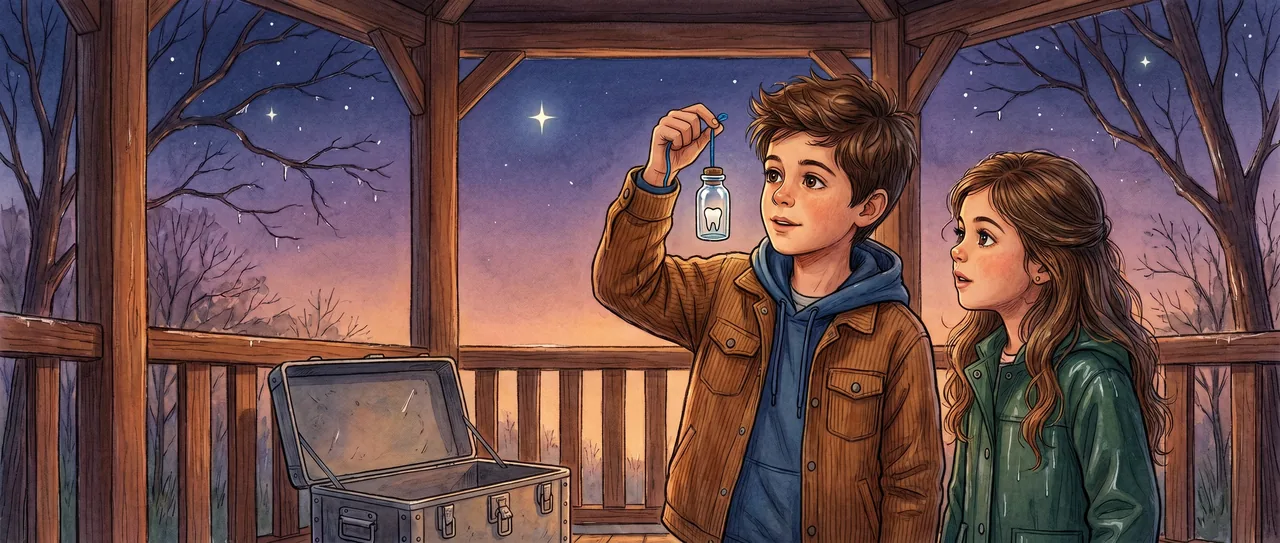
The time capsule box waited at the park under the pavilion. It was not fancy, just a metal trunk with a padlock, already half full of photographs, menus, a cracked skateboard wheel, a library card, a packet of wildflower seeds, and a plastic dinosaur with one foot missing.
Mrs. Alvarez from number twelve stood beside it with a clipboard and a purple raincoat. She took her job very seriously and had already rejected three candy wrappers and one dead beetle.
When she saw the tooth bottle, her eyebrows rose.
"Is that sanitary?" she asked.
"It is dry," Soren said.
"And sealed," Maya said.
Mrs. Alvarez read the label. Her eyebrows went down. Then up again. She read it a second time.
"Still traveling," she said.
"That is the place of origin," Maya said.
"That is not a place."
"Exactly," Soren said.
Behind the pavilion, the evening had cleared. The first stars showed through the wet branches. Mrs. Alvarez held the little bottle by its blue thread. She looked at Soren. She looked at Maya. Then she placed the bottle on top of the wildflower seeds.
"I suppose the future can decide what kind of answer it is," she said.
Maya set the capsule in the metal box. Soren held the tooth bottle up beside his face, and for a second the tiny white tooth covered one bright star.
Read the interactive version, listen to the narration, and earn a gold star →
A science-verified short story for curious kids · Curiosity Land