Lightning in the Ash
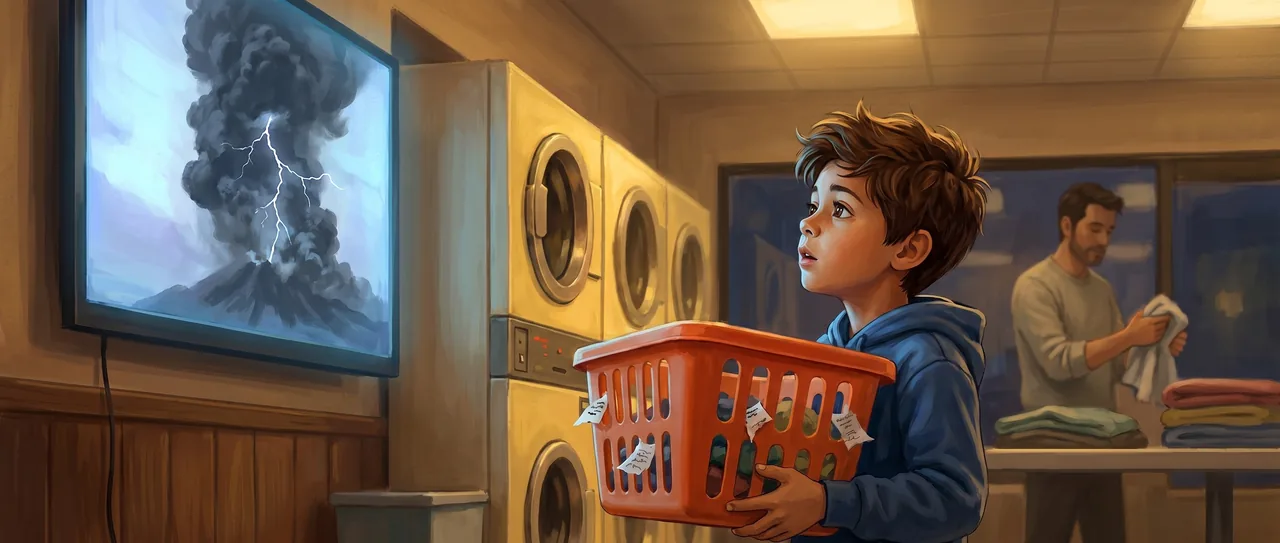
The volcano was on the laundromat television because nobody had changed the channel since dinner.
Soren’s father had meant to. He had said, three times, that customers did not come to spin-dry their socks so they could stare at a mountain exploding on the other side of the ocean. Then washer number six swallowed four quarters and refused to start, and the television kept showing a black tower climbing into the evening sky.
The sound was off. Words crawled along the bottom of the screen.
Volcano eruption sends ash cloud over flight paths.
Soren stood with a broom in one hand and his notebook tucked under his arm. He had written down the flight paths part because it seemed strange that rock from a mountain could reach airplanes. Not lava. Not boulders. Dust. Dust could stop jets.
On the screen, the ash cloud rose higher than the mountain. It boiled upward in slow motion, dark gray at the bottom and white at the edges where the sun caught it. Then the cloud flashed from inside.
Soren stopped sweeping.
The flash happened again. A thin, crooked vein of light appeared in the ash, vanished, then appeared somewhere else, higher up.
His father backed out from under washer number six with a screwdriver between his teeth. He looked at the screen for half a second.
“Storm too,” he said around the screwdriver.
“There aren’t rain clouds,” Soren said.
His father took the screwdriver out of his mouth. “There are always clouds somewhere.”
“Not like that.”
“Soren, if you find weather hiding inside my dryers, tell it to fold the towels.”
He slid back under the washer. The machine gave a metal clunk.
Soren kept looking.
The flashes did not come down from the sky into the plume. They happened inside it. They branched sideways. Some were buried so deeply that the ash glowed purple for less than a blink.
A new caption appeared.
Lightning strikes during volcanic eruption.
Soren frowned at the word strikes. It made the lightning sound like an outside thing. A visitor. A spear from somewhere else.
The dryers along the wall turned and thumped. Inside dryer three, a blue blanket climbed the glass, stuck there, peeled away, and slapped back down. Socks chased each other through the yellow light.
Soren set the broom against the folding table.
He opened his notebook, tore a strip from the ragged edge of a page, and ripped it into tiny pieces. He did not write anything. He placed the pieces on the orange plastic laundry basket.
His father’s voice came from under the washer. “If those are for a nest, use the lint bin. We have plenty.”
Soren rubbed the basket hard with his sleeve.
Nothing happened.
He rubbed faster. The plastic squeaked.
One paper piece shivered. Another stood up on one corner. Then six of them leaped to the side of the basket and clung there as if the orange plastic had become a wall with gravity in it.
Soren breathed once through his nose.
He pulled the warm blanket from dryer three and pressed it against the basket. The paper bits trembled and skittered. One jumped from the basket to the blanket.
Static. Everyone knew static. It snapped from sweaters in winter. It lifted hair under hats. It made socks behave as if they had private plans.
But the ash cloud on the television was not a sweater.
Soren went to the lint bin. The lint there was gray, soft, and mixed with threads. Not ash. Ash was rock and glass, tiny broken pieces blasted apart by gas and heat. He knew that from a book with a photograph of Mount St. Helens, a page where the day had turned darker than night.
He did not need the lint to be ash. He needed it to be small.
He pinched a little lint onto the basket. It clung in patches. He tapped the basket. Some pieces let go. Some sprang back.
Washer number six clunked again, louder.
“Success,” his father said, still invisible. “Probably.”
On the television, the camera zoomed closer to the plume. The mountain itself was dark against a pale strip of sunset. Above it, the eruption cloud kept climbing. It was not smooth like smoke from a candle. It churned, folded into itself, rose and collapsed and rose again.
Inside that churning, bits of ash were hitting other bits of ash. Millions of them. Billions. Tiny broken edges bumping, scraping, separating. Some parts of the cloud would end up with more of one kind of charge. Other parts would end up with the other.
Soren put the basket on the floor and turned it upside down. The paper pieces fell off.
He rubbed the basket again, harder this time, then held his knuckle near the plastic.
A spark cracked.
His father’s head banged the underside of the washer.
“Ow. What was that?”
“Lightning,” Soren said.
His father rolled out, hair flattened on one side. “That was not lightning. That was you trying to electrocute a laundry basket.”
“Small lightning.”
His father opened his mouth, then looked at the paper bits, the lint, the blanket, and the television. His face changed into the expression he made when a receipt did not add up but might, if he turned it sideways.
“Inside the ash?” he asked.
Soren nodded.
The television flashed again. This time his father watched the whole flicker.
“Huh,” he said. “I thought it was a storm behind it.”
“Maybe there can be storm lightning too,” Soren said. “But this one is in the plume.”
He said the last word carefully. Plume was better than cloud. Cloud made it sound gentle. Plume had a stem and a reach.
His father wiped his hands on a towel. “The captions are wrong, then.”
“Not wrong exactly.”
Soren looked at the torn paper pieces scattered on the floor. The smallest ones had moved first. The ones nobody would have noticed. The ragged pieces that came from the edge of a page because he carried a notebook when everyone else used school tablets and laughed at the way paper softened in his pocket.
He picked up one scrap. It was no bigger than a fish scale.
The television showed airplanes parked in rows at an airport, safe on the ground. Then a map with red lines bending around the ash. People had learned to see danger in dust that was too high and too fine to notice from below. Satellites watched it. Sensors measured it. Pilots waited because invisible rock in the sky could hurt engines.
Soren pressed the paper scrap against the basket. It stuck. His father stood beside him now, holding the screwdriver loosely.
“So,” his father said, “the mountain makes a cloud, and the cloud makes its own lightning.”
“The ash does,” Soren said. “By crashing around.”
“That is rude of it.”
“It’s amazing of it.”
His father smiled. “Both can be true.”
The laundromat lights hummed. Outside the front windows, the street was ordinary. A bus sighed at the curb. Someone’s bicycle reflector blinked red and red and red. Inside, the dryers turned their warm circles as if they had been practicing volcanoes all evening.
The television replayed the eruption, slower than before. Ash rose from the crater in a dark fountain. It widened into a tower. Deep inside the tower, light began to pulse.
Soren lifted the orange basket and held it near the screen, where the paper scraps still clung to its side.
On the screen, a white fork of light opened inside the black cloud and disappeared.
Read the interactive version, listen to the narration, and earn a gold star →
A science-verified short story for curious kids · Curiosity Land