Almost All Water
The first wall collapsed before breakfast.
It was made of paper towels, folded into squares and stacked in a plastic picture frame. Soren had tucked radish seeds into the layers the night before. By morning, the bottom was swollen and gray. The top was dry enough to curl.
Maya held the frame over the sink. A single seed slid out and plinked into the drain.
"Dead city," she said.
"Not dead yet," Soren said. He rescued the seed with the tip of a spoon. "Just badly housed."
On the kitchen table, the second wall sagged inside a sandwich bag. That one was sponge. It had looked promising for almost eight minutes. Then all the water had run to the lowest corner, and the seeds there were floating like passengers from a shipwreck.
The third wall was potting soil pressed between two sheets of clear plastic.
Maya did not even pick it up.
"Mud sandwich," she said.
"Invisible roots," Soren said.
"That is the opposite of the assignment."
The assignment was to build a traveling root window for the third-grade classroom downstairs, because their teacher had asked older students to help the little kids see what plants were doing under the dirt. Soren had taken the word see very seriously. Maya had taken the word traveling seriously. Between them, they had produced damp paper, a leaking sponge, and mud.
Soren's mother swept past carrying a tray of tiny fruit jellies. She had flour on one wrist and a pencil behind one ear. Her bakery apron said SWEET ORBIT in purple thread.
"Nothing experimental on the left counter," she said. "That is for orders. Nothing wet near the boxes. Nothing green near the mango."
"Roots are not green," Maya said.
"Then nothing root near the mango."
She set the tray down and hurried to the stove, where a pot trembled gently, full of clear liquid. Beside it lay a packet labeled agar powder.
Maya looked at the pot.
Soren looked at Maya looking at the pot.
"No," he said.
"I didn't say anything."
"You got the face."
"It has a face?"
"The face that means my mother is about to lose a baking ingredient."
His mother pointed a rubber spatula at them without turning around. "I can hear faces."
Maya leaned closer to the tray of finished jellies. Each one held a piece of strawberry in the middle, not sunk, not floating, just suspended. The cubes wobbled when the refrigerator motor clicked on, but they kept their edges.
"That is a wall," Maya said.
"That is dessert," Soren said.
"It is a transparent wet wall."
"It is a transparent wet wall my mother sells for money."
Maya tapped one cube lightly. The whole tray shivered. The strawberry stayed in place.
Soren's mother turned from the stove. "If either of you pokes my jellies again, I will make you wash every piping tip in the drawer."
"Can we have the broken one?" Soren asked.
"There are no broken ones."
Maya pointed to the corner of the tray, where one jelly had torn when it came out of the mold. It had a crescent missing from its side. Juice glistened in the cut.
His mother closed her eyes for one second. "One. You get one. You do not get agar powder. You do not get the stove. You do not get my last clean saucepan."
She slid the torn jelly onto a saucer and went back to stirring.
Maya carried the saucer to the table like it was a captured planet.
Soren fetched a toothpick, a spoon, and his notebook. He did not open the notebook yet. He put one fingertip on the jelly and pressed.
It dented.
He lifted his finger.
The dent slowly rose back.
"Soft," he said.
"Not liquid," Maya said.
He cut a thin slice from the torn side. It held together on the spoon, clear and quivering. Maya dripped water onto it. The water beaded, then slid away.
"It already has water," Soren said.
"Everything in this kitchen has water."
"Not like that." He finally opened the notebook, not to write, but to flip back three pages. "Soft contact lenses are hydrogels. My mom said hers dry out if she forgets the case. They feel like nothing, but they have a shape."
Maya stared at the jelly slice.
Soren turned another page. "Hydro means water. Gel means... gel."
"Excellent Latin."
"Probably Greek. Also not the point. Some are almost all water. Over ninety-nine percent. But the tiny long molecules make a net, so the water can't just pour away."
Maya held the slice up to the window. The morning light passed through it and bent the white cabinets behind it. The jelly was almost entirely what would spill from a cup, yet it could be carried on a spoon.
She stopped moving.
Soren stopped too.
The dishwasher hummed. The torn jelly trembled in Maya's hand, holding its clear square against gravity.
"Water can wear structure," Maya said.
"Or structure can hold water," Soren said.
Maya put the slice down. "We need a seed wall made of almost nothing."
Soren's mother was boxing the good jellies with quick, annoyed movements. "You cannot plant radishes in dessert."
"We won't," Soren said.
Maya said, "We need agar."
"You heard my list."
"Not yours," Maya said. "Ours. We can buy some. The grocery store has it near pudding mix."
Soren's mother glanced at the clock. "I have a delivery in twenty minutes."
"We have bikes," Soren said.
"And helmets," Maya said.
His mother looked from the stove to the boxes to the two of them. She had the expression of a person deciding which disaster would be shortest.
"One packet," she said. "No stove without me in the room. No eating experiments. And if you make the kitchen smell like pond, I am changing the locks."
By lunch, they had a shallow baking pan lined with plastic wrap, a grocery packet of agar, and permission to use the small saucepan under supervision that was mostly his mother saying, "Lower," "Stir," and "Not that spoon."
The liquid looked like water with a secret. Then it cooled.
At first nothing happened.
Maya poked it too early, and her finger came away wet.
"Soup," she said.
"Waiting," Soren said.
They waited badly. Maya circled the table. Soren checked the clock every minute and then tried not to check the clock every minute. His mother left for her delivery with a warning about knives, flames, and whatever Maya was holding at the time, which was only a measuring cup.
Then the surface changed. It stopped shining like water and began shining like glass.
Soren tilted the pan.
The whole sheet slid a little, but it did not pour.
Maya made a sound that was too small to be a laugh and too sharp to be a gasp.
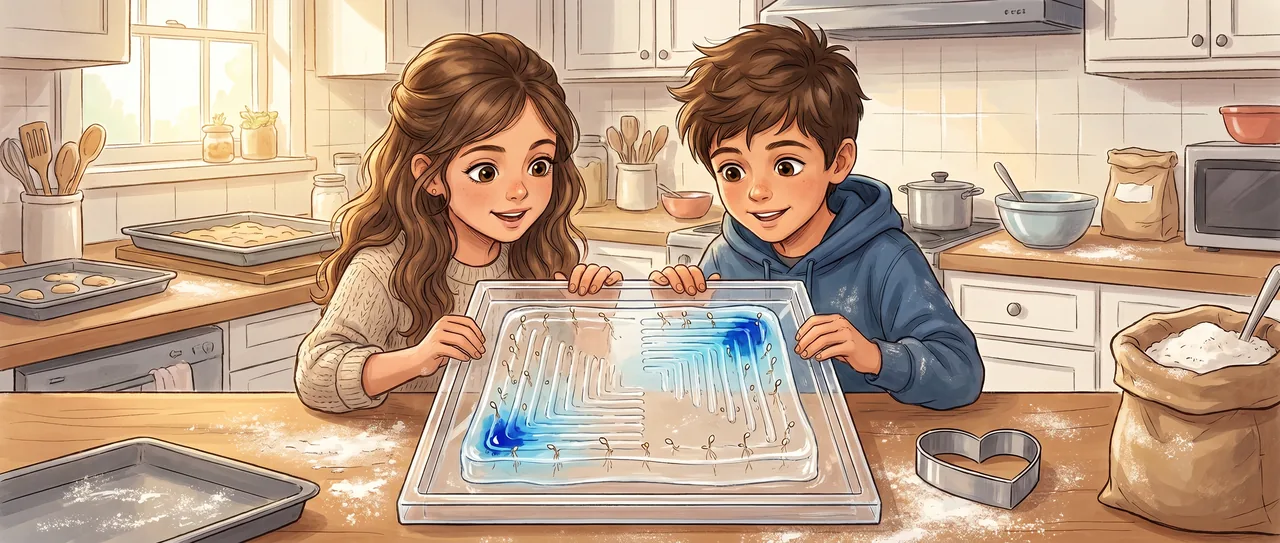
They cut the gel into a rectangle and lifted it into the plastic picture frame. It slumped, but it stayed. Soren pressed a row of tiny channels into it with a clean comb. Maya placed sprouted radish seeds along the top, each with a white root just beginning to show. The roots touched the gel and clung, not stuck like glue, not buried like soil, but held against a wet surface that did not drown them.
"It shakes," Soren said.
Maya bumped the frame with one knuckle. The clear wall quivered from edge to edge. Every seed remained in its groove.
Soren touched the surface. It shook under his finger and did not fall apart. It was not hard. It was not empty. It was the kind of thing people misnamed because they had only checked from far away.
Maya fetched blue food coloring. "Tiny medicine," she said.
"Food coloring is not medicine."
"Tiny traveler, then."
She put one drop at the corner of the gel. Blue spread slowly, feathering into the clear sheet instead of rushing through it. The color found the comb channels first, then softened outward.
Soren bent until his nose nearly touched the frame. "A scaffold that also lets things move through."
"Roots get water."
"Cells could get water."
Maya looked at him.
He tapped the notebook page with one blue-stained finger. "Not in this. Not kitchen agar. But I read about hydrogels for growing tissues. The cells need a wet place with a shape. A scaffold. Some labs are trying them for replacement parts of bodies."
Maya did not answer right away. "A body is not a machine," she said.
"No."
"But it still needs places."
"Yes."
Maya went to the baking drawer and came back with a metal cookie cutter shaped like a heart.
Soren stared at it. "That is for cookies."
"Today it is not."
They did not have enough gel left for anything useful. They both knew that. The root window still needed sealing, and the third-grade classroom still needed a thing that would survive being passed from hand to hand. Soren fitted the clear wall into the frame while Maya taped the edges tight.
When they lifted it upright, the seeds held. The blue corner glowed. One white root had already curved along a comb mark, following the wet path because the wet path was there.
Soren's mother came home with an empty delivery crate and stopped in the doorway.
"Is that my picture frame?" she asked.
"Formerly," Maya said.
His mother stepped closer. Her floury hand hovered near the gel but did not touch it.
"It looks too soft to work," she said.
"It is soft enough to work," Soren said.
The heart-shaped cutter lay on the table beside the saucepan. Maya picked it up. Soren poured the last warm spoonful from the pan.
On the counter, the heart-shaped cutter filled slowly, clear gel rising around the smallest white root.
Read the interactive version, listen to the narration, and earn a gold star →
A science-verified short story for curious kids · Curiosity Land