The Shape of Not Yet
The headline on the old article was too proud.
Maya could tell before she read it. The words stood in a black rectangle at the top of the library printout, large enough to win an argument without trying.
Artificial Intelligence Solves Protein Folding.
Under it was a picture of a ribbon curled like party streamer, except the streamer looked as if it had secret muscles.
Soren read the headline twice. Then he turned the paper sideways, as if the words might behave better from another direction.
Mrs. Pell, the librarian, came past carrying a leaning tower of returned books against her chest. Her glasses had slid to the end of her nose.
"Perfect for the Future Shelf," she said. "Nice and dramatic. Put that in the middle. Children like solved things. Makes a clean display."
She vanished behind Biography before either of them could answer.
Maya looked at the article again. "I don't like solved."
"It says solved," Soren said.
"It says it loudly. That's different."
Their assignment was to make one shelf about a discovery from the past that had changed the future. Mrs. Pell had given them a box of pipe cleaners, colored beads, clothespins, index cards, and one command: no glitter, because glitter had once defeated the vacuum cleaner for three months.
Soren picked up a long green pipe cleaner and threaded beads onto it. Blue, yellow, red, blue, white, red. "Protein is a chain of amino acids. Sequence first. Shape after. If the sequence tells it what to do, then maybe solved is fair."
"Fold it," Maya said.
Soren did. The chain bent into a hook.
Maya shook her head. "Too hooky."
He bent it into a knot.
"Too knotty."
He made a little basket.
"That looks like it holds one raisin."
"You are not helping," Soren said, but he was smiling.
Maya took the chain and held it above the table. The beads clicked faintly against one another. "Rules. Blue ones hate water, so hide them inside. Red and yellow like each other. White ones don't care."
"Real proteins have more kinds than that."
"Library beads have limits."
Soren accepted this and began again. He tucked the blue beads inward. The red and yellow beads were too far apart, so he twisted the chain. Now one blue bead stuck outside.
Maya tapped it.
Soren tucked it in.
The red bead moved away.
Maya tapped that.
Soren stared at the soft, bendy mess in his hands. "This is awful."
"Good awful or bad awful?"
"Interesting awful. Every fix breaks something else."
He pulled his notebook from his backpack, the small paper one with the bent corner and the elastic band. Two girls at the next table looked over, saw the notebook, and looked away again. Soren did not look up. He wrote one line, crossed out half of it, then counted beads.
"If each bend had even three choices," he said, "and there were a hundred bends, that's..."
He stopped writing.
Maya leaned closer. "That's what?"
"Too many. Not just too many for me. Too many for the library. Too many for all the libraries."
The pipe-cleaner protein lay between them, pretending to be harmless.
Maya picked up the article. It said that for about fifty years, scientists had been trying to predict how a protein would fold from its amino acid sequence. Experiments could find structures, using things like X-rays or frozen samples and powerful microscopes, but each structure could take a long time. Then, in two thousand twenty, a system called AlphaFold had predicted many protein shapes with accuracy close to experiments. Later, a database filled with predicted structures for nearly all proteins scientists had catalogued.
Nearly all.
Maya read that part under her breath.
Soren did not ask what she had found. He waited, because when Maya got quiet like that, the next thing was usually either very right or needed more steps.
"The headline is wrong," she said.
"Because not everything is solved?"
"Because it makes the room smaller."
Soren considered this. "That is not a sentence Mrs. Pell will accept on an index card."
Maya pushed the library tablet toward him. "Find the database."
"We are allowed?"
"It's public. That's what public means."
Soren typed AlphaFold Protein Structure Database. A page opened, clean and bright, with a search bar waiting as if it had been waiting for them specifically.
"Search something," Maya said.
"Like what?"
"Something nobody would put on a poster."
Soren typed tardigrade, then stopped. "Too famous."
He erased it and typed soil bacterium. Too many results bloomed down the screen.
Maya grinned. "Dirt has a crowd."
They clicked one result almost at random, then chose a protein with a name that was mostly letters and a label that said uncharacterized.
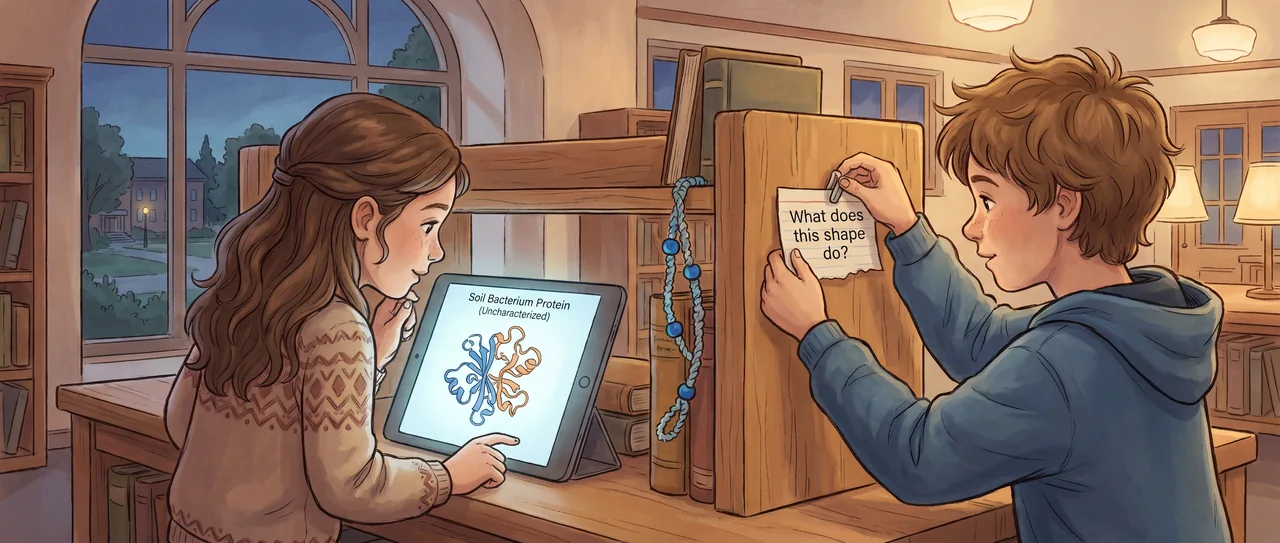
The screen filled with a folded shape.
Not a neat spiral. Not a basket. A strange small construction turned in space, green and blue and yellow, with flat arrows and curling coils packed together like an animal sleeping in a language no one spoke.
Soren touched the edge of the tablet and rotated it. The shape spun. The unknown protein obeyed his finger, not because it was simple, but because someone had made the hidden thing movable.
"Uncharacterized," Maya said.
"That means they don't know what it does," Soren said.
"It doesn't say useless."
"No."
"It doesn't say mistake."
"No."
The girls at the next table had gone quiet. One of them stood and drifted closer, pretending to look for colored pencils.
Soren clicked another result. Another folded ribbon appeared. Then another. Some had high confidence for most of the shape, colored in stronger blues. Some had wobbly orange stretches where the prediction was less certain. Soren liked those parts immediately.
"It admits where it's not sure," he said.
Maya took a blue index card and wrote, Some parts are known better than other parts.
Soren looked at it. "That is better than solved."
Mrs. Pell returned with tape around her wrist like a bracelet. "How are my future scientists? Do we have a big centerpiece?"
Maya handed her the headline.
Mrs. Pell read the black rectangle again. "Very exciting."
"Too exciting in the wrong direction," Maya said.
Mrs. Pell blinked.
Soren turned the tablet so she could see the spinning protein. "If we say the machine solved biology, people will think there are no questions left. But this one has a predicted shape and no known job. There are millions of things like that. The shape is more like a new handle."
Mrs. Pell looked from the tablet to the pipe cleaners to the half-filled index cards. She opened her mouth, closed it, then said, "I have to unjam the copier. The copier has opinions. You have ten minutes before closing. Make it readable."
She left the tape.
Maya said, "That's permission."
"That was not exactly permission."
"Close enough to permission."
They rebuilt the shelf fast.
On the left, Soren put the tangled pipe-cleaner chain under a card: A protein is a chain that must become a shape.
Beside it, Maya placed three failed folds, hook, knot, raisin basket.
Under them, Soren wrote: The wrong shape is not almost right if the molecule cannot do its job.
In the middle, they taped the old article, but Maya covered the loud headline with a new card.
Fifty Years of Trying to See the Fold.
On the right, they propped up the tablet, still plugged into the library charger, with the uncharacterized soil-bacterium protein slowly turning. Its colored ribbons moved without sound.
Soren made one more card and hesitated before clipping it on.
Maya read it over his shoulder.
Predicted structures do not end the work. They show where hands can begin.
"Too poetic?" Soren asked.
"No," Maya said. "But we need a question."
"We have lots."
"One that fits under the unknown one."
Soren tore an index card in half. The ripped edge feathered white. He wrote carefully, because the card was small.
What does this shape do?
The girl who had been pretending to need colored pencils said, "Can you search ocean ones?"
Maya and Soren both looked at her.
She pointed at the tablet. "Like proteins from things that live where it's dark."
Soren moved aside so she could reach the search bar.
Mrs. Pell called from the copier room, "Five minutes. Also, the copier lost."
The girl typed deep sea microbe with one finger. The database answered with a list longer than the screen.
Maya picked up an empty clothespin. Then another. She clipped them along the shelf, under nothing yet.
Soren clipped the card beneath the ribbon on the screen. Maya reached past him and set the dangling pipe-cleaner chain beside it, still twisted, still unfinished, its blue beads tucked into the middle.
Read the interactive version, listen to the narration, and earn a gold star →
A science-verified short story for curious kids · Curiosity Land