The Seventy That Weren't There
The seventieth bead would not stay glued.
Soren pressed it down with the flat of his fingernail. It slid sideways, left a shine of glue on the cardboard, and stuck to his sleeve instead.
Maya watched from the other side of the kitchen table with her chin on her fists.
"It's trying to escape," she said.
"It's trying to make my model look wrong," Soren said.
The model was supposed to be simple. Two tall cardboard strips for parents. One shorter strip for a child. Blue beads for DNA from one parent. Green beads for DNA from the other. The assignment sheet said, in cheerful letters, Show how families pass traits from one generation to the next.
Soren's child strip had blue and green beads, but it also had tiny silver ones. They were not in lines. They were not symmetrical. They looked like someone had sneezed stars onto the glue.
Maya picked one silver bead from his sleeve.
"Why seventy?" she asked.
"Because that's the number," Soren said. "About. Sometimes more. Sometimes less. When scientists sequence a child and both parents, they usually find around seventy places in the child's DNA that are new. Not in either parent. De novo mutations. New, from the beginning."
Maya rolled the bead between her fingers.
"So your model is telling the truth," she said.
"Everyone thinks it's glitter."
His father came through carrying a cracked drawer under one arm and a tape measure between his teeth. He looked at the table, then at the glue on Soren's sleeve.
"Inheritance project?" he asked.
"Yes," said Soren.
His father took the tape measure from his mouth. "Make it clean. Teachers like clean. Parents here, kid there, arrows in between. Done."
"That leaves out the seventy," Soren said.
"Seventy what?"
Soren opened his mouth.
The drawer handle clattered loose onto the floor.
His father sighed. "Tell me after I stop the kitchen from eating socks."
He went out again with the broken drawer bumping his hip.
Maya set the silver bead down in the glue dot where it belonged.
"Clean is the problem," she said.
Soren looked at the cardboard family. The parent strips stood neat and tall. The child strip looked as if it had made seventy tiny mistakes.
"They're not mistakes exactly," he said. "They're copying changes. In an egg or a sperm, or right after the first cell starts dividing. Most don't do anything anyone can see. Some matter a lot. But they weren't inherited from the parents."
"Then don't make them beads," Maya said. "Beads look added on. Like decoration."
"They are added on."
"No," Maya said. She leaned closer. "They're not on the child. They're in the child."
Soren stopped pressing the bead.
Maya was already up, opening drawers she was not supposed to open, but always opened carefully. She found wax paper, three clear report covers, a hole punch, black construction paper, and the tiny flashlight her mother kept for blackouts.
"We need layers," she said.
"For chromosomes?"
"For not seeing something until it doesn't line up."
That was how they ended up under the kitchen table with the chairs pushed back and the tablecloth hanging around them like a tent.
Soren cut three long strips of clear plastic. On the first, he marked blue dots for one parent. On the second, green dots for the other. On the third, he copied many of those dots in both colors, because a child gets DNA from both parents.
"This is nowhere near three billion letters," he said.
"Good," Maya said. "We don't have three billion holes' worth of afternoon."
"Then it's a map, not a genome."
"Fine. Map."
Soren wrote Map on a scrap of tape and stuck it to the flashlight.
Maya took the black construction paper and punched seventy holes in it with a sewing pin, not the hole punch. The hole punch made moons. The pin made points. She counted under her breath, stopping twice because Soren made her start over when she whispered twenty nine twice.
When she finished, her hand had a crescent mark from the pin head.
"Now," she said.
They stacked the two parent sheets over the child sheet and held them against the tablecloth. The blue and green dots matched through the plastic. Then Maya slid the black paper on top.
Nothing showed.
"That's worse," Soren said.
Maya switched on the flashlight.
Seventy sharp points appeared on the underside of the table.
They were small. Smaller than the beads. Smaller than crumbs. But in the dim tent under the table, each one held its place. None belonged to the parent dots. None lined up with blue or green. They did not look added. They looked revealed.
Soren moved the parent sheets away.
The seventy points stayed.
Maya moved the child sheet away.
The points vanished into black paper.
Soren put the child sheet back.
The points returned.
For a while neither of them said anything. The kitchen sounds went on outside the hanging tablecloth. Water in the sink. A drawer sliding badly. A cabinet hinge complaining. Inside the tent, seventy pinholes held light where the parent maps had none.
Soren reached out and blocked one with his fingertip.
"If you only compare the parents," he said, "you can't find them."
Maya nodded.
"If you only look at the child," she said, "you don't know which ones are new."
Soren lowered his finger. The missing point came back.
The next morning, Soren's cardboard model stayed home with one silver bead still glued to his sleeve.
The new model fit in a folder.
Their teacher was trying to make the classroom screen connect to the ceiling projector. The screen displayed a blue square, then a frozen picture of last week's spelling list, then nothing at all.
"Can it wait?" she asked, pressing three buttons at once.
"It needs the lights off," Maya said.
"Everything needs something," the teacher said. "You have two minutes before I start drawing on the board."
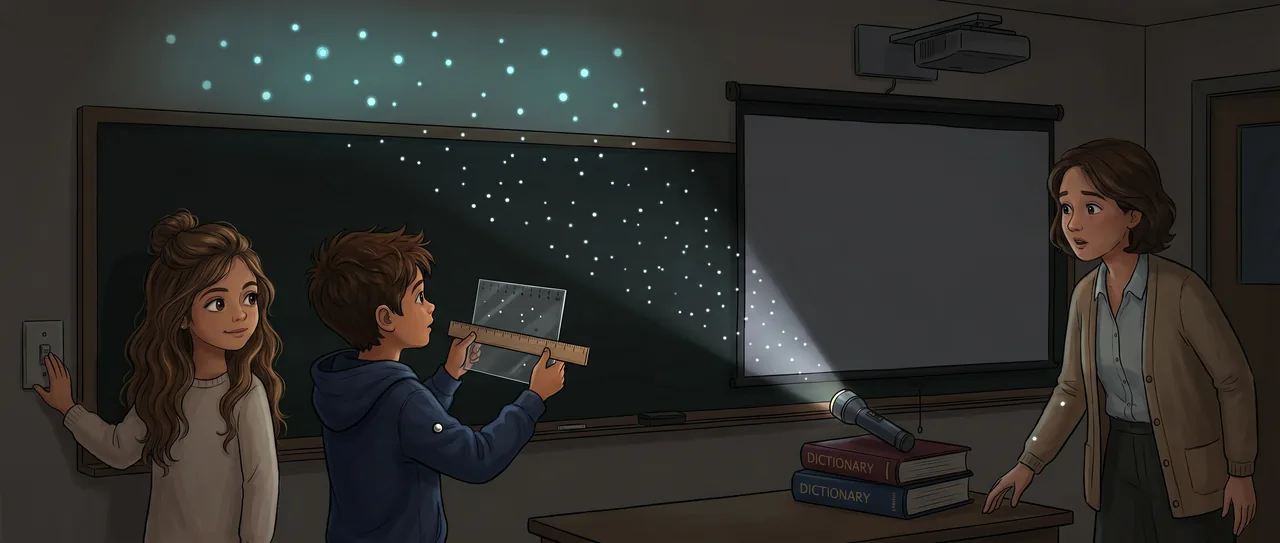
Soren did not use the projector. He put the flashlight on a stack of dictionaries, clipped the plastic sheets to a ruler, and held the black paper in front. Maya went to the light switch.
The classroom went dark.
At first everyone made the noises people make when a room changes before they do. Chairs squeaked. Someone laughed. Someone whispered that Soren had brought a shadow puppet.
Then Maya clicked on the flashlight.
Seventy white points appeared across the wall above the board.
Not many, against the whole wall. Almost nothing. But the room changed size without moving. The dots made the wall look too large to be a wall, and the darkness around them too large to be a classroom.
Soren held up the blue parent sheet. Some colored dots glowed faintly, but the seventy white points did not move into them.
He held up the green parent sheet. The same thing happened.
He held up the child sheet. The seventy points landed exactly where the tiny marks were waiting.
"These are not from either parent," Soren said. His voice sounded smaller in the dark, which made everyone listen harder. "They are new changes. About seventy in each child, if you could compare the whole genome. Most are quiet. Some are not. But they are there."
"In everybody?" someone asked.
"In every child," Maya said.
A chair creaked in the back. The teacher stopped fighting with the projector.
"So," said another voice, "a baby isn't only half and half?"
Soren looked at Maya.
Maya grinned so fast it was almost a spark.
"Half and half," Soren said, "and then not exactly." The teacher walked closer, still holding the useless remote. On the wall, one of the seventy points shone on her sleeve and trembled when she breathed.
"Could you show it again?" she asked.
Soren lowered the ruler, then raised it. The stars disappeared, then returned to the wall.
Maya clipped a blank transparent sheet over the light, empty except for the square glare of the lamp.
Read the interactive version, listen to the narration, and earn a gold star →
A science-verified short story for curious kids · Curiosity Land