The Red Ring
The biology companion had labeled everything too neatly.
Green thread algae, confidence ninety-eight percent.
Rotifer, confidence ninety-six percent.
Human cheek cell, accidental contamination, confidence ninety-nine percent.
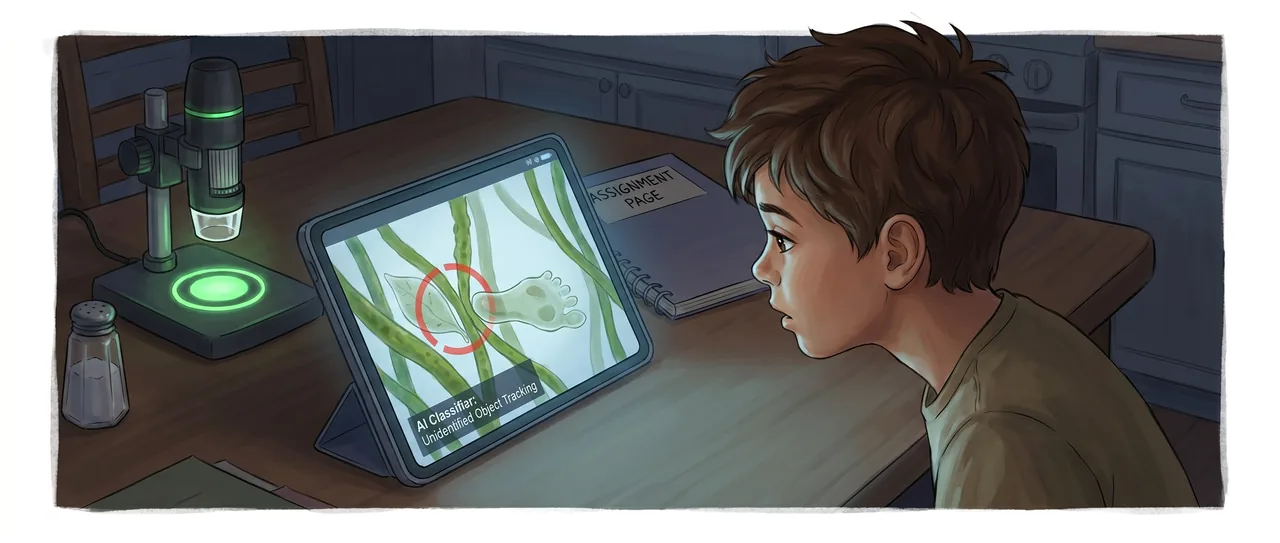
Soren sat at the kitchen table with a drop of roof-garden water flattened under glass. His digital microscope hummed beside the salt shaker. On the tablet, little boxes snapped around living specks as they crossed the bright circle. The companion had been trained on more microscope pictures than any person could look at in a lifetime. It knew blood cells by their pale centers. It knew yeast by their budding edges. It knew pollen, mold, skin flakes, algae, worm eggs, and the blurry half-moons of air bubbles.
It was making his homework unbearably tidy.
His mother leaned under the sink with a wrench and said, “If that thing leaks onto my tax papers, both of you are moving to the balcony.”
“It is one drop,” Soren said.
“One drop is how indoor ponds begin,” she said.
Soren nudged the focus wheel. A green strand sharpened. Tiny bright grains lined up inside it like beads in a bracelet. The companion drew another box.
Filamentous green algae, confidence ninety-seven percent.
Soren wrote it down because the assignment required fifty labeled cells from an ordinary place. He had chosen the roof garden because ordinary places were usually not ordinary if you made them bigger.
Then a red ring appeared.
Not a box. A ring.
It circled something clear and flat, caught between two green threads. It was shaped a little like a leaf and a little like a footprint. Its edge was not smooth. There were faint gray textures inside it, not dots exactly, more like weather seen through old glass.
The companion paused long enough that Soren heard the sink drip into the bucket.
Uncertain classification.
Soren waited.
The words stayed.
He tapped the ring.
Nearest matches: unknown artifact, damaged epithelial cell, unclassified protist-like cell. Confidence below reporting threshold.
His mother’s voice came from under the sink. “Pick a different one.”
“It won’t count,” Soren said.
“Then definitely pick a different one.”
He almost did. The assignment page had little green check marks beside accepted labels. Uncertain classification would leave an empty square, and empty squares made teachers write cheerful comments like, Try again next time.
The clear thing drifted out of the ring. The ring followed it.
Soren stopped reaching for the next sample jar.
Dust did not drift like that.
He turned the microscope light lower. The green algae dimmed. The clear thing did not disappear. Its ragged edge brightened on one side. When he moved the focus up, the green thread blurred first, then the clear thing, then a tiny scratch on the coverslip came sharp and vanished again.
The scratch was on top. The clear thing was in the water.
Soren pulled a fresh slide from the paper sleeve. He washed the dropper twice, even though washing droppers felt like arguing with invisible crumbs. He opened a new coverslip with tweezers. His mother’s wrench clinked.
“Now what?” she asked.
“Trying to make it go away.”
“That is the first sensible sentence you have said all week.”
He took another drop, not from the top of the jar but from the green-brown fuzz stuck to a pebble at the bottom. The coverslip settled crooked, making a little clear wedge of water. He slid the glass onto the stage.
The companion began its cheerful work again.
Diatom, confidence ninety-five percent.
Ciliate, confidence ninety-four percent.
Plant debris, confidence ninety-two percent.
Then three red rings appeared at once.
Soren sat back so fast his chair bumped the cupboard.
His mother’s head appeared from under the sink. One cheek had a line of dust across it. “Broken?”
“No,” Soren said.
“Homework done?”
“No.”
She looked at the screen, saw the red rings, and frowned the way adults frowned at machines, as if machines had manners and were choosing not to use them. “Can you reset it?”
“I can. But it will forget the part where it doesn’t know.”
His mother opened her mouth, then closed it. The bucket dripped once. “Dinner in twenty minutes,” she said, and disappeared under the sink again.
Soren changed the light from straight-through to side illumination. The tablet image became shadowy, like a moon seen through soup. The three clear cells showed ridges inside them, faint folded lines that had not been visible before.
The companion did not name them.
He asked for artifact checks. The tablet displayed a list. Air bubble. Fiber. Dust. Scratch. Stain crystal. Compression damage.
Soren did not have stain. The coverslip scratch was elsewhere. Fibers were long and frayed. Air bubbles had dark rims and round bodies. These things were flat, irregular, and too similar to one another to be crumbs. He pressed lightly on the coverslip with the wooden end of a cotton swab. Water slid. The algae bent. The clear things moved with the water, then one of them squeezed through a gap and widened again on the other side.
His mouth went dry.
He did it again, more gently.
The cell narrowed, passed the green thread, and spread back into its leaf-footprint shape.
The companion added a yellow line beneath the red ring.
Persistent uncertain classification across frames. He drew three lopsided outlines, then crossed out the first because he had made it too neat.
The companion offered a button.
Auto-complete catalog with nearest likely labels.
Soren looked at the fifty green squares waiting on the assignment page. He looked at the red rings.
A machine that knew thousands of cell shapes was refusing to pretend.
He closed the assignment page.
The companion opened a different panel when he tapped Report uncertain sample. It did not ask for a name. It asked for controls.
Fresh slide used?
Yes.
New coverslip?
Yes.
Repeated sample from same source?
Yes.
Focus stack captured?
Soren did not have one yet.
He set the microscope to climb through the water one thin slice at a time. The table vibrated when his mother tightened something under the sink, so he held his breath and waited for the image to settle between each tiny movement. The clear cells appeared and disappeared in layers. Not flat stains. Not marks on glass. Small bodies in water, each with thickness, each with its own cloudy interior.
When the focus stack finished, the companion built a ghostly version that could be turned in space. The three clear things hung among green threads like scraps of invisible paper caught in weeds.
The report panel opened one last question.
Known source organism?
Soren typed, Roof garden overflow water, north drain, collected after rain.
The companion displayed another warning.
Uncertain samples may be artifact, damaged known cells, rare known organisms, or potential novel observations. Submission will be reviewed by distributed biology network.
“Dinner,” his mother said.
“In one minute.”
“You said that twelve minutes ago.”
Soren did not argue. He attached the focus stack. He attached the side-light images. He attached the plain images where the cells looked like almost nothing at all.
The submit button turned blue.
His finger hovered.
On the screen behind the panel, one red-ringed cell slid free of the algae mat. Its edge puckered, then loosened. The ring followed without naming it.
Soren tapped submit.
The panel changed to Awaiting review.
He did not move away from the microscope.
The sink stopped dripping. The kitchen went quiet except for the soft fan inside the tablet.
Soren lowered the room light and turned the focus wheel with two fingers. In the bright circle, the clear cell squeezed between two green threads, opened flat again, and carried its red ring with it.
Read the interactive version, listen to the narration, and earn a gold star →
A science-verified short story for curious kids · Curiosity Land