The Ones Who Waited
The bad news was printed on the rubric before Maya and Soren even touched the tray.
Observable growth, it said.
Their moss had not grown. It had browned at the edges, curled into stiff little hooks, and become the exact color of old toast. The plastic lid had a crack in one corner where someone had stacked a box of magnets on top of it during winter break.
All around the classroom, other survival projects looked alive in ordinary ways. Bean plants leaned toward windows. Yeast balloons sagged but still smelled like bread. One group had mealworms in oats, which were definitely surviving because they kept being where no one wanted them.
The teacher came by with a roll of tape around her wrist and a marker cap in her mouth.
“Yours may need to be a poster,” she said, after looking into the tray for less than a second. “Explain what should have happened.”
“It did happen,” Maya said.
The teacher took the marker cap out of her mouth. “The moss dried out.”
“Yes,” Maya said.
Soren looked at the curled moss. He did not say anything yet. Saying something too early made adults answer the thing they thought you meant.
The teacher glanced toward a crash by the sink. Someone had dropped the mealworm oats.
“If you take it home, bring back something clean,” she said. “No mud on the bus.”
Maya put both hands on the tray before the teacher could change her mind.
On the walk to Soren’s apartment, the tray rode between them like a very small desert. The lid rattled when the bus turned. A flake of moss slid from one corner to the other.
“It looks dead,” Soren said.
“That’s not the same,” Maya said.
“It might be the same.”
“It might not.”
Soren liked that answer better than yes. Yes could be sloppy. Might not left a place to put tests.
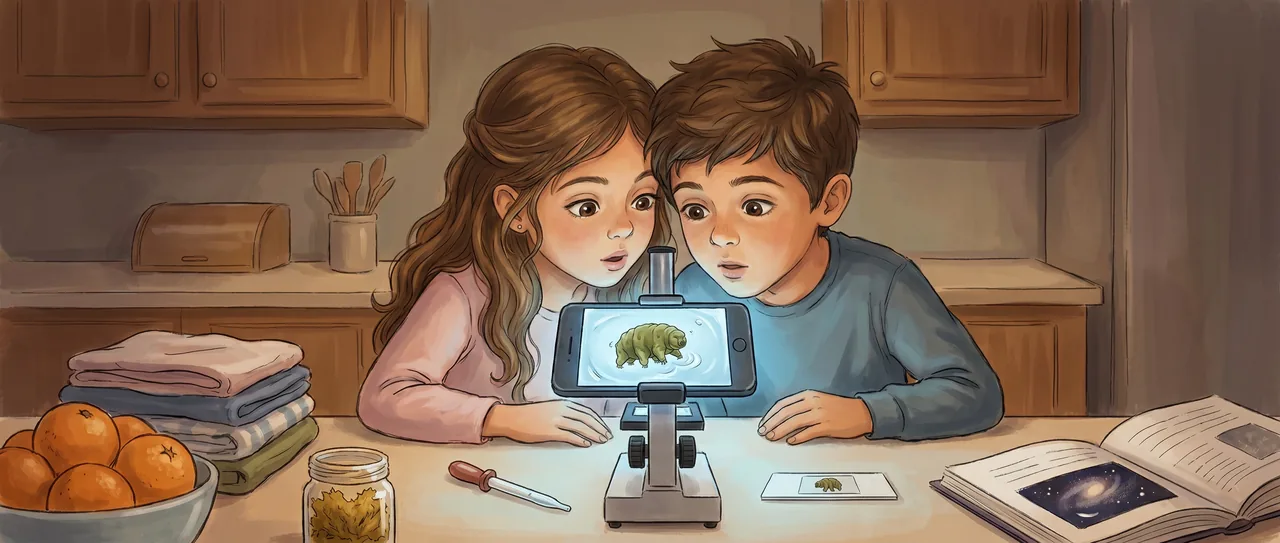
In Soren’s kitchen, they cleared a space between a bowl of oranges and a pile of folded laundry. Soren brought out his clip microscope, the one that snapped over a phone camera. Maya fetched a lamp and a clean jar lid. They did not ask permission. Permission took longer than water.
Soren pinched off the smallest piece of moss with tweezers. It made a dry sound, like a tiny broom breaking. He placed it on a glass slide, put the slide under the clip microscope, and nudged the phone until the screen filled with a brown forest.
Nothing walked.
Maya leaned close enough that her hair brushed his cheek.
“Lower left,” she said.
“That’s grit.”
“Grit with legs tucked in?”
Soren adjusted the focus. The brown lump became clearer, then blurrier, then suddenly shaped. It was short and wrinkled, with little folds pulled tight, like a sleeping bag tied with string.
He did not breathe for three seconds.
“Tardigrade?” Maya asked.
“Maybe a tun,” Soren said.
Maya smiled at the word. “A tun is a waiting shape.”
“It’s a dried shape,” Soren said, but he was already reaching for the dropper.
He put one drop of water on the moss. The dry strands darkened. Dust lifted and swam. On the phone screen, the lump stayed a lump.
Maya tapped the table with one finger.
“Don’t shake it,” Soren said.
“I’m not shaking it. I’m waiting loudly.”
They waited five minutes. Then ten. The kitchen clock clicked as if it were chewing.
Soren pulled a library book from his backpack. It had a page marked with an old bus ticket. The photograph showed a tardigrade magnified huge, pudgy and strange, with eight legs and claws like commas.
“Water bears,” Maya said.
“Moss piglets,” Soren said.
“That is worse.”
“That is also a real name.”
He ran his finger down the page, not reading aloud at first. His lips moved on the hard words.
Maya watched the screen. The little folded thing did not move.
Soren turned the page to a picture of a spacecraft. There was a metal box on the outside, bolted where Earth’s air could not reach.
“They sent them outside,” he said.
“Outside what?” Maya asked.
“Outside the spacecraft.”
Maya looked away from the microscope.
Soren read in pieces. “Dried tardigrades. Low Earth orbit. Vacuum. Radiation. Some survived when they were brought back and given water.”
Maya’s hand stopped above the table.
The kitchen was still the kitchen. Oranges in a bowl. Socks on a chair. A spoon in the sink with a smear of peanut butter on it. But the brown crumb on the slide had changed size without changing size at all. Soren kept reading, softer now. “In cryptobiosis, metabolism can drop so low it can’t be measured.”
“Zero?” Maya asked.
“Not exactly zero. It says no measurable metabolism.”
“No eating. No breathing. No growing.”
“No moving.”
Maya turned back to the screen. “That is a terrible way to look alive.”
Soren put the book down.
At school, participation points went to people who raised their hands fast. Science fair ribbons went to plants that climbed strings. The rubric liked arrows, stages, labels, proof that something had done something while people watched.
On the screen, the tun did nothing at all.
Soren got his notebook out, then closed it again. He took a second slide and placed a different dry piece of moss on it.
“What are you doing?” Maya asked.
“Leaving one dry. If this one moves after water, the water matters. If the dry one moves, we have a ghost problem.”
Maya grinned. “I would accept a ghost problem.”
“I would write it down first.”
They checked the wet slide again. The lump had swollen slightly. Or maybe the water made everything look swollen. Soren adjusted the focus until the moss strand behind it sharpened.
One of the tucked legs came loose.
Maya made a sound so small it was almost not a sound.
The leg curled inward, then pushed. Another leg unfolded. The body lengthened from a tight oval into something animal. Not an animal like a dog or a beetle. An animal like a secret with claws.
“It’s moving,” Soren said.
“I see it,” Maya said.
The tardigrade dragged itself forward through the water film. Its claws gripped the moss strand and let go. Gripped and let go. Slow, clumsy, certain.
Soren switched to the dry slide. The folded thing there stayed folded.
Maya whispered, “The project isn’t growth.”
Soren looked at the rubric on the table. Observable growth. Evidence of survival strategy. Clear explanation.
He crossed out only one word with his finger, leaving no mark.
Maya was already pulling cardboard from the recycling. She cut a circle of black paper and punched pinholes through it. Soren taped the spacecraft picture beside a hand-drawn moss forest. Under it he wrote: Some tardigrades survived space vacuum and radiation after drying into tuns. Other experiments chilled them close to absolute zero. Water can wake some again.
Maya read it and shook her head.
“Too flat,” she said.
“It’s true.”
“True can still be flat.”
So they made the display in two halves.
On the left, they glued the rubric word: observable.
On the right, they placed the dry moss in a clear jar lid. Beside it they taped a little paper flap that said: Wait.
Under the microscope phone, the tardigrade kept walking. It did not know it had crossed from failed project to evidence. It did not know it had been the right answer while everyone was looking for green shoots.
Soren checked the book again. The sentence about cold sat at the bottom of the page, small and impossible-looking. Near absolute zero. Almost as cold as cold could be. A place where ordinary motion inside matter nearly stopped.
Maya held an ice cube from the freezer and looked at it with disappointment.
“Not even close,” Soren said.
“I know,” Maya said. “That’s the problem.”
They both looked at the dry moss in the jar lid.
There were limits they could not test in a kitchen. No vacuum of space. No cosmic radiation. No cold almost at the end of cold. The book did not make the kitchen smaller by saying so. It made the kitchen table seem like the nearest edge of something.
Soren set the wet slide in a small plastic box with a damp paper towel so it would not dry overnight. Maya put the dry moss beside it.
“You think there are more?” Soren asked.
Maya did not answer right away. She moved the lamp so the black paper circle shone with pinprick stars.
In the morning, the teacher was at her desk, trying to unjam a stapler. The classroom smelled like glue and soil and oats. Maya and Soren carried the tray between them.
The poster boards around the room showed roots, leaves, bubbles, worms. Things doing things people knew how to count.
At the classroom door, Maya held the tray while Soren lifted the clear lid. Under the drop of water, the tiny animal pulled itself across the green strand, one claw at a time.
Read the interactive version, listen to the narration, and earn a gold star →
A science-verified short story for curious kids · Curiosity Land