The Not Tree
The family tree template had a trunk, branches, leaves, and a smiling sun in the corner, which made Maya suspicious immediately.
"It already thinks it knows the answer," she said.
Soren looked up from the instruction sheet. The city was sending a thumb-sized archive to the Moon, tucked inside a library brick with seed lists, river maps, songs, and one family map from every classroom. The sheet said: Show where you come from.
"Trees are traditional," Soren said.
"So are wrong things."
Maya cut the sun off first.
Her mother was at the counter, trying to fix the kitchen pump with one hand and keep a soup from boiling over with the other. She had a crescent wrench in her back pocket and a strip of sealant stuck to her sleeve.
"Please make something your teacher can recognize," she said. "Last month you turned the weather chart into a spiral and I had to attend a meeting."
"Weather is a spiral sometimes," Maya said.
"That was your argument at the meeting."
Soren smoothed the template. He liked clear directions, even when he was about to disobey them. "It asks where family is. Not only where it came from."
Maya stopped cutting.
That was the sentence that had been bothering her, though she had not caught it yet.
Soren opened his paper notebook. Everyone else used wrist screens that unfolded in the air, but Soren liked pages because pages stayed where he put them. He flipped past sketches of pulley knots, moon phases, and six separate tests of whether a hallway echo changed when the fire door was open.
"I wrote down something about this," he said. "Not family trees exactly. Bodies."
Maya leaned over his shoulder.
He had copied the line in careful block letters: During pregnancy, cells can cross the placenta in both directions. Some fetal cells remain in the mother's body for decades.
Under it, in smaller letters: Found in blood. Skin. Liver. Heart. Brain. Microchimerism.
Maya said the last word silently, shaping it with her mouth.
Her mother turned off the stove. "Micro what?"
"Chimerism," Soren said. "Like a chimera. More than one kind of cell in one body."
Maya's mother looked at the wrench, the soup, the clock, and the torn-up family tree. "I am not enough awake to be a mythological creature."
"If you carried my cells," Maya said, "then I'm not just on a branch."
"The placenta mostly keeps blood separate," her mother said. "Mostly is doing a lot of work in that sentence, apparently. I have to get this pump sealed before it floods under the cabinet. Do not use glue on the table."
She knelt by the sink and vanished into clanking.
Soren did not move for a moment. Then he took the template and placed it between them like evidence.
"If we make a tree," he said, "your mother is the trunk and you are a branch."
"But if she has cells from me inside her, then some branch is inside the trunk."
"That sounds like a bad diagram."
"It sounds like the diagram is the bad part."
They tried anyway.
Soren drew a trunk and two neat branches. Maya drew tiny dots inside the trunk, then frowned and made the dots the same color as the leaves. Then she drew a line from a leaf back into the trunk, which looked like a worm.
"No," she said.
Soren did not say he agreed. He took another paper and drew a body outline instead. Maya's mother, roughly. Head, shoulders, one hand holding a wrench because he had drawn what was in front of him.
"Now the archive thinks your family is only your mother," he said.
Maya pulled open the drawer where her mother kept string, tape, batteries, buttons, old keys, and things that were absolutely not glue. "Then we need layers."
"We need facts first."
They checked the city library database, the medical dictionary for students, and an article summary Soren trusted because it said when scientists were not sure. They did not find magic. They did not find that mothers became half their children, or that children's cells steered thoughts, or that every ache had a secret tiny passenger in it.
They found smaller sentences, which were stranger.
A few cells could cross.
Some could persist for years.
Sometimes decades.
Scientists had found fetal cells in mothers' blood and in organs, including heart and brain.
No one knew all the things those cells did.
"We cannot draw them fixing anything," Soren said.
"I wasn't going to."
"You were looking at the heart."
"I was looking at the question mark next to the heart."
Soren considered this and nodded.
Maya searched the drawer for clear plastic. Soren, after a small hesitation, unzipped the side pocket of his backpack. Inside was a flat packet of saved things: a transparent wrapper from a screen protector, two pieces of blue thread, copper foil from a broken circuit kit, and a square of mesh he had once said might be useful for something.
Maya looked at the packet. She did not tease him. She held out her hand.
"The clear one," she said. "Please."
Soren gave it to her very carefully.
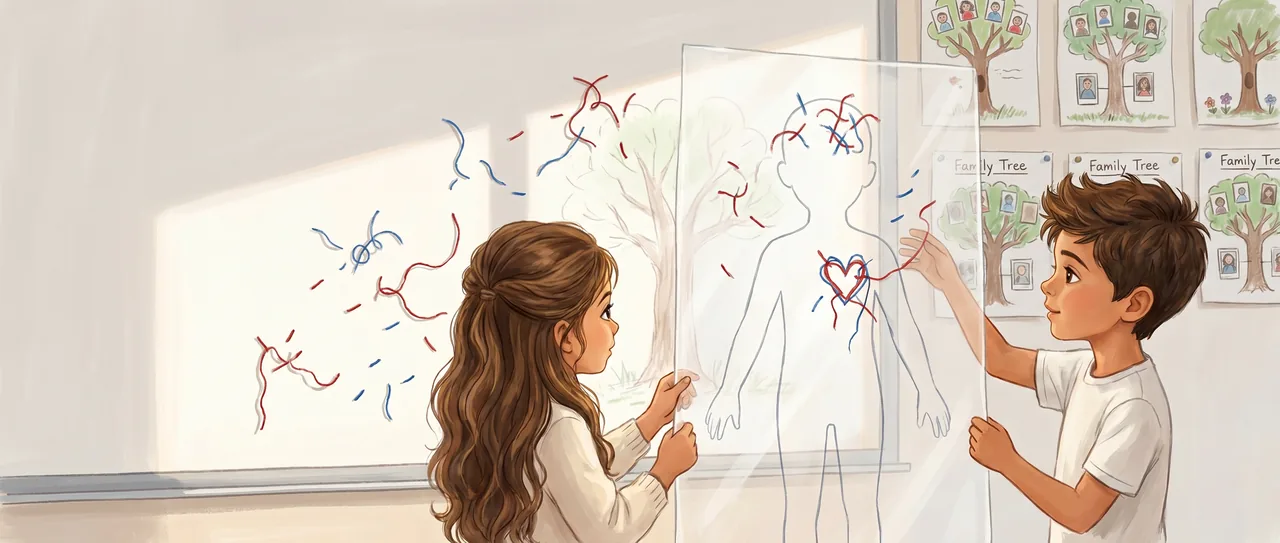
They traced Maya's mother's outline onto the wrapper. Behind it they placed the failed tree, not as the picture, but as one layer under the picture. Ancestors below. Children around. Then Maya threaded red through the outline for herself, not filling it, only crossing it in tiny stitches like sparks that had stopped traveling but had not gone out.
Soren added blue thread for the idea of any other child, then paused.
"Only if there is another child," he said.
Maya's needle stopped.
From under the sink, her mother said, "There was a pregnancy before you. It did not become a baby."
The pump clanked once.
Maya held the needle still between finger and thumb.
Her mother did not come out. "I don't talk about it much because people make their faces soft in that awful way. But if you are mapping, don't make the map smaller than the truth."
Soren slid the blue thread closer to Maya without speaking.
Maya put three blue stitches near the red ones. Not many. Enough to make the clear body no longer empty. At school the next morning, the other family trees stood in bright rows. Some had glitter apples. One had tiny printed faces. One had a pop-up house. The teacher walked down the line with the scanner pad for the lunar archive.
When she reached Maya and Soren, she stopped.
"This is not a tree," she said.
"Correct," Maya said.
Soren put the transparent sheet on the scanner pad. The classroom lights washed it almost blank.
"It may not record well," the teacher said. She was not annoyed yet, but she was getting ready.
Soren looked at the scanner, then at the window. The scanner light came from below. Sunlight came sideways.
"Can we tilt it?" he asked.
The teacher checked the clock. "Quickly."
Maya lifted one edge. Soren held the other. The morning sun passed through the transparent body and threw the threads onto the white wall beside the class trees.
The red stitches appeared first. Then the blue. The drawn tree underneath showed faintly, roots and branches trapped behind the body like an old idea that had not been thrown away, only made insufficient.
No one talked for a breath.
Then someone in the back asked, "Are those inside her?"
"A few cells can be," Soren said. "From a pregnancy. They can stay a long time. Scientists have found them decades later."
"In the brain too?" another voice asked.
Maya touched the tiny cluster near the drawn head. "They have found them there. They don't know everything about what they do."
The teacher lowered the scanner pad slowly. "The archive category has family tree, household map, and other."
"Other," Maya said.
"Other," Soren said.
The teacher tapped the air above the pad. The scanner brightened. On its screen, the not tree became a field of lines inside a body, and the file name blinked, waiting.
Soren looked at the clear sheet, then at Maya, then at his own hand resting on the table.
"If cells can cross from a child into a mother," he said, "what crossed the other way?"
Maya took the last clear sheet from Soren's box and laid it over the light.
Read the interactive version, listen to the narration, and earn a gold star →
A science-verified short story for curious kids · Curiosity Land