The Name Mover
The librarian said, "Twenty minutes, then the chairs win."
She was stacking them upside down on the tables, four legs pointing at the ceiling each time. The makerspace smelled like warm plastic from the printer that had jammed during robotics club. Everyone else had gone home with half-built rovers and snack crumbs in their pockets.
Maya and Soren stayed because the class laptop had not been put away.
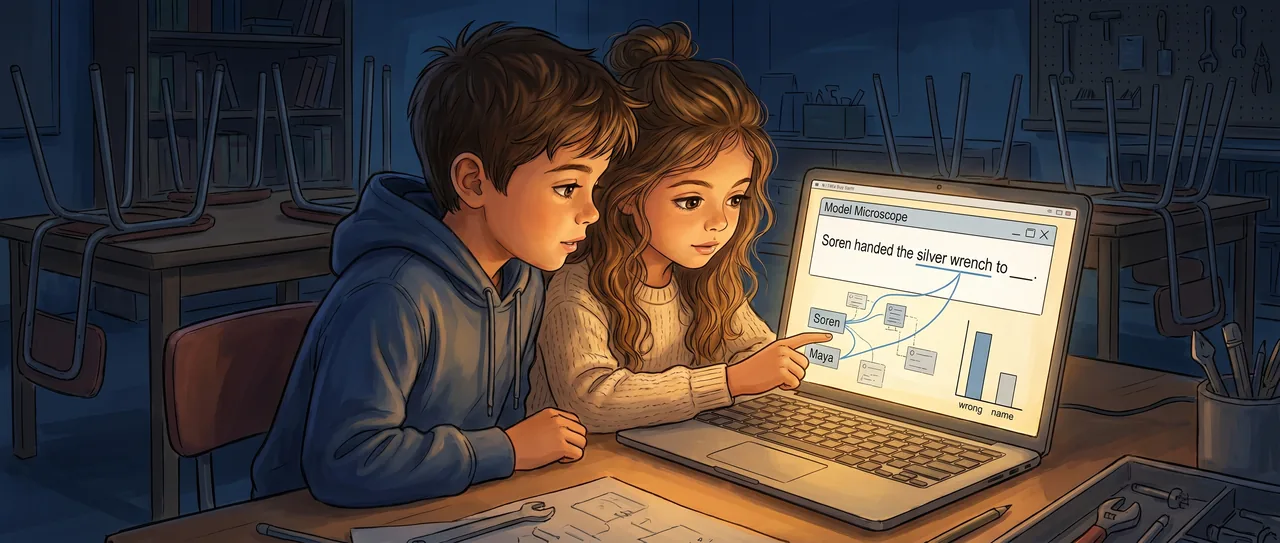
On its screen was a window called Model Microscope. The club had used it to make an old language model finish silly space advertisements. Buy Moon Cheese, the model had written. Now the page showed a blank prompt box, a row of little squares, and two bars labeled with possible next words.
Soren leaned close. "It's just autocomplete with a nicer hat."
Maya typed before he finished talking.
When Maya and Soren opened the airlock, Maya handed the silver wrench to
The model blinked. The bar for Soren rose higher than the bar for Maya.
Maya sat back. "It picked you."
"Because my name was last," Soren said.
Maya put the cursor in the sentence and changed only the middle.
When Soren and Maya opened the airlock, Soren handed the silver wrench to
This time the bar for Maya rose.
Soren made a small sound, not quite admitting anything. He took the laptop and changed silver wrench to cracked helmet. Then to sleeping cactus. Then to eight-sided banana.
Each time, the model gave the other name.
"Still could be surface pattern," he said.
"Everything has a surface," Maya said. "Where is it keeping the who?"
The librarian clapped a chair too loudly onto a table. "If you two are using the writing robot to write your apology notes for staying late, I respect the efficiency."
"We're not writing," Maya said.
"Even better," the librarian said, and carried another chair away.
Soren clicked a tab at the side. It opened a diagram with tiny square labels. Layer nine, head six. Layer nine, head nine. Layer ten, head zero. The page had a short note at the top: In a small transformer model, researchers found attention heads that help move the indirect object's name to the final prediction.
Soren read it twice. "Name movers," he said.
"That sounds fake."
"It's in the paper link."
"Still sounds fake. Try one."
He clicked layer nine, head six. The square went gray. The bars barely moved.
Soren looked pleased in the worst possible way. "Soup."
Maya frowned at the screen. She did not look disappointed. She looked like someone had put a door in the wrong wall.
"Try the others with the same name," she said.
"Why?"
"Because if one bridge breaks and you still cross, there is another bridge."
Soren clicked layer nine, head nine. The bar for Maya trembled but stayed taller. He clicked layer ten, head zero. The bar dropped sharply. He clicked one more square from the list, marked backup name mover. The bar for Maya fell below the bar for Soren.
The sentence on the screen still said Soren handed the silver wrench to, but the model no longer leaned toward Maya. It leaned toward the wrong name.
Soren stopped smiling.
Maya whispered, "Put them back."
He did. One by one, the gray squares brightened. The Maya bar climbed again, not all at once, but like a kite finding wind.
Soren opened his paper notebook, then shut it without writing. The inside of his head had not gotten smaller, but the room had.
"Show me what the square is looking at," Maya said.
Soren clicked the first name mover. Lines appeared over the sentence. They were thin and blue and nervous-looking. One ran from the blank space at the end back to Maya's name. Another square drew lines to both copies of Soren. A third lit near the repeated name and then near the name that was not repeated.
Maya touched the screen without touching it, her finger hovering a breath away.
"It isn't a word bag," she said.
Soren did not answer. He changed the sentence again.
When Maya and Soren entered the garden, Maya gave the lantern to
The model chose Soren.
He muted the same group of squares.
The model wavered, then chose Maya.
Again, he changed the place, the object, the names' order, the verb. Again, the same little group mattered. Not perfectly. Not like a gear in a clock. More like a team in a dark hallway passing a message by touch.
The librarian came back with the last chair and squinted at the screen. "Is the robot behaving?"
"No," Soren said.
Maya said, "Yes."
The librarian blinked. "That sounds advanced. Ten minutes."
When she walked away, Soren opened the paper linked at the bottom. Most of it was too dense, with diagrams like cities seen from above. But some words stood out. Circuit. Algorithm. Indirect object identification. The model had been trained to predict the next word from enormous amounts of text, not handed a tiny labeled drawer that said, Put the person who receives the thing here.
Yet there was the drawer. Not wooden. Not simple. Not alone. But findable.
Maya read over his shoulder. "People found this by turning parts off."
"And tracing where information moved," Soren said.
"So the question wasn't, does the model know. It was, where does the knowing happen."
Soren's fingers pressed flat on the table. At school, when he asked how an answer machine got its answer, people often said it was too complicated and moved on. Too many numbers. Too much training. Too black a box. But here the black box had seams. Someone had cared about the seams enough to name them.
Maya had gone still in the way she did before moving too fast.
"There are more tabs," she said.
Soren looked.
Under the indirect object circuit were other folders. Induction heads. Modular addition in tiny networks. Factual associations. Some had neat diagrams. Some had question marks. One was titled Circuits We Do Not Understand Yet.
"Modular addition," Maya said. "Like clock math."
"In a network," Soren said.
"It made clock math inside itself?"
"Researchers found patterns for it," he said. "Not in this model. Tiny ones trained for that. But yes. Kind of."
Maya grinned, quick and fierce. "Kind of is huge."
The lights over the nonfiction shelves clicked off in a row. The makerspace stayed lit, a bright island with chair legs sticking up all around it.
Soren typed a new sentence into the prompt box.
When Soren and Maya built the rover, Soren passed the broken wheel to
The model chose Maya. He muted the name movers. The answer shifted. He unmuted them. It shifted back.
Maya did not cheer. Soren did not write it down. For a moment they only watched the bars rise and fall when small hidden pieces were allowed to speak.
The librarian called, "Chairs have officially won."
Soren closed the paper but not the microscope. Maya reached over him and opened the folder titled Circuits We Do Not Understand Yet.
The screen went quiet except for the blinking cursor. Maya slid the pointer onto the first unmarked square.
Read the interactive version, listen to the narration, and earn a gold star →
A science-verified short story for curious kids · Curiosity Land