The Moon That Would Not Settle
Soren had drawn the volcano perfectly.
It had a cutaway side with orange magma rising through a pipe, red lava running down the cone, and three labels written in black pencil: leftover heat from formation, radioactive decay, molten rock.
Maya stared at the page for six seconds too long.
Soren knew the look. It was the look she got when a number did not add up or when a cloud moved against the other clouds or when somebody said always.
"What?" he asked.
"Too Earth," Maya said.
"The assignment is volcanoes. Earth has volcanoes."
"Io has volcanoes."
Soren tapped the word radioactive with his pencil. "Io is a moon. Small things cool faster. It should be colder than Earth inside."
"Yes," Maya said. "That's the problem."
From the stove, Soren's father said, "If you need a volcano, there is vinegar under the sink and baking soda in the blue box. Do not use my good trays."
He was making pancakes for dinner because the washing machine had flooded the hallway and the day had already lost all its rules.
"We are not making a vinegar volcano," Soren said.
"Everyone says that before they need the vinegar," his father said, and flipped a pancake too high. It folded on landing.
Maya had already left the table.
Soren found her at the calendar by the back door. It showed Jupiter, striped and enormous, with four tiny moons beside it like beads somebody had lined up with a ruler. The picture was from a space telescope. Somebody had circled Io in red marker months ago. Probably Maya.
"Look," she said.
Soren looked. Io was only a dot.
"That dot has volcanoes taller than mountains," Maya said. "And it is not hot because it is near the Sun. It is very much not near the Sun."
Soren waited. Maya usually leaped first and built the bridge afterward.
"Jupiter," she said.
"Jupiter what?"
"Pulls it."
"Everything pulls everything. That does not make volcanoes. The table is pulling me. I am not erupting."
Maya grinned. "Not enough."
The washing machine thumped from the hallway, hard enough to make a spoon tremble on the counter.
Soren's father groaned. "It is walking again."
He hurried out with a screwdriver in one hand and a pancake spatula in the other.
Soren watched the spoon settle. He wrote one word on the corner of his volcano drawing: pull.
Then he crossed it out.
"Pulling is not heat," he said.
Maya opened the drawer where Soren's family kept batteries, tape, bent nails, three rulers, and things no one could name. She took out a wire coat hanger.
"Do we need permission?" Soren asked.
"It is already a triangle," Maya said. "It has no future."
She bent the hanger back and forth at one corner. The metal made a small hard squeak. After ten bends, she handed it to Soren.
"Touch the bend."
He did. The corner was warm.
Not hand-warm. Not stove-warm. A secret kind of warm, exactly where the metal had been forced to change shape.
Soren took the hanger and bent another corner. Once. Twice. Three times. He touched it. Nothing much. He bent it faster. The warmth arrived, small but real.
"Motion into heat," he said.
Maya nodded. "A moon into a coat hanger."
"A rocky moon is not a coat hanger."
"No," Maya said. "It is better. It cannot break and complain."
The washing machine thumped again.
"Rock can flex," Soren said slowly. "Earth has tides in the oceans. There are solid Earth tides too. Tiny ones. The ground moves."
Maya pointed at the calendar. "Io is close to Jupiter. Very close. Jupiter is enormous."
Soren pulled a clean sheet of paper toward him. He drew Jupiter as a circle so large it ran off the page. Then he drew Io as a dot near it. He added an orbit with his compass, neat and round.
Maya made a face.
"Wrong circle," she said.
"Orbits are almost circles."
"Almost," Maya said.
Soren did not like ruining a good compass circle. He put his pencil down.
Maya reached over and pressed one side of the circle flatter with her finger, as if the graphite could be shoved into a different path.
"If Io went around perfectly," she said, "wouldn't the pulling be the same?"
Soren looked at the giant Jupiter, the little Io, the circle he had made too perfect.
"Mostly," he said. "The bulge would stay pointed. Less changing shape. Less heating."
"So it needs to be wrong."
Soren picked up the pencil again. He drew a second path, slightly oval. He hated how untidy it looked. He liked that it mattered.
"Something has to keep it oval," he said. "Jupiter's pull would try to make it settle down."
Maya was already at Soren's bookshelf, pulling down the thick space book with the cracked spine. She did not ask because she had asked a hundred times before and the answer had become yes.
She dropped it open on the table. The page showed the Galilean moons: Io, Europa, Ganymede, Callisto.
Soren read the caption with his finger under the line. "Io, Europa, and Ganymede are locked in an orbital resonance. For every one orbit of Ganymede, Europa orbits twice and Io orbits four times."
Maya tapped the table four times fast, then twice slower, then once.
"They keep meeting in a pattern," she said.
"They tug it before it can settle," Soren said.
Maya went very still.
That was when the kitchen changed size.
It still had pancake batter on the counter and one sock from the flooded hallway stuck to a chair leg. But the calendar dot was no longer a dot. Soren did not write anything. His pencil stayed in his hand.
"Wait," Maya said.
It came out almost too softly to hear.
She turned the page.
Europa was white and cracked, with brown lines crossing its ice like scratches on an eggshell.
"Europa," she said. "It is in the pattern too."
Soren read ahead. "Scientists think there may be a salty ocean under the ice. Tidal heating may help keep it liquid."
Maya pulled the book closer. "Volcanoes on one moon. An ocean under ice on another. Same pull."
"May help," Soren said.
"May," Maya said. She did not sound disappointed. She sounded as if may was bigger than yes.
Soren's father came back, carrying a wet towel and the washing machine's little metal leveling foot.
"I solved it," he said. "Mostly. Why is my coat hanger warm?"
"Volcanoes," Maya said.
He looked at the bent hanger, the giant drawing of Jupiter, the space book, and the uncooked pancake batter.
"Right," he said. "Do I want to know?"
"Not yet," Soren said.
His father considered this, then took the spatula from his back pocket. "I also do not want to know why this was in my pocket. Carry on."
They moved to the basement after dinner because the kitchen table was declared sticky beyond science.
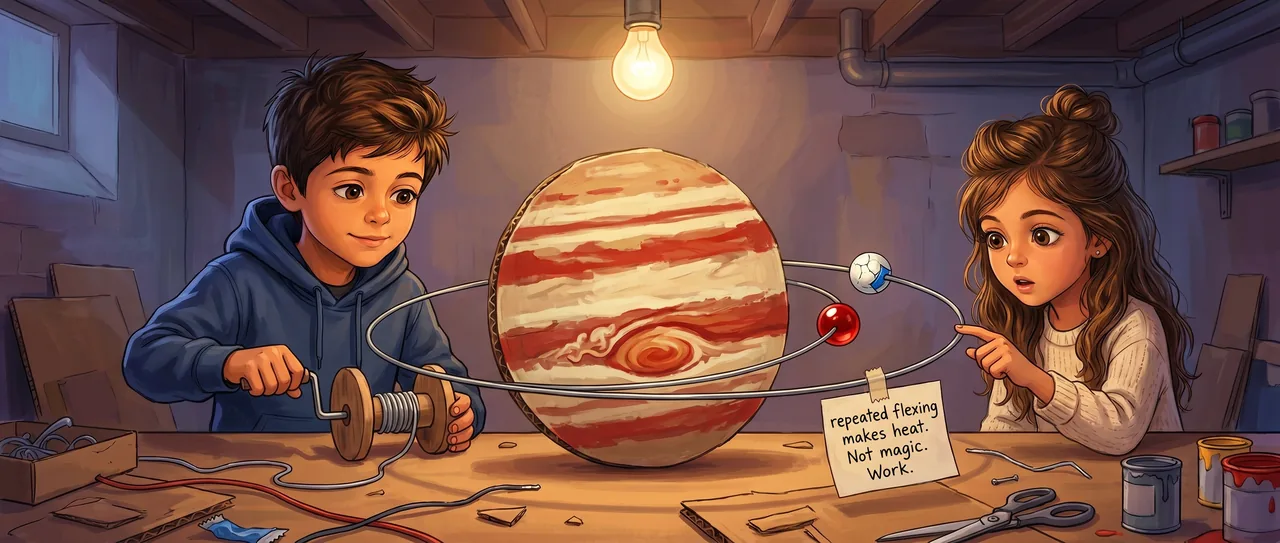
Soren found an old cardboard box and cut a circle from one side for Jupiter. Maya painted it with red and cream stripes, leaving a storm spot bigger than all the moons. For Io, they used a red glass bead from a broken bracelet. For Europa, Maya chose a white bead and cracked its paint with the tip of a pin. Under the cracks she glued a sliver of blue candy wrapper.
"That is not scientifically useful," Soren said.
"It is under the ice," Maya said.
"Fine. It is emotionally accurate."
They made tracks from wire. The first track was too round, and Maya would not let it stay. Soren bent it into a slight oval. He made the bend carefully, measuring with a ruler, then not measuring, because the moon did not need his permission to be strange.
The heat demonstration was the hard part. A wire hanger warmed if a person bent it, but a poster could not bend itself.
"We can use our hands," Maya said.
"Then people will think our hands made the heat."
"They will be partly right."
"Too partly."
Soren dug through the box of leftover project pieces. String. Tape. A broken hand crank from a music box. Rubber bands. A wooden spool.
He threaded the wire through the spool so turning the crank flexed the same spot back and forth. Maya taped a tiny paper flag beside it that said, repeated flexing makes heat. Not magic. Work.
Soren frowned at the word work, then kept it. It was the right word even when it looked ordinary.
They tested the crank. The wire squeaked. Soren touched the bend. Cold.
"More," Maya said.
He turned faster. The wire squeaked higher. Maya counted under her breath, not evenly, because Io did not travel alone. After half a minute, Soren stopped and touched the bend.
Warm.
Maya touched it too and smiled with her whole face.
On the cardboard, the red bead of Io ran closest to Jupiter. Europa's white bead followed farther out. Ganymede was a gray button. Callisto was a dark bead at the edge, quiet and distant.
Soren added one last label, then crossed out half of it.
Maya read what remained.
Not all volcanoes need old heat from the beginning, or radioactive elements breaking apart. Some worlds are heated by being pulled.
"Some worlds," she said.
Soren looked at the white bead with its blue hidden flash. "Some oceans too. Maybe."
They did not add an answer after that.
The next morning, when the projects were lined along the classroom wall, there were seven red paper volcanoes, four vinegar volcanoes waiting for permission to foam, one volcano cake, and Jupiter taking up half of Maya and Soren's table.
A boy named Theo leaned over the crank. "Where does it explode?"
"It doesn't," Maya said.
Theo made the face people made when something had failed to become loud.
Soren turned the crank. The wire squeaked. The red bead hurried around Jupiter's painted side. Maya held out her hand, palm up, inviting but not explaining.
Theo touched the bent wire.
His face changed.
Behind him, two more kids leaned in.
Maya set the white Europa bead into its track. Soren turned the crank once. The red bead hurried around Jupiter, the white bead followed, and under the painted ice, a line of blue glass flashed.
Read the interactive version, listen to the narration, and earn a gold star →
A science-verified short story for curious kids · Curiosity Land