The Jar With No Brain
The assignment was called Feed the First Moon Kids, which sounded exciting until Maya read the rules.
No candy. No crumbs. No floating soup. No foods that smelled like old socks in a sealed room.
Soren had written those rules in his paper notebook because the classroom wall had blinked them away too fast. Underneath, he had drawn a tiny astronaut with a frown inside a helmet.
“Everyone is making brain food,” he said.
On the classroom feed, the other teams had already posted their ideas. Memory mousse. Focus noodles. Dream bars with blue spirulina stars.
Maya looked at the clean jar on the kitchen table. It had cabbage, salt, carrot shreds, and a glass weight pressing everything under brine.
“Our food has no brain,” she said.
“It has bacteria,” Soren said.
“That is worse for posters.”
The jar gave a small click. Not a big sound. Just the lid flexing as gas pushed out through the air valve.
Maya smiled. “It is at least awake.”
The school had loaned them a pocket sequencer for the weekend, sealed in a yellow case with two warning stickers and one cheerful sticker that said, Read the tiny world. Maya’s father had signed the permission form while stirring noodles with one hand and answering a kitchen call with the other.
“Do not culture anything from the bathroom,” he had said. “Do not put anything in the dog. Do not make me famous.”
Then he had gone back to the restaurant kitchen downstairs, where pans clanged like cymbals.
Maya and Soren were not culturing anything from the bathroom. Their sample came from the jar, with sterile swabs and gloves and the exact steps Soren had copied twice. The sequencer would not tell them every secret in the jar, but it could read bits of DNA and match them to likely microbes.
They wanted a Moon food that stayed alive until launch, tasted sharp, and helped a crew’s gut stay normal when everything else was strange.
Soren opened the first result file. A colored wheel spun on the tablet. Names appeared in slices. Lactobacillus. Leuconostoc. Weissella.
Maya read them out loud. “They sound like moons already.”
“They are common in vegetable ferments,” Soren said. “That part is not surprising.”
Maya leaned closer. “Then why are your ears doing that?”
“My ears are normal.”
“They went red.”
Soren scrolled down. The tablet showed a section called Possible Metabolic Pathways.
Under it were words that did not belong in a cabbage jar.
Gamma-aminobutyric acid.
Dopamine pathway.
Tryptophan metabolism.
Serotonin related.
Soren went very still.
“That is wrong,” he said.
Maya’s face sharpened. “Wrong how?”
“Neurotransmitters are brain chemicals.”
“Mostly?”
He did not answer. He tapped back, opened the control file, checked the barcode, and compared the sample number to the sticker on the jar. The numbers matched.
“Maybe we contaminated it,” he said.
“With a brain?” Maya asked.
“With us. Fingers. Breath. Something.”
They ran the second swab, the one Soren had insisted on taking in case the first one became weird. The sequencer hummed softly, like a mosquito trying to be polite. While it worked, Maya circled the jar.
The cabbage had changed since morning. The green pieces were becoming the color of sea glass. Tiny bubbles clung to the carrot shreds. The whole jar smelled sour and alive.
Soren flipped through the printed guide from the yellow case. “It says some microbes have genes for making neuroactive compounds.”
Maya kept looking at the jar. “In cabbage.”
“In lots of places, maybe.”
“In us?”
Soren’s finger stopped on the page.
The second result appeared.
The same words returned.
Not exactly the same amounts. Not the same neat colors. But there again, under the names of microbes from a jar of salty vegetables, was the chemical language everyone kept putting on drawings of brains.
Maya sat down hard. The chair squeaked.
“People say stomach feelings like they are fake,” she said.
Soren looked at the jar instead of at her.
Before oral reports, his stomach always turned cold first. Then his hands. Then his mouth forgot how to start. Teachers told him it was just nerves, all in his head, as if his head had sent a memo and the rest of him was overreacting.
He pulled the tablet closer and searched the school library page, not the open web. Their teacher had made a rule after someone’s volcano project cited an article written by a blender.
He found a review with a diagram of the gut. Not a silly pink tube from a health app, but a crowded, folded country with nerves around it and tiny cells tucked into its lining.
Soren read silently. His lips moved.
Maya waited for three seconds, which was a long time for Maya.
“Well?” she asked.
“About ninety percent of the body’s serotonin is made in the gut,” Soren said.
Maya blinked.
“Not the brain?”
“Not the brain. Mostly gut cells make it. Microbes can push those cells to make more, and some microbes make neurotransmitter chemicals themselves. But gut serotonin mostly stays in the body. It helps with things like moving the intestines. It does not just swim up and become a thought.”
Maya took that in with her eyes on the jar. “So the Moon menu is not feeding an astronaut,” Maya said.
Soren looked up.
“It is feeding an astronaut and everybody they bring inside them.”
The sequencer blinked green, as if it approved, though Soren would not have accepted approval from a light.
He opened their project slide. The title still said Brain Brine, because Maya had typed it as a joke.
“No,” he said.
Maya reached across him and deleted it.
For a while they argued without being angry.
Soren wanted the title to say Support for Gut Microbial Diversity in Closed Habitats.
Maya said that sounded like a door no one would open.
Maya wanted The Crew Inside the Crew.
Soren said that sounded like a horror movie, and also possibly correct.
They settled on Passengers.
Then they built the menu the way the science made them build it. Not a magic happiness pickle. Not a cure. Not a promise that cabbage could make a lonely Moon kid cheerful. They wrote that bodies carry microbial communities, and those communities can shift during stress, travel, diet changes, and strange environments. They wrote that fermented vegetables could bring live microbes and fibers that gut microbes use. They wrote that chemical messages did not belong to the brain alone.
Maya drew the habitat as a silver cylinder under black sky. Soren added a long table inside it. At first he drew four astronauts. Then he paused.
“That is too few,” Maya said.
He did not ask what she meant.
He drew pale dots around each person, hundreds of them, then thousands, until the astronauts looked surrounded by soft weather.
At dinner, Maya’s father came upstairs carrying bowls and smelling like garlic.
“How is the Moon cabbage?” he asked.
“It has no brain and makes brain words,” Maya said.
He looked at Soren.
Soren said, “That is not inaccurate.”
Maya’s father stared at the jar, then at the tablet, then at the two of them. “I am too hungry for that sentence.”
He served the noodles and left them alone.
After dinner, the class feed filled with polished videos. A girl in silver gloves held up focus noodles. Two boys made a zero-gravity smoothie pouch puff like a pillow. Someone’s dream bars glittered with edible dust.
Maya and Soren did not record themselves.
They recorded the jar.
Soren set the tablet camera close to the glass. Maya turned off the kitchen light. The small lamp over the sink made the brine glow gold. Bubbles crawled up the cabbage ribs. One broke loose, rose, and vanished at the surface.
Soren spoke from behind the camera.
“This is not the astronaut’s food,” he said. “This is food for the passengers who help the astronaut’s body send messages.”
Maya added, “Some of those messages have names people think only belong in the brain.”
Soren’s voice came in again, quieter. “Most of the body’s serotonin is made in the gut.”
The jar clicked.
Neither of them spoke for a moment.
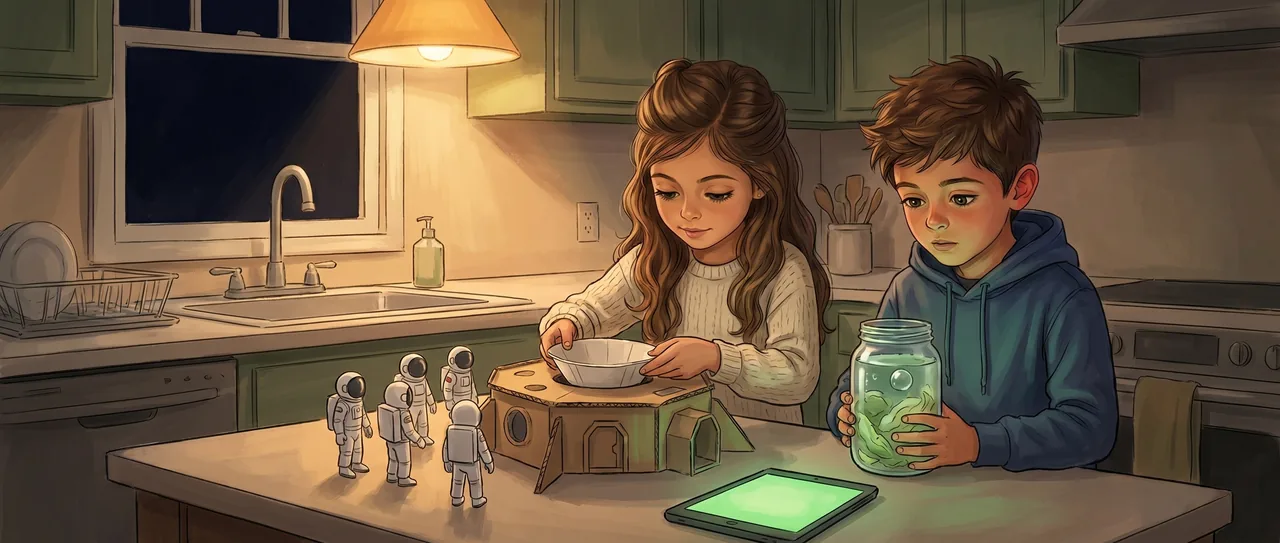
Then Maya picked up the tiny paper Moon habitat they had built from a flour bag. Soren brought the jar with both hands, careful not to slosh the brine. On the cardboard table inside the model, four paper bowls waited beside four paper astronauts.
Maya cut a fifth bowl from the flour bag and set it in the middle of the table.
A bubble rose through the cloudy brine and tapped the glass.
Read the interactive version, listen to the narration, and earn a gold star →
A science-verified short story for curious kids · Curiosity Land