The Empty Drawer
The first time the basement listened to the sky, the companion called it nothing.
On the tablet, the gray line climbed without hurry. It did not jump like footsteps. It did not scribble like the washing machine. It rose, rounded, and sank again, as if something enormous had leaned its elbow on the neighborhood and then taken it away.
The companion made a soft chime.
Unclassified signal. Confidence high. Known categories, low match.
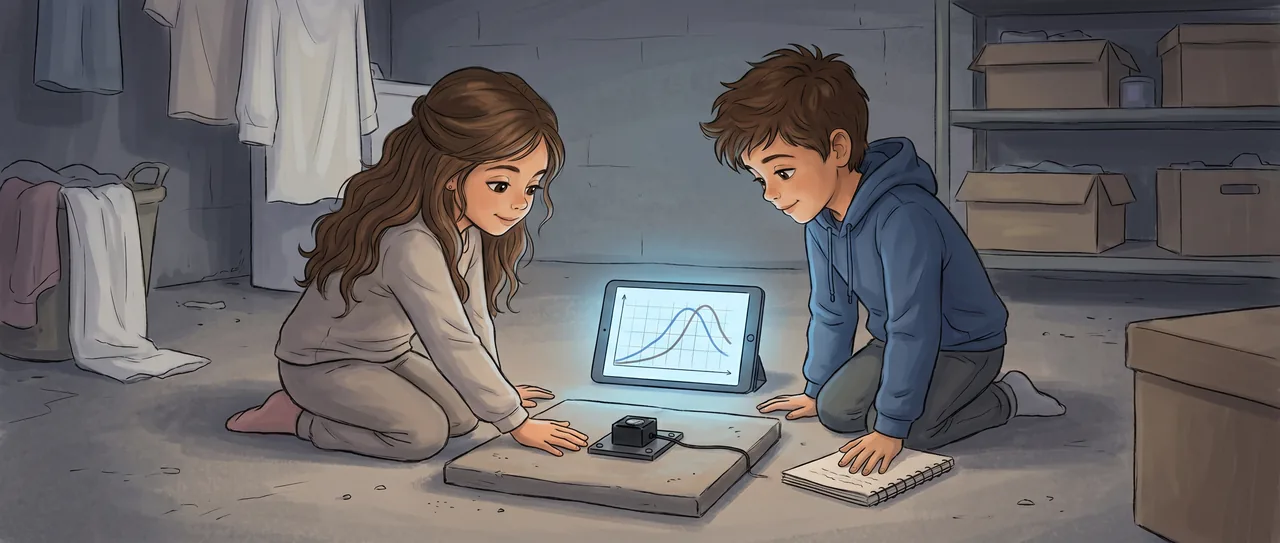
Soren was sitting cross-legged beside the little black seismometer, which was bolted to a square patio stone on the basement floor. Maya lay on her stomach with her chin in her hands, watching the line.
"That was not nothing," she said.
"It says unclassified," Soren said.
"That means its drawers are wrong. Not that the thing is nothing."
The companion listed what the signal was not. Not local foot traffic. Not rail. Not road freight. Not construction. Not quarry blast. Not thunder. Not earthquake. Not household appliance. Not wind shake.
At the bottom, in a smaller line, it added: Repetition detected. Twelve hours.
Soren wrote the time in his notebook because that was what he did when his head got too crowded. Ten fourteen in the morning. He drew the shape, a slow hill with a flat shoulder.
Maya had already stood up.
"What happens again at ten fourteen tonight?"
"Bed," Soren said.
"Not to the ground."
Soren's father came down the stairs with a laundry basket under one arm and a screwdriver in his mouth. He was trying to fix the dehumidifier and wash towels at the same time, which made him look like a person assembled from unfinished errands.
He took the screwdriver out. "If the robot says it doesn't know, ask the network tomorrow. That's what networks are for."
"The network is asleep at ten fourteen," Maya said.
"The network is never asleep," he said. "I am, if nobody needs plumbing."
He carried the towels away and forgot the screwdriver on the freezer.
At ten fourteen that night, Soren's house was quiet enough to hear the refrigerator click off upstairs. Maya had permission to stay because her mother was working late and because Soren's father had said, "Basement science is better than rooftop science. Fewer broken arms."
The line rose again.
Same shoulder. Same slow sinking. Same chime.
Unclassified signal. Repetition confirmed. Twelve hours.
Maya did not say anything for a while. That was unusual enough that Soren looked at her instead of the screen.
She was staring at the floor.
"People are messy," she said.
"Usually."
"Trains are late. Washing machines wait for socks. Thunder doesn't keep appointments."
Soren checked the city rail schedule anyway. No train at ten fourteen. He checked the quarry reports. No blasting at night. He checked the neighborhood construction map. Nothing after five.
Then he asked the companion to show the last two days.
Four hills appeared. Ten fourteen in the morning. Ten fourteen at night. Ten fourteen in the morning. Ten fourteen at night.
"Too tidy," Maya said.
Soren tapped for nearby stations. The monitoring network unfolded across the map, tiny dots in basements, schools, pump houses, libraries, and one bakery that shook every morning at four when the mixers started.
He selected the closest five.
Five gray lines appeared. All of them had the same slow hill.
"Not your basement," Maya said.
Soren selected stations farther away. A farm station outside town had the hill too, smaller but there. A station near the river had it bigger. A station on the hill by the old water tower had it cleanest of all.
The companion chimed again, but softly, as if embarrassed.
Pattern detected across network. Source model unavailable.
Maya smiled with only one side of her mouth. "It has no drawer."
Soren looked at the list of drawers. Earthquake, explosion, machine, vehicle, weather vibration, animal, human activity, structural noise, electrical interference. The companion was very good at things that kicked, cracked, rumbled, rolled, stomped, buzzed, or broke.
This thing did not seem to do any of those.
"What can push a whole city without making noise?" Soren asked.
Maya pointed upward.
They both looked at the basement ceiling.
"The house?" Soren asked.
"Higher."
"Wind? It said not wind shake."
"Higher and everywhere."
Soren opened the weather layer. Temperature made a wobbly line. Humidity wandered around like it was lost. Wind had spikes.
Air pressure made two small, neat humps each day.
Ten fourteen in the morning. Ten fourteen at night.
Maya took the tablet so quickly Soren almost said careful, but didn't. She overlaid pressure and seismic motion. The blue pressure curve and the gray ground curve were not twins. They were more like one person stepping and another person answering through a wall.
"Air," Soren said.
He said it the way he would say a strange mineral's name after cracking a rock open and finding crystals inside.
Maya whispered, "The sky is heavy." But the tablet showed the air pressing the ground in a rhythm. Not wind shoving trees. Not storms. The ordinary clear sky, arriving twice a day with a weight the seismometer could hear.
Soren asked the companion for atmospheric tides.
A paragraph appeared, then a diagram, then a warning that the companion could compare data but not certify a cause without more cycles. The Sun warmed the atmosphere unevenly. Pressure waves circled the planet. In many places, air pressure rose and fell twice a day. Sensitive instruments could record the loading of the ground by changes in air pressure.
"Tides," Maya said. "In the air."
Soren looked back at the empty category. Unclassified.
At school, unclassified was what happened to lunch leftovers nobody wanted to identify, or to papers the teacher slid aside with a sigh, or to Soren's notebook when someone asked why he used paper when every desk had a screen. It usually meant wrong place.
On the tablet, it meant the model had reached the edge of what it had been taught.
Maya tapped the candidate label box. It asked for a proposed tag.
"Atmospheric pressure tide," Soren said.
"Candidate," Maya added.
He nodded. "Candidate. We need more cycles."
Maya typed the words. The companion accepted them, but did not become certain. It placed a new pale drawer beneath all the confident ones.
Candidate label saved. Awaiting confirmation from future data.
The next morning, Soren's father came down for the dehumidifier and found both of them asleep on a pile of old camping pads, the tablet still glowing between them. He squinted at the screen.
"Did you catch your basement ghost?" he asked.
Maya sat up with her hair flattened on one side. "No. The sky did it."
He stared at her.
Soren pointed to the overlaid curves.
His father looked at the tablet, then at the ceiling, then at the screwdriver on the freezer. "I am going to make coffee before I answer that."
He went upstairs.
The companion counted down to the next predicted rise. Ten fourteen. Twelve minutes away.
Maya carried the seismometer's cable so no one would trip. Soren wiped dust from the patio stone with his sleeve. The basement smelled like concrete, laundry soap, and rain that had not fallen.
At ten fourteen, they both knelt beside the little black box. On the screen, the gray line lifted one hair's width. Maya pressed her palm flat to the basement floor.
Read the interactive version, listen to the narration, and earn a gold star →
A science-verified short story for curious kids · Curiosity Land