The Cable That Lost to Itself
By the time the soup began to smell burned, Maya and Soren had already broken the future twice.
The first future used kite string. The little climber went up two steps, made a noise like an angry beetle, and fell backward into Soren’s shoe.
The second future used dental floss. That one worked until Maya’s cat walked through it and carried the whole elevator under the sofa.
The third future was supposed to be serious.
Maya’s mother came through the hall with a wooden spoon in one hand and a phone tucked under her chin.
“Use picture wire,” she said. “Steel. Strongest thing in the junk drawer.”
Then she was gone again, saying into the phone, “No, I said cumin, not cinnamon.”
Maya dug through the drawer and found a coil of silvery wire wound tight as a spring. Soren held it with both hands. It was heavier than it looked.
“Steel,” Maya said. “We win.”
“I don’t like how fast you said that,” Soren said.
“You don’t like any answer until it has suffered.”
“That is not true,” Soren said, and then added, “Mostly.”
They tied the picture wire to the upstairs railing. Their climber was made from a toy car motor, two rubber wheels, a battery pack, and a cardboard box painted with tiny windows. Soren had insisted on windows. Maya had insisted on writing ORBIT OR BUST across the side.
The little box gripped the wire.
Maya clicked the switch.
The motor whined. The wheels spun. The climber shivered in place as if it wanted to go but had remembered something terrible.
“It’s slipping,” Maya said.
Soren touched the wire above the climber. “No. It’s pulling.”
The railing creaked.
Maya clicked the switch off.
They both looked up.
The steel wire did not snap. It had not even tried to snap. It hung down the stairwell, shining and perfectly smug, while the cardboard elevator dangled six inches above the floor.
“Strongest thing in the junk drawer,” Maya said.
Soren crouched beside the climber. “It didn’t lose because it was weak.”
Maya was already unwinding more wire from the coil. “Say that again.”
“It didn’t lose because it was weak,” Soren said. “It lost because it was heavy.”
Maya held the coil in her palm. The wire pressed into her skin. She looked at the stairs, then the railing, then the coil.
“Steel won the short test,” she said. “It lost the tall test.”
Soren opened his notebook on the step. He did not write the ending. He wrote three columns: material, holds weight, is weight.
They tested everything in the drawer.
Cotton thread snapped when Maya hung a mug from it.
Fishing line held the mug and sliced a pale line across Soren’s finger when he pulled too hard.
Yarn stretched so much that the climber looked seasick.
Picture wire held the mug, the wrench, the battery box, and three spoons tied together, but when they ran it from the top landing to the bottom step, the whole stairwell seemed to be holding its breath under the heaviness of it.
Maya lay flat on the floor and looked up the length of the wire.
“If Earth had a string to space,” she said, “it would have to hold the elevator.”
“And itself,” Soren said.
“And all the parts of itself above itself.”
“And all the parts below the parts above itself.”
Maya turned her head toward him. “That was a Soren sentence.”
“It was accurate.”
“It was extremely itself.”
He smiled without looking up.
Their assignment sheet lay on the bottom step. FUTURE TRANSPORTATION, it said. Most people in class were making rockets. One person was making a train that ran through vacuum tubes. Maya and Soren had chosen a space elevator because everybody had laughed when Maya said the word elevator and space in the same breath.
“It is not a tower,” Soren had told the table.
“Then what holds it up?” someone had asked.
Soren had opened his mouth.
Maya had said, “That is the interesting part.”
Now the interesting part was lying on the stairs, coiled and tangled and too heavy to climb.
Soren dug in his backpack and pulled out the article he had printed from the library computer. The top had a picture of Earth with a ribbon rising from the equator. The ribbon went up and up until it reached a dot labeled geostationary orbit, where something could circle Earth once each day and stay over the same place.
Maya had liked that picture immediately. It made Earth look as if it had grown a single black hair.
Soren ran his finger down the page. “Here.”
Maya leaned over his shoulder.
The article said steel was far too heavy for an Earth space elevator cable. Even the strongest ordinary materials would break under their own weight long before reaching the needed distance.
Then came the part Soren had underlined twice.
Carbon nanotube fibers, if made long and flawless enough, could have a theoretical tensile strength about a hundred times that of steel, with far less weight. A space elevator, if humans ever built one, would need a material with that kind of strength to weight ratio. Real carbon nanotube fibers were not there yet. Tiny defects and joins made them weaker than the perfect tubes scientists could imagine and measure in small pieces.
Maya touched the word theoretical.
“That means not in the junk drawer,” she said.
“Not in anybody’s junk drawer,” Soren said.
“What are they, exactly?”
Soren flipped the page. There was a drawing, not much bigger than a postage stamp. It showed a sheet of carbon atoms rolled into a tube. The atoms made hexagons, like a fence built for bees.
Maya stared.
“That’s mostly holes,” she said.
“The wall is one atom thick,” Soren said. “Carbon bonds are strong. The tube is tiny. Really tiny.”
“How tiny?”
“Nanometer tiny.”
Maya held up the picture wire. It flashed in the hall light.
“So the thing that might hold an elevator to space is not a huge cable.”
“Not like this.”
“Not a chain. Not a tower.”
“No.”
Maya looked at the little drawing again. A hollow tube, too small to see, too thin to think about properly, made from the same kind of atom that left gray smears from a pencil and glittered in diamond rings in shop windows. The stairwell changed size without moving.
The railing was still the railing. The soup still smelled scorched. The cat still had dental floss caught on one ear under the sofa. But between Maya’s hand and the top landing there was suddenly room for a ribbon reaching far past airplanes, past weather, past the place where the sky stopped being blue, all because the question was not only what is strong.
Soren took the steel wire down. It landed in a heap with a hard little clatter.
“We cannot build it,” he said.
“We can build the problem,” Maya said.
They worked until the soup was rescued into a different pot and Maya’s mother stopped saying cumin with such sadness.
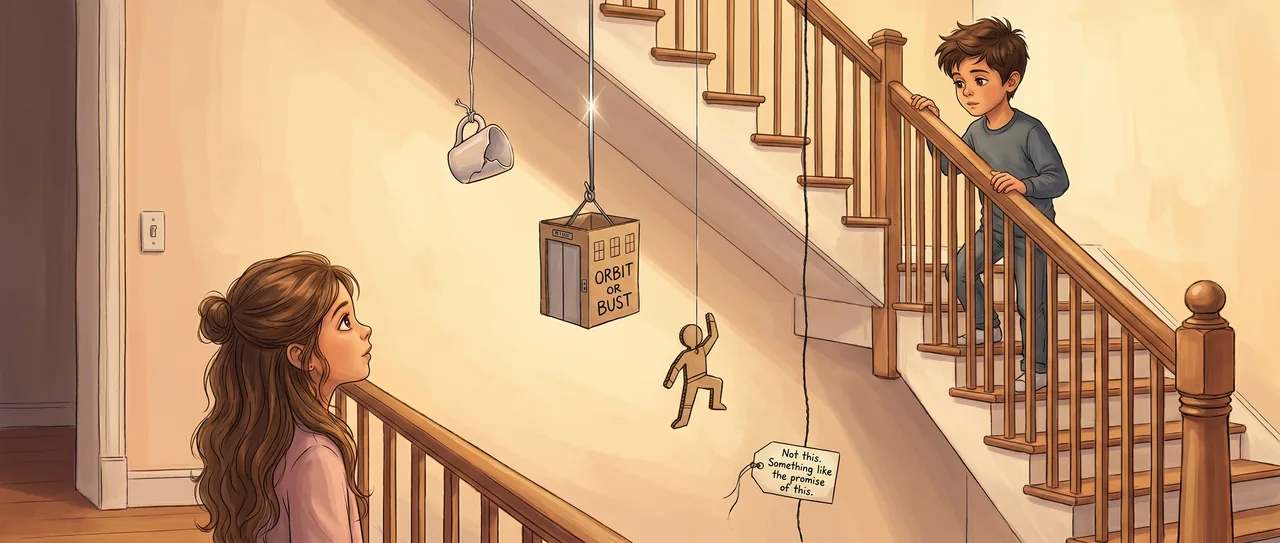
They hung three tethers from the railing.
The cotton thread had a broken mug handle tied to the end.
The picture wire had the toy elevator stalled halfway up, its motor silent.
The fishing line held the cardboard elevator, but the label beside it said not long enough for Earth.
For the fourth tether, Maya took the black thread from her mother’s sewing basket. It was not carbon nanotube fiber. It was ordinary thread, fuzzy when the light hit it, weak enough that Maya could snap it with her fingers.
Soren made a label anyway.
Not this.
Something like the promise of this.
Maya read it and did not make him change it.
“That is not a material,” she said.
“No,” Soren said. “It is a missing material shaped like a line.”
They tied the black thread to the railing. It weighed almost nothing. It moved when they breathed.
Maya set the cardboard climber at the bottom, but did not switch it on.
“How long would the real one be?” she asked.
“Past geostationary orbit,” Soren said.
“That is not an answer.”
“It is the start of one.”
Maya stood on the bottom step. Soren stood three flights above, one hand over the rail. Between them, the black thread hung straight and still, too thin to cast a shadow.
Read the interactive version, listen to the narration, and earn a gold star →
A science-verified short story for curious kids · Curiosity Land