The Button for Absence
Maya decided the rainforest computer was wrong before dinner.
The archive had given her a square of sound from March, recorded by a small black microphone tied to a tree somewhere under leaves so wide they could hold bowls of rain. The class assignment was simple. Listen to the forest. Mark three animals. Say what made each sound different.
Maya did not like simple assignments. Simple assignments usually had lids on them.
The companion on the screen had already marked insects, night birds, and distant howler monkeys. It had also made one pale square in the corner.
Túngara frog not detected.
Maya put her chin in her hands and listened harder.
The kitchen window rattled with rain. Her mother was stacking clean containers by size and muttering about a missing lid for the soup pot. On the recording, rain hissed on leaves. Something clicked. Something chirred. Something made a wet gulping sound that might have been mud, or throat, or the forest turning over in its sleep.
“It is obviously there,” Maya said.
“What is?” her mother asked.
“The frog.”
“If it is homework, choose a louder frog.”
“It is not homework anymore.”
Her mother looked at the clock, then at the containers. “That sounds dangerous for dinner.”
Maya slid the headphones tighter over her ears.
The companion showed a little picture of the túngara frog’s call. Not the frog. The call. A long whine, then one or more short chucks, stacked on the screen like a tiny thrown rope with knots at the end. The training clips from February had them everywhere. Whine-chuck. Whine-chuck-chuck. Whine, chuck. The companion painted each one green.
March was green with other things. Crickets made combs. Rain made curtains. A bird gave one lonely note, again and again, as if testing a doorbell. But the frog’s little rope was missing.
Maya did not believe missing.
She opened another March file from the same recorder. The companion worked for a moment, its blue circle turning and turning.
Túngara frog not detected.
She opened one from the next night.
Not detected.
“Maybe the computer only likes February,” she said.
The companion did not answer jokes. It only waited, which Maya found rude and useful.
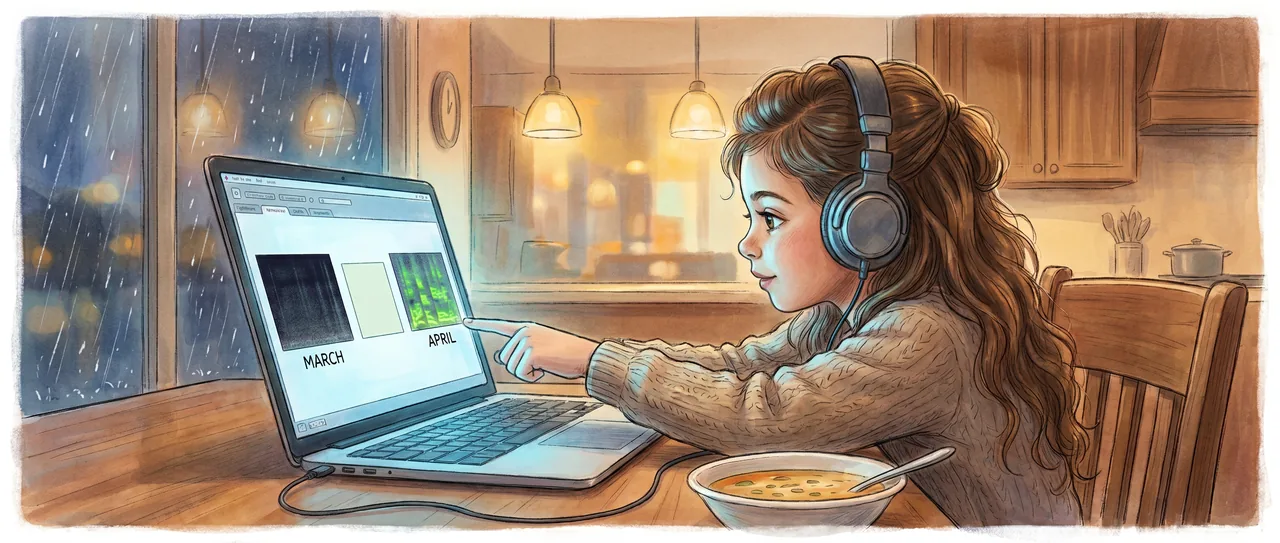
She clicked April.
Whine-chuck.
The green marks came back.
Maya sat up so fast the headphones pulled against the cord.
March had rain. April had rain. March had insects. April had insects. March had the same recorder name, the same tree number, the same dusk hour. The frog had not vanished forever. It had stepped out of the sound and stepped back in.
Her mother came past with a towel over one shoulder. She looked at the screen without slowing down. “Did you finish?”
“No.”
“Did you find three animals?”
“I found almost one.”
Her mother opened her mouth, closed it, and decided the soup lids were easier.
Maya opened the map.
The rainforest appeared as dots. Each dot was a recorder, one of hundreds. The lesson had said there were arrays like this in forests around the world, recording day and night until they held millions of hours. Too much for people to listen to. People had to sleep and eat and lose soup lids. The companion did not sleep. It had been trained on known calls, and it could search for them the way a nose searched for smoke.
Maya dragged the date bar across March.
The dot for her recorder stayed pale for túngara frog.
She clicked the nearest dot.
Pale.
The next dot, farther downhill by the stream.
Pale.
The dot across the ridge.
Green.
Maya stopped moving.
On the recording from across the ridge, the frog called through light rain as if nothing strange had happened. On her side, the forest was loud, busy, dripping, clicking, alive, and missing one small voice.
She turned the volume down. The spectrogram kept moving. Sound became colored bars and streaks, a bright little weather system made of throats and wings and water. The whole forest was not one noise. It was rooms inside rooms. Some rooms had the frog. Some did not. Some had lost it only for March.
Maya pressed her palm on the table.
For a moment the kitchen felt too flat. The refrigerator hummed. A spoon clinked in the sink. Outside, city rain ran down a pane of glass. But under another rain, far away, black boxes were listening from trees, keeping the hours humans could not hold. They were not just catching what called. They were catching the shape left when something stopped.
Maya clicked the pale square again.
A menu opened.
Confirm absence?
She stared at the words.
Most school websites had buttons for answers, quizzes, and next lesson. This one had a button for a thing that was not there. Somebody had made space for missing.
Maya did not click it yet. Rain level high but not broken. The companion had detected insects in the same frequency range. It had detected other frogs, too, little peeps and trills that belonged to names Maya had never heard before.
“So not deaf,” she said.
The companion showed no sign of pride.
She tried to trick it. She played the February frog call through the March search. The green marker appeared exactly where the call should be. She lowered the volume. The marker appeared later, then stopped when the call disappeared under rain. The companion was not magic. It missed things when sound buried them. It found things when the pattern was clear.
Maya went back to March.
No green ropes.
Her mother leaned over her shoulder at last. There was flour on one sleeve. “You are still on frogs.”
“This side of the ridge stopped calling in March.”
“Maybe they went visiting.”
“They are frogs.”
“Frogs may have private lives.”
Maya smiled, but only halfway. “They came back in April.”
Her mother looked at the pale dots, then at the green dot across the ridge. “Can you ask someone?”
Maya glanced at the report form. It had boxes for confidence, recorder condition, nearby detections, and question for review. Not answer. Question.
The cursor blinked in the empty space.
Why did túngara frogs stop calling on this side of the ridge in March but not April?
The sentence looked too small for the amount of forest around it.
Maya added the dates. She added the recorder names. She added that insects and other frogs were still detected, and that the ridge recorder still had túngara calls. She did not write maybe disease, maybe dry pools, maybe a predator, maybe people, maybe something no one had named yet. Those belonged on the other side of the question.
Her mother set a bowl of soup near Maya’s elbow and did not tell her to stop.
The rain on the kitchen window softened. In the headphones, April began calling again.
Whine-chuck.
Whine-chuck-chuck.
Maya put the March square on the left and the April square on the right. She circled the pale space between them with her fingertip on the glass. Then she pressed send.
Read the interactive version, listen to the narration, and earn a gold star →
A science-verified short story for curious kids · Curiosity Land