The Blank Square
The compound looked like a dare.
Soren read the name from the library screen in pieces, because that was the only way his mouth would accept it.
“Yttrium lithium bismuth hydrogen sulfide,” he said.
Maya leaned over his shoulder. “That is not a material. That is a drawer someone shook.”
The AI companion had ranked it seventh.
Not seventh in their class list. Seventh in the whole city queue for possible higher-temperature superconductors, above neat little copper oxides and tidy iron compounds and a silvery hydride with a name that sounded like it already owned a lab coat.
On the wall screen, thousands of predicted materials drifted in colored dots. Most were gray now. Gray meant no crystal formed, or the atoms slid into a different shape, or the predicted superconducting temperature sank into ordinary cold, the kind that needed liquid helium and patience.
Ms. Arroyo, the librarian, was standing on a chair with a blue bucket under one arm. Rain had found the ceiling again.
“Pick a sensible one,” she said, without looking down. “Sensible things make better posters.”
“We are not making a poster,” Maya said.
“You are making something with glue sticks in my library,” Ms. Arroyo said. “That is a poster in its heart.”
Soren had his notebook open, but the page was mostly columns of crossed-out names. Their class had been given one request to send to the public materials queue, one tiny slice of time on the city’s remote instruments. The AI could suggest. The students had to choose what to ask for.
Everyone else had chosen compounds that sounded possible.
Maya tapped the seventh dot. It flashed green, then opened a card full of predicted structures, pressure ranges, uncertainty bars, and a neat label at the bottom.
Confidence, low.
“Low,” Soren said.
“Ranked seventh,” Maya said.
“Low.”
“Seventh.”
“That is the argument?”
“That is the problem.”
Soren wrote the compound name carefully. It took almost a whole line.
The AI companion pulsed in the corner of the screen. Its name was Henna, and it used a little orange hexagon for a face because someone in the city office thought children liked faces on things. Soren mostly liked that it answered the actual question you asked, even if the answer was embarrassing.
He typed: Why is this ranked seventh if confidence is low?
Henna answered in calm blocks of text.
Predicted high ranking is due to possible strong electron phonon coupling in a hydrogen rich lattice under pressure. Confidence is low because key vibrational data are missing.
Maya read it once. “It likes the hydrogen.”
“A lot of the hydrides are high,” Soren said. “Under pressure.”
“Pressure like deep inside a planet?”
“Pressure like diamond anvils squeezing a speck until it thinks it is inside a planet.”
Maya smiled at that, then pointed at the screen. “Ask it what’s missing.”
Soren typed: What key vibrational data?
Henna paused longer this time.
No measured phonon spectrum found for the predicted pressure-stabilized phase. Model used related compounds as substitutes. Largest uncertainty comes from hydrogen vibration modes near the bismuth layers.
Ms. Arroyo climbed down from the chair. The bucket had caught exactly one drop, which seemed to offend her.
“Is it telling you to make the ridiculous one?” she asked.
“No,” Soren said.
“Yes,” Maya said.
They looked at each other.
Maya backed up. “Not make. Ask.”
Soren’s pencil stopped above the notebook.
On the wall screen, the card showed a tiny drawing of atoms in a cell, heavy bismuth sitting like dark marbles, hydrogen in pale clusters around it, sulfur off to one side, lithium tucked into gaps. It looked crowded and unlikely and still, somehow, arranged.
Soren clicked the explanation map.
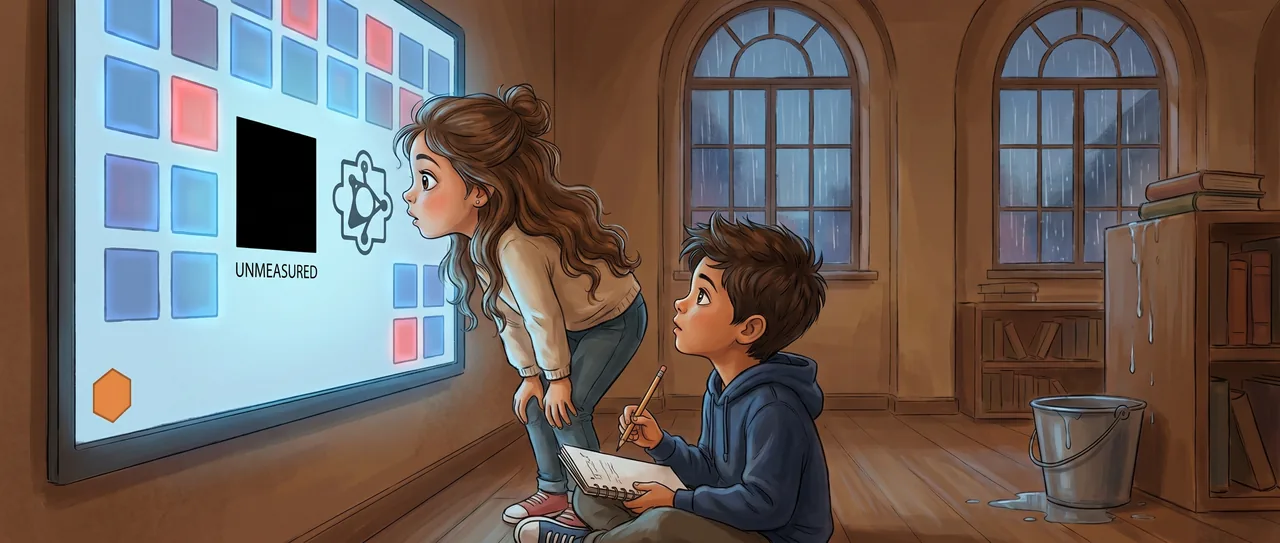
The dots vanished. In their place came a grid of properties. Some squares glowed blue. Some glowed red. Some were plain white, which meant measured and boring. One square beside the strange compound was black.
Not dark blue. Not red.
Black.
Maya moved closer until her nose almost touched the screen.
“What does black mean?” she asked.
Soren already knew where to look. He checked the key.
Unmeasured.
There were only a few black squares in the top fifty candidates. The sensible compounds had rows of tidy white boxes, numbers pressed flat by many experiments. The ridiculous compound had one blank place exactly where Henna had put its finger.
Hydrogen vibration spectrum under pressure.
Maya whispered, “It didn’t find an answer.”
Soren said, “It found a hole shaped like an answer.”
The rain tapped harder at the windows.
Maya dragged three rejected candidates beside it. Henna redrew the map. Their squares were full, but their predictions were gray for reasons already known. Not enough hydrogen. Unstable structure. Weak coupling.
She dragged in the top-ranked candidate. Its map shone almost completely measured. The AI liked it because many numbers agreed with other numbers.
Then she dragged the ridiculous one back.
The black square stayed black.
Soren asked Henna, “If that square is measured and the hydrogen modes are not soft, what happens to the rank?”
Henna answered: Likely falls below one thousand.
Maya nodded. “And if they are soft?”
Soren typed it.
If measured hydrogen modes are strongly coupled to electrons and structure remains stable, predicted transition temperature could rise. Uncertainty remains high.
Maya made a small sound. Not a word. The kind of sound a door hinge might make if it were excited.
Ms. Arroyo came over with a towel on her shoulder. “Please tell me you have not chosen the one that sounds like soup.”
“We haven’t chosen a superconductor,” Soren said.
Maya said, “We chose a measurement.”
Ms. Arroyo looked at the screen. “That seems smaller.”
“No,” Maya said.
Soren turned the request form toward himself. It had boxes for compound, reason, predicted use, and requested first test. He skipped predicted use. Everyone loved that box. Maglev trains. Lossless power lines. Tiny hospital magnets that did not need giant cooling machines. The future was easy to decorate.
The first test box was harder.
He typed: Measure phonon spectrum.
Maya shook her head. “Too broad.”
He erased it.
She walked to the shelves where the old science books lived, the ones with cracked plastic jackets and bright drawings of atoms from before either of them was born. She pulled down a book on superconductivity, not because it would contain yttrium lithium bismuth hydrogen sulfide, but because old books were good at making new machines sound less magical.
She flipped to the index. “Phonon.”
Soren joined her on the floor.
The book described atoms vibrating through a crystal, not like loose beads, but like a whole crowd passing a shiver from one person to the next. In some superconductors, those shivers helped electrons pair up and move without resistance. The page had a picture of a magnet floating over a cold black disk.
Maya traced the floating magnet with one finger.
“My cousin said superconductors are just cold tricks,” she said.
“They are cold tricks,” Soren said. “Good ones.”
“But this is not asking if the magnet floats.”
“No.”
“It is asking how the atoms shiver.”
Soren went very still.
The library around them did not change. The bucket still waited under the leak. Ms. Arroyo still muttered at the copier. The old book still smelled like dust and plastic. Soren stood up so fast his sneaker squeaked.
He typed: Requested first test, measure hydrogen vibration modes of the predicted pressure-stabilized phase, using Raman or neutron data if sample amount permits.
Henna highlighted neutron data and added a note.
Neutron measurement may be difficult for hydrogen rich samples at high pressure. Raman spectroscopy more likely as first measurement.
“Fine,” Maya said. “It gets to correct us.”
Soren changed the line.
Ms. Arroyo looked over again. “Are you two almost done? The library closed twelve minutes ago.”
“Almost,” Soren said.
Maya did not say anything. She was looking at the class list in the corner of the screen. Beside each team name was a chosen candidate. The first six had shining confidence bars. Their dots sat in well-lit neighborhoods on the map.
Their dot sat at the edge, pressed against a black square.
Soren filled in the reason box.
Candidate ranked highly because model predicts strong electron phonon coupling, but ranking depends on unmeasured hydrogen vibration modes under pressure. Measuring this property will test whether the prediction is meaningful.
He did not write that the compound was sensible. It was not.
He did not write that it would work. It might fall below one thousand before breakfast.
Maya read the reason twice. Then she took the pencil from his notebook and drew, in the margin of his open page, one small black square.
On Soren’s screen, the request form made a new line: Property to measure first, hydrogen vibration modes under pressure.
The rain clicked against the high library windows.
Maya reached past him and pressed send.
Read the interactive version, listen to the narration, and earn a gold star →
A science-verified short story for curious kids · Curiosity Land