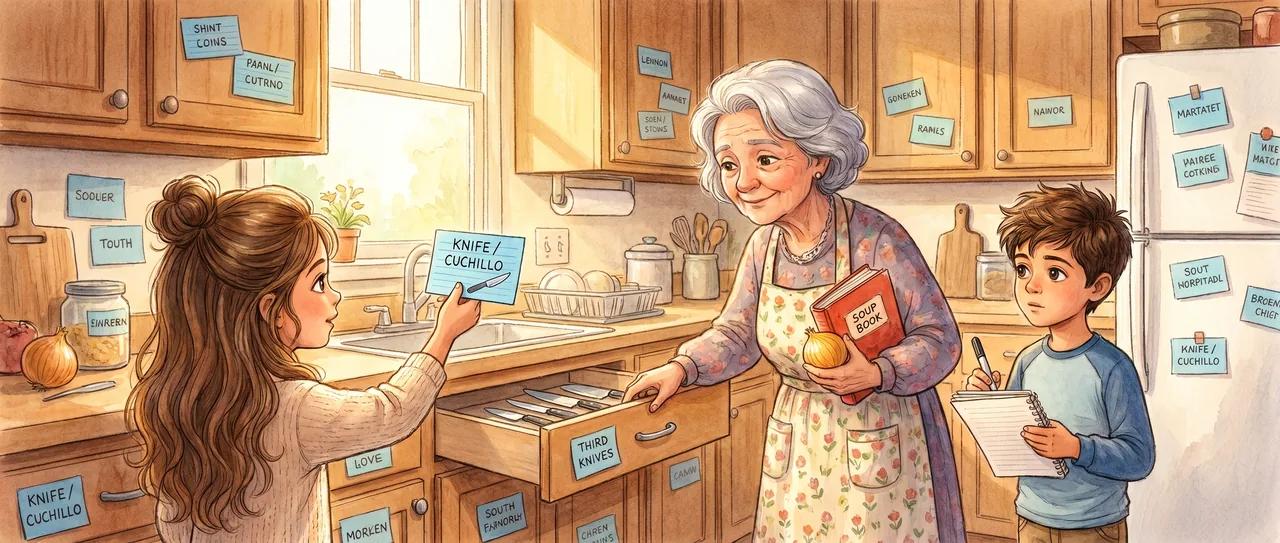
More Than One Door
The first label said CUP.
Maya stuck it to the cabinet with a strip of blue tape, stepped back, and frowned.
“Wrong,” she said.
Soren looked up from the stack of index cards. “The spelling is right.”
“I know the spelling is right.”
Maya peeled the label off again. It left a tiny paper scar on the cabinet door.
From the living room came the soft sound of Maya’s grandmother humming. Not a whole song. A path through a song. She sang three notes, stopped, found another piece, and went on in Spanish.
Maya’s mother was at the kitchen table with a laptop, a phone, a bowl of cold soup, and the expression she got when there were too many windows open in her head.
“Labels in English will be easiest,” she said, without looking up. “Her doctor said make things simple.”
Maya held the label by one corner. “Simple for who?”
Her mother did look up then. Her face softened, but only halfway. “For her. For all of us. I have a call in seven minutes. Please just help.”
Soren wrote CUP on another card because he liked having a clean backup. He had brought his paper notebook, which made Maya’s mother smile in the careful way adults smiled at unusual pets.
Maya watched her grandmother through the kitchen doorway.
Grandmother stood in front of the bookshelf, touching the spines with two fingers. “Where is the little book,” she called. “El de las sopas. The soup one.”
Maya’s mother closed her eyes for one second.
“I’ll get it,” Maya said.
She knew the book. Red cover. Bent corner. Recipes written in two languages and in handwriting that leaned uphill. It was not on the shelf. It was under the fruit bowl, because Grandmother had been reading it at breakfast and using it to flatten a receipt.
Maya brought it to her.
Grandmother took the book and tapped Maya’s wrist. “You see? You find the missing things because your eyes are nosy.”
“They are normal eyes,” Maya said.
“No,” Grandmother said. “Nosy.”
Soren, who had followed with the card in his hand, said, “What does she call the cup?”
Maya blinked. “What?”
“The cup. If we’re labeling things for her, what word does she reach for first?”
“Cup,” Maya said. Then she heard the answer before it arrived. “No. Taza.”
From the table, Maya’s mother said, “The doctor said consistency matters.”
Soren did not argue. He turned the clean card over and wrote TAZA beneath CUP, careful and square.
Maya took it from him, tore off another strip of blue tape, and stuck it to the cabinet.
Her grandmother came into the kitchen with the soup book clutched to her chest.
She looked at the cabinet.
Her mouth moved once around no sound. Then she smiled.
“Taza,” she said, and opened the right door.
Maya’s mother missed it because her meeting began. Her face filled the laptop square, bright and busy. “Yes, I’m here,” she said. “Sorry. Family thing.”
Maya and Soren kept working.
PLATE. PLATO.
SPOON. CUCHARA.
WINDOW. VENTANA.
The kitchen changed by inches. Blue cards appeared on drawers, doors, the jar of rice, the box of tea. Maya moved faster than Soren could write.
“Slow down,” he said.
“No.”
“You’re making me miss accents.”
She stopped. “Fine. Accents matter.”
“They change the sound.”
“They change the word.”
“They change the map,” Soren said.
Maya looked at him.
He looked surprised to have said it. Then he opened his notebook, not at the end, where people expected new things to go, but in the middle, where he kept things that were not finished yet.
“My dad sent me an article,” he said. “Because of your grandmother. I didn’t know if I should show you.”
Maya’s hands went still.
“It’s not bad,” Soren said quickly. “Or it is about a bad thing, but not in a bad way.”
“That is not clear.”
“I know.”
He pulled a folded printout from the notebook. It had a picture of a brain on it, sliced into colored weather. Maya disliked brain pictures at first because they looked like secrets taken from someone who had not agreed. But this one had arrows pointing to parts with long names.
Soren said, “It says people who use two languages a lot can have denser gray matter in some language and control parts of the brain.”
“Denser like heavier?”
“More tissue in those regions. Or thicker in some studies. Not magic. Not always the same for every person.”
Maya took the page. The words were small and adultish. She found the sentence Soren had underlined.
Bilingual patients showed symptoms of Alzheimer’s disease four to five years later, on average, than monolingual patients with similar disease changes.
Maya read it again.
In the living room, Grandmother had begun humming the soup song, the one that was not really a song but became one when she could not remember the next instruction.
Maya whispered, “Later?”
“On average,” Soren said. “It doesn’t stop the disease. It’s more like the brain has extra ways to keep working when some roads get damaged. Cognitive reserve.”
Maya did not like the word damaged. She liked roads.
She looked at the kitchen.
The cabinets had two names now. The drawers had two handles of sound. The labels did not make the room simpler. They made it less easy to get trapped.
Grandmother came back carrying an onion.
“Knife?” she asked.
Maya’s mother, still in her meeting, pointed vaguely toward the sink without looking.
Grandmother opened the wrong drawer. Then the drawer with towels. Then she stood still, onion in one hand, the soup book in the other.
Maya did not move toward her.
Soren did not move either.
Maya took a blank card and wrote KNIFE. Under it, she wrote CUCHILLO. She drew a small careful blade beside the words, not sharp-looking, just enough.
She held it up across the kitchen.
Grandmother squinted.
“Cuchillo,” she said.
Her hand went to the third drawer.
The drawer opened.
The knives lay inside, silver and ordinary and found.
Maya’s mother’s voice stumbled in the laptop meeting. She had seen that one.
“Sorry,” she said to the screen. “One moment.”
She muted herself.
For a second no one spoke.
Then Grandmother said, “Why are you all looking at the drawer like it performed opera?”
Soren laughed first. Maya tried not to, then did.
Her mother laughed too, but her eyes were wet, which made Maya look away fast because some adult weather was private.
They made more labels after that.
Not just nouns. Places.
BATHROOM. BAÑO.
BEDROOM. CUARTO.
BALCONY. BALCÓN.
Grandmother corrected their spelling twice and their tape placement six times. She said labels should sit where the eyes arrive, not where children think eyes ought to arrive. Soren tested this by walking from the hallway with his eyes half closed, opening them suddenly, and reporting what he saw first.
“The lamp,” he said.
“The shadow,” Maya said at the same time.
“The card is too low,” Grandmother said.
They moved it higher.
At four thirty, Maya’s mother ordered them to eat oranges. She was not crying anymore. She was pretending very hard that she had not been crying, which fooled nobody and saved everyone from discussing it.
Maya peeled her orange in one long strip. Grandmother called it a snake. Soren tried to peel his the same way and produced five sad continents.
Maya kept looking at the article.
Four to five years.
Not a cure. Not a shield. Not a promise you could hold someone to.
Still.
All those mornings when Grandmother had said, “Pass me la spoon,” and Maya’s cousins had giggled. All those times Maya had answered teachers in the wrong language first and had to drag the sentence across into English while everyone waited. All that switching, back and forth, back and forth, like stepping between stones in a river.
Grandmother took a piece of orange and said, “Your face is doing algebra.”
Maya said, “Did you know your brain was making extra roads?”
Grandmother chewed thoughtfully. “My brain did not send me a report.”
Soren said, “It might be one reason you’re good at going around a missing word.”
Grandmother pointed at him with the orange slice. “Missing words are rude. You go around rude things.”
Maya laughed, but softly.
Then Grandmother leaned toward the labels.
“Too few,” she said.
“We labeled almost everything,” Soren said.
Grandmother shook her head. “Only the apartment. What about the people?”
Maya did not understand until Grandmother reached for a card.
On one side she wrote MAYA.
On the other side, below it, she wrote mi linterna.
“My flashlight,” Maya translated for Soren.
Grandmother taped the card to Maya’s sweater before Maya could object.
Then she wrote SOREN on another card. She paused, considering him.
“El que comprueba,” she said.
Maya grinned. “The one who checks.”
Soren accepted the card as if it were an official document.
Maya’s mother said, “Mamá, don’t tape things to children.”
Grandmother said, “They are labeled gently.”
The apartment doorbell rang.
No one moved at first.
Then Maya’s mother remembered the grocery delivery and hurried to the door, apologizing to the delivery person, to the laptop, and to the oranges.
A cold wind slipped into the apartment. The blue cards fluttered. CUP, TAZA lifted at one edge. KNIFE, CUCHILLO tapped softly against the drawer. WINDOW, VENTANA trembled beside the glass.
Grandmother looked at the moving labels and then at the blank cards left on the table.
“Tomorrow,” she said, “we label the songs.”
Maya picked up a clean blue card.
Soren uncapped the marker.
Grandmother hummed three notes, stopped, and tapped the table for the next one.
Read the interactive version, listen to the narration, and earn a gold star →
A science-verified short story for curious kids · Curiosity Land