The White Place With No Roads
The knee arrived in a silver box with a blue sticker that said, Do not stack.
It was not the whole knee. Maya knew that. It was only the practice kit, because the real patch, the living one grown from her mother’s cells, was already at the clinic in a warmer box with people watching it.
Still, when her mother set the silver box on the kitchen table, Maya stepped back.
“That is not how knees should arrive,” she said.
Her mother laughed once, the tired kind. She had one hand on the counter and one hand on her right leg, just above the swollen joint. “Tell my knee that.”
The clinic video was supposed to explain everything. It froze after the first sentence.
“Articular cartilage is the smooth white tissue that covers the ends of bones in joints,” said the woman on the tablet.
Then her face stopped with her mouth open.
Maya tapped the screen. Nothing.
Her mother looked at the clock. “We’ll ask tomorrow.”
“You always say that when tomorrow is too full.”
“I say it when today is full.” Her mother smiled without looking up. She was sorting forms into piles. Surgery forms, insurance forms, permission forms, instructions with tiny boxes to check. “Don’t open anything sealed. The white gel crescent is only a model. You can use the blue dye packet if you want. Don’t spill it on the grout.”
Maya opened the box.
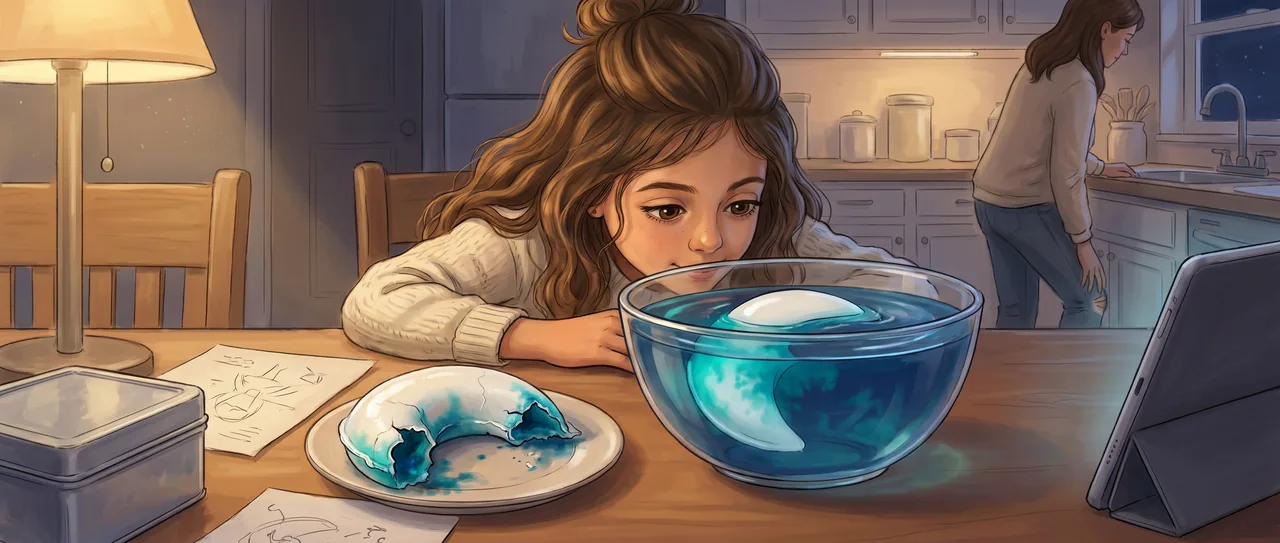
Inside was a clear bowl, a packet of bright blue liquid, plastic tweezers, and a crescent of white gel shaped like the moon when the moon has been bitten. It shone wetly under the kitchen light.
There was also a card.
Cartilage has no blood vessels, it said.
Maya read it twice.
“That’s wrong,” she said.
Her mother was hunting for a pen. “What’s wrong?”
“Bodies feed things with blood.”
“Mostly.”
“Mostly is not an answer.”
“Tonight, mostly is the only answer I have.” Her mother found the pen behind the fruit bowl. “The doctor said my old skating fall made a bad place in the cartilage. I was eleven. I thought it healed. It did not, apparently.”
Maya looked at her mother’s knee. She looked at her own knees, both scratched from the alley wall she was not supposed to climb.
“When you were eleven?”
“Yes.”
“That was forever ago.”
“Thank you.”
“No. I mean, how can a fall wait that long?”
Her mother signed another paper. “Ask tomorrow, Maya.”
Maya hated tomorrow answers. Tomorrow answers turned into after school answers, and after school answers turned into the kind of answer adults gave while walking into another room.
She took the gel crescent out with the tweezers. It sagged a little. There were no red lines inside it. No branching, no threads, no tiny roads.
At school, in every body poster, blood vessels were red and blue trees. Hearts had arrows. Lungs had tunnels. Muscles had ropes. Everything important had a map.
The white crescent had nothing.
Maya got a red marker from the junk drawer and drew a branching line across the gel.
The ink sat on top in beads.
“Hah,” she said, though she was not sure who she was arguing with.
She pressed harder. The marker tip dented the gel. A red puddle smeared across the surface, then slid off onto the plate.
Not roads, then.
She found a drinking straw and poked it through one end of the gel crescent. A perfect round tunnel opened. If cartilage needed blood, it should have tunnels. Maybe the body had made a design mistake, which seemed unlikely but not impossible. Bodies had wisdom teeth. Bodies hiccupped.
Maya mixed the blue dye packet with water in the clear bowl. It turned the water the color of deep swimming pools.
She lowered the punctured gel into it.
Blue rushed through the straw hole and bloomed inside the tunnel.
“There,” she said.
But the gel split from the hole to the edge. The crescent opened like a cracked seed.
Maya froze.
Her mother looked up. “Did something break?”
“Only the fake part.”
“Good. Please don’t improve the real part.”
Maya pushed the broken crescent gently with one finger. The torn edges were blue. The center was still white.
She took the second crescent from the box. Unbroken. Smooth. Roadless.
The card had more words on the back.
In joints, cartilage is nourished by diffusion from surrounding fluid. Gentle movement helps fresh fluid reach the cells.
Maya read the sentence under her breath.
Diffusion was a word from the day their classroom smelled like peppermint because one person opened one candy at the back and, after a while, everyone accused everyone else of having candy.
No arrows. No pipes. Just spreading.
Maya poured clean blue water into the bowl and set the new white crescent in it.
Nothing happened.
She waited.
A thin blue edge appeared.
She leaned closer.
The blue did not rush. It crept. It entered without a door. The white gel accepted it by being next to it.
Maya’s kitchen made its ordinary sounds. The refrigerator clicked. Her mother’s pen scratched. A bus sighed at the corner. Blue moved into white so slowly that looking away felt dangerous.
At school, people said things like, “Just join a group,” as if groups had doors with signs on them. Maya was usually near the edge of things. Near the game, near the joke, near the table where everyone knew when to laugh. She had thought near was the same as not in.
The gel’s edge deepened to turquoise.
The middle stayed pale.
Maya pressed the crescent lightly with the back of the spoon. Blue water squeezed away from it. When she let go, the gel swelled back, and blue slid in along its surface.
She pressed again. Let go.
Press. Let go.
The blue reached farther.
She pulled out the cracked crescent and set both pieces beside the whole one. The one with the tunnel was damaged and blue in the wrong place. The whole one was slow, but the color was entering everywhere at once, from the outside in.
Her mother’s old fall had not waited like a monster under the bed. It had stayed in a place with no roads for repair trucks, no red river to bring a scab, no quick crew to rebuild the smooth white sliding place. Every step for years had pressed fluid through what was left.
Maya touched the side of her own knee. Skin healed pink and brown and itchy. Cartilage was underneath, quiet and pale, living by being bathed.
The tablet unfroze suddenly.
“Because cartilage lacks its own blood supply,” said the woman in the video, “injuries may heal very slowly or not completely. Damage in young joints can contribute to osteoarthritis later in life.”
“I got there first,” Maya said.
Her mother looked up, then at the bowl. “You got where first?”
Maya did not answer right away. She was watching the color.
“If it has no blood,” Maya said, “then the new patch can’t be too thick.”
Her mother put down the pen.
“And it can’t just sit there,” Maya said. “It needs the fluid around it to keep changing. Not fast. Like breathing, but for a joint.”
Her mother came to the table slowly, favoring her right leg. “The machine after surgery bends my knee a little at a time.”
Maya nodded. “It is not exercising you. It is feeding the white part.”
Her mother looked at the blue bowl for a long time. “I was going to skip that machine if it hurt.”
“Don’t skip it,” Maya said.
“I’ll complain while using it.”
“That is allowed.”
Her mother smiled, but her eyes stayed on the crescent. “When I was eleven, I got up after I fell because everyone was watching. I skated the rest of the afternoon.”
Maya pictured an eleven-year-old version of her mother on wheels, pretending not to limp, while a white place inside her knee went on being white.
“How many people are walking around with old quiet places?” Maya asked.
Her mother did not say ask tomorrow.
The instruction sheet had a small plastic rocker in the bottom of the box, but its hinge was bent. Maya took two butter knives, a rubber band, and the round handle of the wooden spoon. She made a cradle that tipped when she nudged it. The bowl rocked. Blue water washed over the crescent, withdrew, washed over it again.
The color did not hurry. It did not need to.
Maya lifted the pale crescent with the tweezers and set it back in the rocker. Then she touched the rim of her own ear, the bendy place with no red roads showing, and turned the spoon handle again.
Read the interactive version, listen to the narration, and earn a gold star →
A science-verified short story for curious kids · Curiosity Land