The Wall the Sun Uses
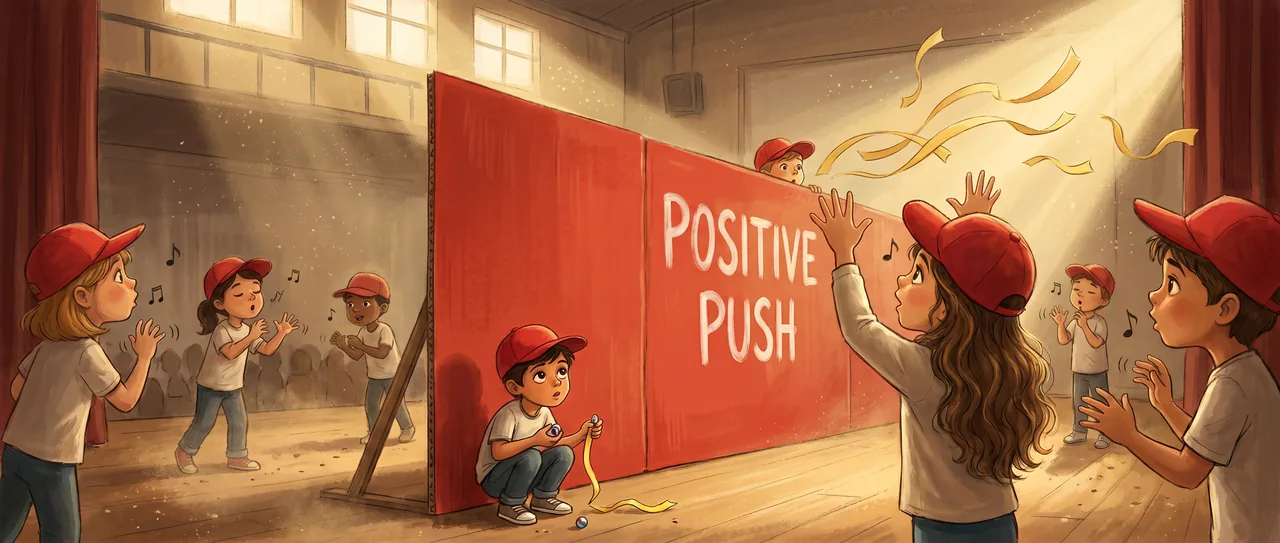
The cardboard wall was taller than Maya and painted the color of a stop sign.
Across the front, Soren had written POSITIVE PUSH in careful block letters. Under that, in smaller letters, he had added, SAME CHARGES SHOVE APART.
Ms. Kline stood in the aisle with tape on one sleeve and a paper crown in her hair from the kindergarten moon dance. She looked at the wall. She looked at the clock. She looked at the wall again.
"Cut it," she said.
Maya had a red cap in each hand. They were supposed to be hydrogen nuclei. "Cut the wall?"
"It is confusing," Ms. Kline said. "The little ones need to know the Sun is hot, the atoms smash together, and light comes out. Simple. Bright. Done. Also, the planets are waiting for their turn. Saturn has lost a ring."
Soren put one hand on the cardboard. "But the wall is the problem."
"Exactly," Ms. Kline said. "We do not need more problems in the spring assembly."
She hurried away toward Saturn, who was crying behind the curtains.
Maya set the red caps on the floor in a line. "If we cut the wall, the Sun cheats."
Soren opened his notebook, not to write, just to find the page he had already folded. He had copied a sentence from a library book because it had bothered him so much he had carried it around all week.
He read, "Classically, the protons in the Sun's core do not have enough energy to get over the electric barrier between them."
Maya picked up one cap and threw it softly at the cardboard wall. It bounced off and rolled under a chair.
"So the Sun should be dark," she said.
They both looked toward the high auditorium windows.
Afternoon light lay across the dusty floorboards. It made every floating speck show itself. It touched the taped planets, the folded chairs, the cardboard wall that said POSITIVE PUSH.
Soren closed the notebook.
"Not dark," he said.
"No," Maya said. "So something gets through."
They had known the word already. Soren had underlined it twice. Quantum tunneling. A particle could be found on the far side of a barrier it could not cross like a thrown ball. Not because it found a crack. Not because it climbed. Because tiny things did not have to be only tiny balls.
Knowing the word had not helped the play.
They tried marbles first.
Maya stacked books on the stage and rolled marbles toward them from a ruler ramp. The marbles clicked, jumped, and fell back.
"Good," Soren said.
"Bad," Maya said. "No Sun."
They made the ramp steeper. The marbles flew over the books.
"Also bad," Soren said. "That is climbing over."
Maya sat on the edge of the stage and swung her sneakers. "Marbles are lying."
"Marbles are being marbles," Soren said.
"Same thing right now."
The rest of the class returned from water break, noisy and damp around the edges. Ms. Kline clapped twice and told the hydrogen group to practice. Six children in red caps ran across the stage, hit the cardboard wall with their palms, and bounced backward.
"Again," Maya said.
They did it again.
"Again."
On the fourth time, someone said, "This is boring."
On the seventh, someone said, "Do we ever get to be sunlight?"
Soren looked at the rows of red caps. Most of them were crooked. One was inside out. The children were hot and annoyed and doing the same impossible thing over and over.
"That is closer," he said.
Maya turned to him.
"Most tries do not work," Soren said. "Almost all of them do not work. But almost all is not all."
Maya slid off the stage. "Rare is not pretend."
"Rare is not zero," Soren said.
The hydrogen group went quiet, not because Ms. Kline clapped, but because Maya had stopped moving.
When Maya stopped moving, it usually meant something was about to move differently.
She took one red cap and put it behind the wall.
"You start there," she said to the smallest hydrogen.
"Is that allowed?" the child asked.
"For theater, yes," Maya said. "For marbles, no. For protons, listen."
Soren walked to the front of the stage. He did not like talking to rows of people. Rows of people made his voice feel folded. But the wall was wrong, and wrong things pulled words out of him.
"If these were balls," he said, holding up a marble, "they would bounce forever unless they had enough speed to go over. The Sun's middle is extremely hot and squeezed tight, but if protons had to act like this marble, the bright Sun we know would not work."
The room stayed quiet.
Maya lifted both hands, palms out. "Tiny things are not only marbles."
Soren nodded. "A proton is quantum. There is a small chance it can be found on the other side of the barrier. That is tunneling. Not a hole. Not a trick door. A chance."
Someone in a red cap frowned. "So I stand here forever and maybe somebody else gets to be the miracle?"
Maya grinned. "You stand there because most of the Sun is waiting."
Soren pointed at the cap behind the wall. "And because if the tiny chance never happened, no one in this room would see their own hands."
No one said boring after that.
They rebuilt the scene.
The hydrogen children rushed the wall and bounced back. They rushed and bounced, rushed and bounced, until the sound of palms on cardboard became a soft drumbeat.
Then they stopped being runners.
They spread across the stage, still wearing red caps, and hummed. Not a song. A low, uneven hum that seemed to come from the floor and the curtains and the hollow space under the stage. Maya had them hold their hands out, fingers wiggling, not touching the wall, not crossing it.
On the far side, the hidden red cap rose slowly into view.
The hum changed.
Two hydrogen children, one from each side, stepped together around the end of the wall, not pretending to tunnel with their bodies, only showing that the story had reached the far side. Soren had insisted on that part. The audience would see the wall still had no door.
They joined hands.
The yellow ribbons came next.
Every child had one tucked in a sleeve. At Maya's signal, the ribbons snapped out and streamed over the stage. Not fire. Not explosion. Light. The kind you could hold for half a second before it slipped away.
Ms. Kline came back during the third rehearsal with Saturn's ring repaired in silver tape. She stopped in the aisle.
The red caps were bouncing again. The wall shook but did not fall. The hidden cap waited behind it.
"I thought we cut the confusing part," Ms. Kline said.
"We cut the fake simple part," Maya said.
Ms. Kline opened her mouth. The clock clicked loudly above the sound booth.
Soren held up the marble. He held up the yellow ribbon.
Ms. Kline looked at the wall, then at the sunlight on the floor, then at all the children waiting for the almost-never part.
"You have ninety seconds," she said.
"We need one hundred and twenty," Soren said.
"You have one hundred," Ms. Kline said.
Maya said, "We can make the first bounces faster."
They did.
By assembly time, the auditorium smelled like warm curtains and floor polish. The kindergarten moons sat cross-legged in front. Parents filled the folding chairs. Someone's baby kept saying, "Ball," every time Earth rolled past.
Then the Sun scene began.
Maya stood in the wing with one hand raised. Soren crouched beside the cardboard wall, checking that the hidden cap could rise without catching on tape.
The red caps ran.
Smack. Back.
Smack. Back.
Smack. Back.
A few parents laughed at first. Then the bouncing kept going. The laughter thinned. The room began to hear the wall.
Soren stepped forward with the marble. His voice shook on the first word and steadied on the second.
"If the Sun's protons were only tiny balls, this would be the end."
Maya raised both hands.
The red caps became still.
The hum began. On the far side, one red cap lifted into the light.
The kindergarten moons leaned forward.
The yellow ribbons flashed out.
For one second, the whole stage shone with strips of paper held in small hands.
Afterward, while the planets lined up for their bow, Maya and Soren carried the cardboard wall into the wing. Its bottom edge was bent from all the palms. One corner had a shoe print on it.
A strip of yellow ribbon had stuck to Soren's sleeve. Maya peeled it off and tied it to the top of the wall.
The auditorium doors opened for families to leave, and the backstage dimness filled with footsteps and coat sounds.
Maya slid the folded program under the stage door to hold it open. A blade of afternoon sun crossed the dark floor and touched the cardboard wall.
Read the interactive version, listen to the narration, and earn a gold star →
A science-verified short story for curious kids · Curiosity Land