The Valleys Under the Table
Maya said, "Old molecules must have armor."
Soren looked up from the kitchen floor, where three glow sticks lay beside a lump of gray modeling clay and his open chemistry book. The power had gone out twenty minutes ago. Rain pressed against the windows like handfuls of rice.
"Armor?" he asked.
"Something like it." Maya tapped the printed article on the floor. It showed a dark crumb of asteroid material inside a silver container. The caption said scientists had found organic molecules in asteroid samples, materials older than Earth’s oceans. "If a molecule can sit inside a rock for billions of years, it must be tougher than other molecules."
Soren held up one of the glow sticks. "Then these are the opposite of armor."
"Those are expired party bracelets."
"The book says glow sticks make a high-energy molecule that falls apart almost as soon as it forms. Some reaction intermediates only last microseconds."
"Microseconds is rude," Maya said. "That is not enough time to be a thing."
Soren smiled and wrote one word in his notebook, rude.
From the far side of the kitchen, Soren’s mother said, "If anything leaks on my floor, I am naming the stain after both of you." "We are not opening them," Soren said.
"That is exactly what someone says before opening them," his mother said.
Maya snapped the first glow stick. A tiny crack sounded inside the plastic. Green light slid along it, slow and liquid, until the whole stick shone in her hand.
"Not dead," she said.
"Just waiting," Soren said.
They had meant to make a model for Question Night at school, but the power outage had turned the kitchen into a better place for questions. Their first model was a molecule made from clay balls and toothpicks. It looked like every school molecule ever, which was the problem.
Maya turned it in her hand. "This says old molecules have better sticks."
"Maybe they do. Stronger bonds."
"But the glow stick makes light because things change into things with stronger bonds, right?"
Soren checked the book by flashlight. His finger moved under the words. "The energy ends up lower after the reaction. Some of the extra energy goes into the dye, and the dye gives off light."
"So breaking is not the whole story."
"No," Soren said. "The whole path matters."
Maya dropped the toothpick molecule. It rolled under the table and stayed there.
"Good," she said. "It was lying."
Soren’s mother stepped over them with a bag of frozen corn. "Models are supposed to make things clearer."
"This one made the wrong thing clear," Maya said.
"That sounds useful and annoying," his mother said, and left them with the headlamp beam bobbing down the hall.
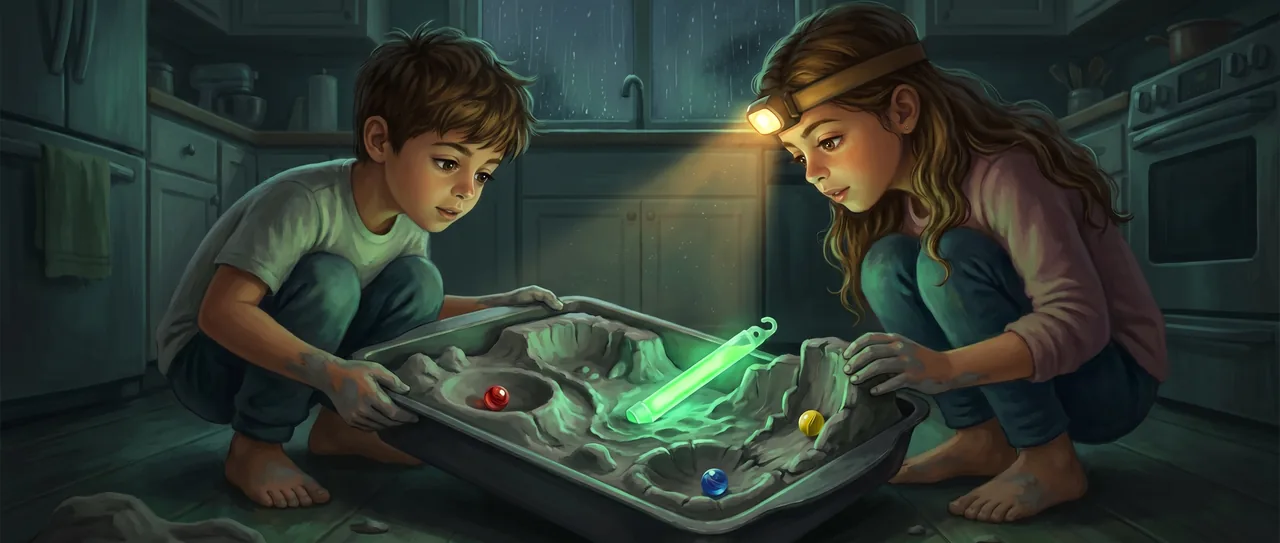
Soren flattened the modeling clay on a baking sheet. He pressed his thumbs into it, making dents. Maya pulled marbles from a jar that usually held buttons.
"If the molecule is the marble," Soren said, "then the clay is what?"
"Not the molecule," Maya said. She made a ridge with the side of her hand. "The possibilities."
Soren waited.
She frowned at the clay. "No. The possible shapes the molecule can be. The possible arrangements."
"Energy landscape," Soren said.
Maya pointed at him. "That."
They put a blue marble in a shallow dent. It rolled out when Maya breathed on it.
"Microsecond," she said.
"Maybe," Soren said. "If there is a downhill path."
He made the dent steeper on one side, like a cup with a broken lip. The marble slid through the gap and knocked into the glow stick.
The green stick wobbled, throwing light across the clay. Shadows filled the dents. The baking sheet no longer looked like clay. It looked like a tiny country after rain, with basins, cliffs, passes, and one narrow valley that went nowhere.
Maya stopped moving.
The article about asteroid dust was still beside her knee. The glow stick was still brightening by her foot. Between them, the clay held places where a marble could rest and places where it could not, though all the places were made of the same gray stuff.
"Do it again," she said.
Soren put the marble back at the top. It rolled down the same way, not because it wanted to, not because it was old or young, but because the path was there.
Maya took a red marble and set it inside the deepest bowl. She tapped the baking sheet. The marble shivered but did not climb out.
"Billions of years," she said softly.
"If nothing gives it enough energy to get over the wall," Soren said.
"So stable does not mean nothing can ever happen."
"It means the way out is too high, or there is no easy path."
Maya picked up the glow stick and held it over the clay. "And unstable does not mean weak."
"It means the arrangement is sitting somewhere that has a way down."
The rain thickened against the windows. Somewhere in the house, the refrigerator clicked and failed to start.
Soren turned a page in the chemistry book. "It says electrons are only allowed certain arrangements. Quantum rules. Like how a flute can play certain notes, not all the sounds between."
Maya looked at the clay hills. "The invisible rules make the hills."
"And the valleys."
She reached for more clay. "Then the model cannot be neat."
Soren’s mother returned with a towel over her shoulder. She looked down at the baking sheet, the marbles, the glowing plastic stick, and the crumbs of gray clay on the floor.
"I thought models were supposed to be tidy," she said.
"Not this one," Soren said.
Maya used two fingers to pinch up a crooked ridge. "If we smooth it out, everything rolls the same."
Soren added a bump beside the deep bowl. "And then old and fast look like accidents."
His mother watched the red marble sit in its hollow while the blue one escaped again and again. Her headlamp reflected in both marbles.
"I have no idea what I am looking at," she said, "but I believe you need a larger baking sheet."
She brought them the roasting pan.
The roasting pan changed everything. It had room for a high plateau, a cliff, three valleys, a crooked pass, and a place Maya called the Almost, where a marble could balance until the table shook.
Soren tested every path. He did not trust the first roll or the second. He lifted the pan at one corner, then another. Maya kept adding ridges where the marbles escaped too easily and shaving ridges where nothing could ever move.
"You are making traps," Soren said.
"I am making choices," Maya said.
"For marbles."
"For possible molecules."
He grinned. "That is worse."
They made a high valley with no easy entrance. Soren put a yellow marble beside it and tried to roll it in. The marble bounced off the rim and fell away.
"Could be a molecule that would be stable if you could make it," he said.
Maya leaned close. The green glow stick lit one side of her face. "But maybe nobody has found the path."
Soren did not write that down. His notebook lay open near his ankle, but his hands were gray with clay.
The lights came back all at once. The refrigerator hummed. The microwave beeped. The kitchen ceiling turned ordinary and bright.
"Turn them off," Maya said.
Soren reached up and flicked the switch. The kitchen fell back into green glow and rain sound.
They sat on the floor with the roasting pan between them. In the deep bowl, the red marble waited. On the broken slope, the blue marble had rolled to the bottom. Near the high valley, the yellow marble rested against a wall it could not climb.
Maya took one last clear glass bead from the button jar. It caught the glow stick’s light and held a green spark at its center.
The candle guttered once. Maya set the last glass bead in the unmarked hollow and did not push it.
Read the interactive version, listen to the narration, and earn a gold star →
A science-verified short story for curious kids · Curiosity Land