The Quiet Part of the Sky
The first thing the alien detector heard was Soren’s refrigerator.
It came through the headphones as a fat electric buzz every time the motor switched on. Soren frowned at the laptop screen, where a green line jumped and spattered.
“That is not aliens,” Maya said.
“I wrote refrigerator,” Soren said.
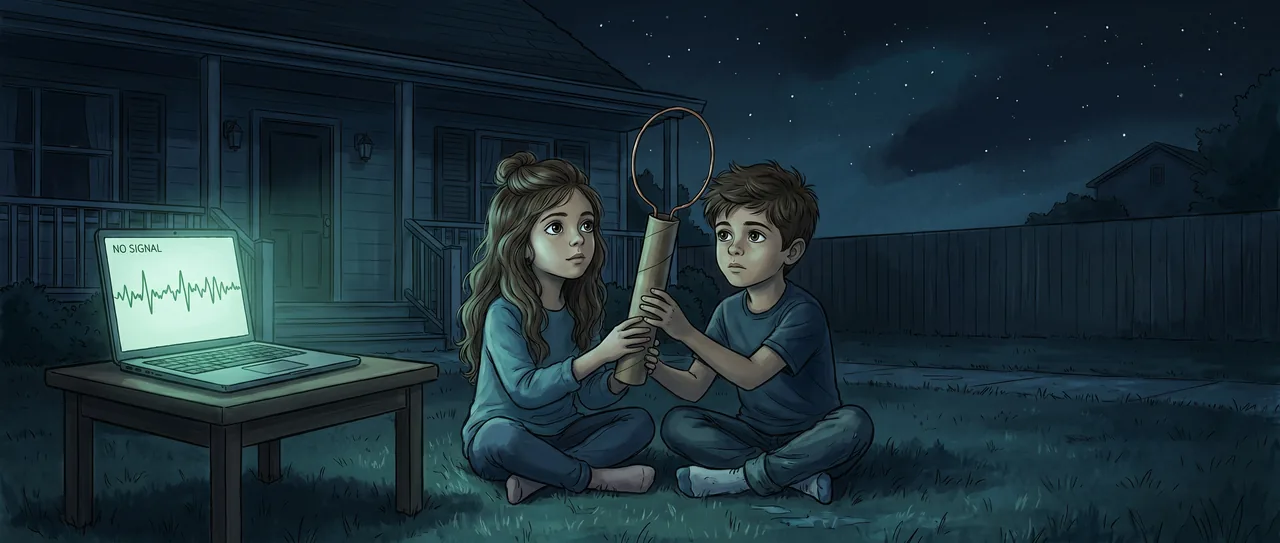
He had written it in the margin of his paper notebook because the laptop was too full of numbers to be trusted by itself. The notebook lay open beside the coil of copper wire, the tiny radio receiver, two clothespins, three wrong screws, and the cardboard tube from a roll of wrapping paper.
Maya had named the whole thing the Everybody Detector.
Soren had objected. It did not detect everybody. It did not even detect most things. It listened to a narrow slice of radio waves and drew a line when something pushed through.
“That is exactly why it’s the Everybody Detector,” Maya had said. “Because if everybody is out there, even one is enough.”
They had started after the library book fell open to the question printed in huge letters across one page.
Where is everybody?
Under it were stars, not drawn as decoration, but as a crowd. Hundreds of billions in the Milky Way. More galaxies beyond that than Soren liked to imagine all at once. Old light. Old worlds. Planets found around other stars so often that the first shock had worn off and become a catalog.
And still, no confirmed hello.
Not a beacon. Not a city glow. Not a machine crossing the dark with a flag out the window. Nothing that everyone could point to and say, There.
The book had called it the Fermi paradox. Maya had read the words twice and then gone very still, which for Maya meant something had caught.
“Maybe they’re not loud,” she had said.
“Maybe there aren’t any,” Soren had said, because if he was going to be wrong, he preferred to be wrong clearly.
Maya had looked at the crowded page of stars. “That feels like saying our street is the only street because nobody knocked.”
Now their Everybody Detector sat on the old card table in Soren’s back garden, under a sky the color of rinsed ink. The refrigerator buzz had stopped. A neighbor’s garage door made a quick jagged comb on the screen. Somewhere beyond the fence, a dog barked at something that was probably not radio.
Soren adjusted the copper loop clipped to the cardboard tube.
“We need to know what counts as a signal,” he said.
Maya leaned close to the laptop. “That spike.”
“That’s the garage door.”
“That spike.”
“Also garage door.”
“That skinny one?”
Soren changed the tuning by a careful little slide of his finger. A human voice burst into the headphones, bright and sudden, singing about summer rain.
Maya yanked one side away from her ear. “Too much everybody.”
“FM station,” Soren said, and wrote it down.
They spent twenty minutes discovering that Earth was extremely talkative. It muttered in routers, clicked in car keys, sang in stations, and popped when someone turned on a porch light. The laptop filled with peaks and scratches. Nothing stayed still long enough to feel like a message. Everything belonged to a person who was not trying to speak to them.
Maya stood, turned in a slow circle, and stopped facing the darkest corner of the garden.
“What if the problem is us?” she asked.
Soren looked at the cardboard tube, the copper, the open window where the refrigerator waited to buzz again. “Very possible.”
“No,” Maya said. “Not the machine. Us. The planet. We’re yelling in our own ears.”
Soren did not answer right away. He liked when Maya said something that was not yet a fact but had a fact-shaped shadow.
They carried the table to the far side of the garden, away from the kitchen wall. The laptop battery complained. Soren unplugged the charger. The green line lowered a little, as if the screen had taken a breath.
“Again,” Maya said.
They turned off the porch light.
The line lowered.
Soren ran inside, pulled the plug on the string of holiday lights his family had never taken down from the fence, and came back with one sock wet from the grass.
The line lowered again.
Maya smiled, not big. Just enough.
“Quiet has parts,” she said.
They sat on the damp ground with the headphones between them, one ear each. Soren tuned past the station, past a hard ticking, past a squeal that made both of them flinch. He found a place where the screen nearly flattened.
Nearly.
There was always a tremble. A grainy hiss pressed against their ears. Not a voice. Not a code. Not a secret. Just the receiver, the air, the warm electronics, the far-off clutter of their own world, and beyond that whatever the sky did when no one was making it into music.
Maya lay back in the grass. “So if a signal came, it would have to get through all this.”
“And distance,” Soren said. “And time.”
“And us being pointed the wrong way.”
“And not listening at the right kind of wave.”
“And them not using waves.”
“And them not being there anymore.”
“Or not yet,” Maya said.
Soren wrote not yet in his notebook, then stopped with the pencil still touching the page.
The book had listed explanations in a tidy column. Maybe life was rare. Maybe intelligent life was rare. Maybe civilizations were quiet. Maybe they used technology we did not know how to notice. Maybe they were too far apart. Maybe everyone was listening and no one was sending. Maybe the lifetime of a radio-loud civilization was just a blink compared with stars.
On the page, the explanations had looked like answers standing in line.
In the garden, with one ear full of hiss and the other full of night insects, they did not feel like answers. They felt like doors that had no walls around them.
Maya sat up sharply. “Give me the star map.”
Soren passed her the printed sheet, already soft at the corners from being folded into his pocket. It showed the summer sky, with bright names and thin lines humans had invented because dots alone made them nervous.
Maya held it above the laptop glow. “Everyone points at the famous ones.”
“For good reasons,” Soren said. “Nearby stars. Sun-like stars. Stars with planets.”
She tapped the paper between two constellations, where there was almost nothing printed at all. “What about this part?”
“That’s still sky.”
“I know.”
“There are stars there too. Just dimmer from here.”
“I know.”
Soren looked at the blank-looking patch on the map, then up at the same patch above the fence. It was the kind of place people’s eyes slid over while searching for something with a name.
He adjusted the cardboard tube, though it was not a proper dish and did not point as sharply as he wished. Maya held the copper loop steady with both hands. The laptop line shivered.
“Maybe this is stupid,” Soren said.
Maya did not look away from the dark patch. “Good.”
“That is not an argument.”
“It is if everybody sensible already tried the sensible parts.”
A small laugh got out of him before he could stop it.
The receiver heard a car passing. Then the car passed. It heard a phone chirp inside the house. Then the phone went quiet. It heard a brief scratch neither of them could name, and Soren marked the time because unnamed did not mean important, but it did mean unnamed.
Then the line flattened again into its narrow restless hiss.
Maya’s arms began to shake from holding the antenna still. Soren reached up and took one side of the cardboard tube. Their fingers touched the clothespins. Neither of them moved away.
The question from the book seemed too large for the page now. It had crawled into a back garden and made room for two children who could sit very still with a thing that did not answer.
Soren clicked record.
Maya tilted the copper loop toward the blank place on the star map.
On the screen, the flat green line began crawling through the dark.
Read the interactive version, listen to the narration, and earn a gold star →
A science-verified short story for curious kids · Curiosity Land