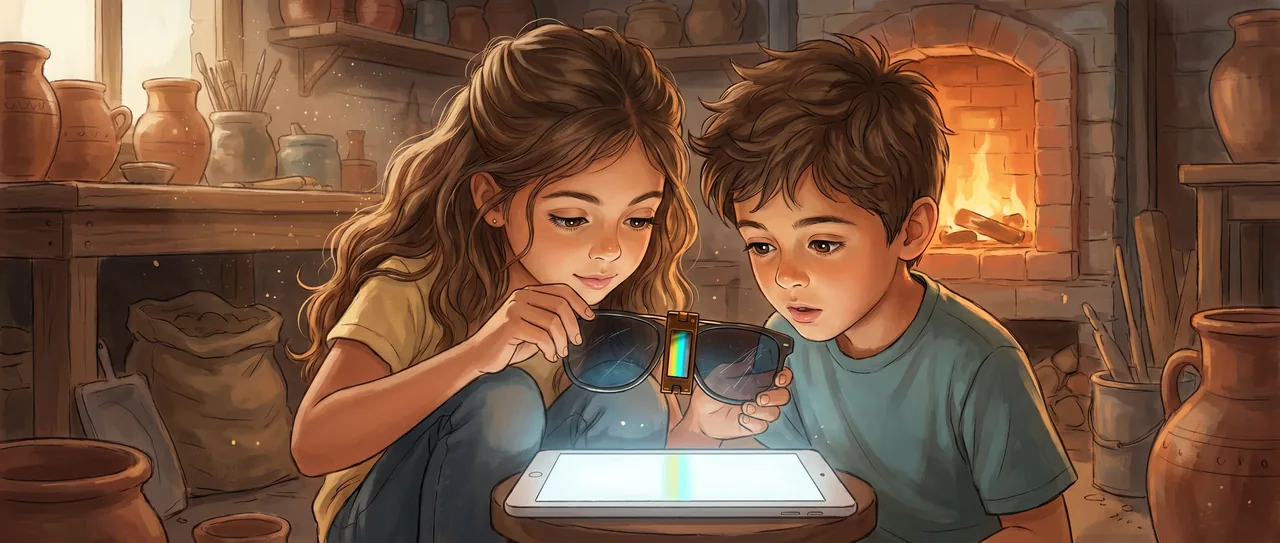
The Plug That Remembered the River
At two hundred degrees Celsius, their first connector gave up.
It did not burst. It did not flame. It simply bent its little white face toward the kiln brick and drooped, as if it had grown sleepy. Then came the smell, sweet and wrong, like a toy left on a stove.
Aunt Lina yanked the kiln switch down with her elbow because both hands were blue with glaze.
"No plastic," she said. "I told you. Clay, metal, glass. Those are kiln words. Plastic is not a kiln word."
Maya crouched beside the test tile, staying behind the yellow tape line Aunt Lina had painted on the shed floor. The connector hung from the end of Soren's temperature alarm, warped around the wires like chewed gum.
"It failed slowly," Maya said.
"That is not a compliment," Aunt Lina said.
Soren had his paper notebook open on the workbench, but his pencil had stopped moving. Their alarm was supposed to chirp when the kiln reached the perfect heat for Aunt Lina's tiny moon bowls, the ones with glaze that turned silver only if she opened the lid at the right moment. The thermocouple could take the heat. The ceramic bead on the wire could take the heat. The metal clip could take the heat.
The place where two wires had to meet had turned into a white plastic frown.
Aunt Lina wiped glaze across her apron and looked at the clock. "I have twelve bowls drying, one customer coming at four, and no patience left for melted gadgets. If you want to keep trying, use the junk box. Nothing goes near my kiln unless it stops smelling like a robot sneeze."
She went back to her wheel, which was thumping because one leg of the table was shorter than the others.
Maya picked up the ruined connector with pliers. "It melted from the inside shape. See? The outside sagged after the holes moved."
Soren leaned close. "The pins stayed straight. The house didn't."
"So the house is the problem."
"The housing," Soren said, and wrote that down.
The junk box lived under the bench. It held dead chargers, cracked remote controls, a laptop keyboard with seven missing keys, copper wire, screws in a jam jar, and three things no one could name. Maya dumped half of it onto the floor.
"Aunt Lina said no plastic," Soren said.
Maya had already stopped listening in the way she did when a thing in the world had snagged her. She picked up a flat brown connector from an old printer board. It was smaller than her thumbnail, with two rows of bright metal teeth.
"This one was soldered," she said.
"Lots of things are soldered."
"Solder is hot."
"Not three hundred degrees hot for a long time."
Maya turned the connector over. On its side, barely raised, were three letters and one number so tiny Soren had to use the magnifying lamp.
"L-C-P," he read. "And something that might be thirty. Or three hundred. Or a squashed spider."
He opened Aunt Lina's old tablet, the one with clay in the charging port, and searched the letters with the word connector. The shed's internet worked only when the wind was kind. The first page loaded in strips.
Liquid crystal polymer.
High temperature electrical connectors.
Continuous use up to three hundred degrees Celsius, depending on grade.
Low outgassing.
Soren stopped scrolling.
"Plastic is a kiln word," Maya said.
"Maybe one plastic," Soren said. "Maybe this plastic."
He did not sound happy yet. Soren did not like answers that arrived wearing capes.
Maya found the broken sunglasses in the junk box next. One lens was missing. The other was dark and scratched. She held it over the connector, then over the tablet, then squinted.
"The screen goes black when I turn it."
"Polarized," Soren said. "The tablet light and the sunglass lens are arguing."
Maya slid the brown connector between the screen and the lens. Nothing happened at first. Then she tilted the connector so light passed through one thin amber latch at its edge.
A narrow stripe flashed blue.
"Do that again," Soren said.
Maya turned the lens slowly. The amber latch changed from blue to green to a small sudden gold, then vanished into black. Soren took the connector, held it where she had held it, and turned the lens six times. Blue. Green. Gold. Black.
He breathed through his nose very carefully.
"It's not just brown," Maya said.
Soren pulled a clear plastic spoon from the sink cup where Aunt Lina stirred glazes. He held the spoon between the tablet and the sunglass lens. The spoon bowl filled with wild colors, streaks pouring from the little round spot where the plastic had entered the mold.
Maya touched the round spot. "A river started there."
Soren scrolled again, slower this time. Maya looked at the warped white connector. It had no color under the lens, only dull gray patches.
She looked at the brown one again.
The thin latch flashed gold.
"It remembers how it flowed," she said.
Soren did not write that down. He put his finger on the tiny gate mark at the back of the connector, the place where the hot material must have entered the mold. Fine lines ran away from it, so small they were almost a texture.
"The strong way might not be every way," he said. "If the molecules point, the part has directions inside it. Like wood grain, but poured."
Maya grinned at him. "Poured wood."
"Do not say that to a materials scientist."
"We don't have one."
They had Aunt Lina, who came over because her wheel had stopped thumping and because Maya had said plastic like it had become a dare.
Soren held up the connector with pliers. "This says liquid crystal polymer. It is used for electrical connectors that go through soldering heat. This grade says three hundred degrees. It also says low outgassing, so it should not fog your glaze or stink much."
Aunt Lina narrowed her eyes. She did not like being rushed, and Maya always sounded like a door half-open in a high wind.
"Should," Aunt Lina said.
"We test it alone," Maya said. "No bowls. No glaze. Just a scrap tile. You run the kiln. We stand back. If it smells, we lose."
Aunt Lina looked at the clock again. Then at the twelve moon bowls. Then at the connector, which was very small and very brown and did not look magical at all.
"One test," she said. "If my shed smells like robot sneeze, I am naming the smell after both of you."
They rebuilt the alarm on a square of broken kiln shelf. Soren crimped the wires instead of twisting them. Maya made a little metal bracket that held the connector away from the brick but close enough for the test. They left the white melted connector on the bench where everyone could see what failure looked like when it had done its job.
At one hundred degrees, nothing happened.
At two hundred, the alarm wire gave one soft click as the metal expanded. The brown connector sat where they had fixed it, square and plain.
At two hundred fifty, Aunt Lina leaned close, sniffed once, and said, "Not yet."
At three hundred, the alarm chirped.
It was not a beautiful sound. It was thin and bossy and exactly on time.
Maya did not jump. Soren did. Aunt Lina laughed once, surprised out of herself, and shut the kiln down.
The connector had not sagged. It had not gone shiny. No sweet wrong smell filled the shed. The little brown housing held the wires apart as neatly as if heat were weather happening to someone else.
Aunt Lina bent over it with her hands on her knees. "That," she said, "is a very strange plastic."
"It got strange before it got solid," Soren said.
Maya was already looking around the shed. At the cracked remote. At the printer gears. At the handles on Aunt Lina's trimming tools. At the shiny spoon with the hidden river in its bowl.
She picked up the sunglass lens again.
Soren switched the tablet screen to white and held it out without being asked.
Maya lifted the dark lens over the tray of broken switches, and one tiny amber edge after another flashed blue, green, and gold.
Read the interactive version, listen to the narration, and earn a gold star →
A science-verified short story for curious kids · Curiosity Land