The Helmet Cut
On the afternoon their Mars movie broke, Soren blamed the helmets.
The helmets were not real helmets. They were bicycle helmets wrapped in foil, with clear plastic from a cookie box taped across the front. Maya had made the air tanks from soda bottles. Soren had made the little blinking panel from a calculator that no longer calculated.
The movie was called The Red Planet Does Not Care About Your Snack Schedule. It was supposed to be seven minutes long. It had become forty-eight minutes of two silver astronauts walking up and down Soren’s apartment hallway, opening doors as if they were air locks, and saying things like, "Oxygen is low," while holding peanut butter sandwiches.
Now they had to cut it.
Soren sat at the kitchen table with the laptop. Maya leaned over his shoulder, still wearing one silver glove.
"That clip is me," she said.
Soren stopped the video. On the screen, an astronaut stood by the laundry room door.
"How?"
"Because it is me."
"That is not evidence."
Maya pointed at the screen. "My face is in the visor. Sort of."
Soren looked. There was a face behind the crinkled plastic. Eyes. Nose. Mouth. A smudge of cheek. The face looked perfectly face-shaped. It did not arrive anywhere.
"It could be you," he said. "It could be me. It could be a very serious raccoon."
Maya laughed once, then did not laugh again.
Soren rewound the clip. The astronaut lifted one hand to adjust the right shoulder strap. Soren clicked pause.
"That is you," he said.
"Now it is?"
"You pull the strap twice. I pull once and then forget it exists."
Maya looked from the screen to him. Her eyes got quick, the way they did when some loose thing in the world had clicked against another loose thing.
"Do the next one," she said.
Soren played another clip. A silver astronaut crossed the hall with slow, careful steps.
"Me," he said.
"Face?"
"Feet. My left shoe squeaks on the sticky place by the bathroom."
"Next."
He played a close-up. Helmet off this time. Just a face filling the screen, hair flattened, cheeks pink from running in the hallway.
Soren waited for the face to do what faces were supposed to do.
It stayed a face.
"That one," Maya said carefully, "is you."
Soren’s fingers came off the keyboard. "I know," he said, because he did know. The shirt collar was his blue one. The wall behind the face was the kitchen wall. The video had been recorded from his laptop, in his kitchen, after lunch.
Maya reached over and dragged the video window smaller. The collar disappeared. The wall disappeared. Only the face remained.
"Now?"
Soren looked at the eyes. He looked at the mouth. He tried the way he tried with spelling words, with fractions, with constellations. Hold still. Find the piece that gives the answer.
Nothing.
"It is a person," he said.
Maya’s hand hovered above the trackpad.
"Make it harder," Soren said.
She did.
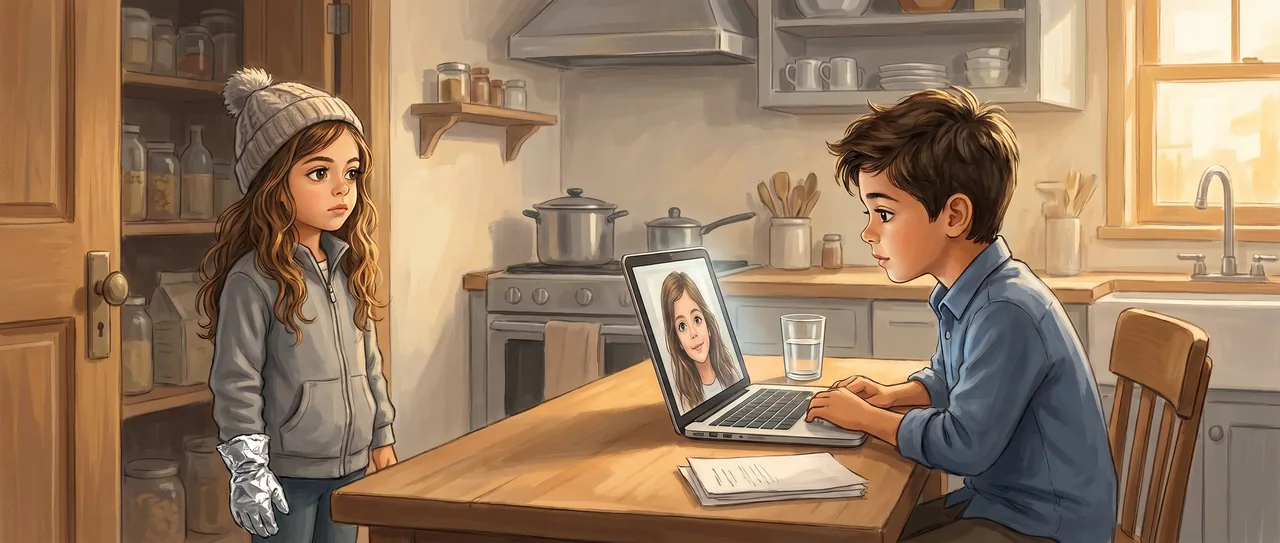
Maya pulled her hair into Soren’s winter hat and zipped herself into his gray sweatshirt. She stood by the pantry with her arms at her sides and her mouth shut.
Soren looked straight at her. The room was bright. His eyes were working. He could see the hat fuzz, the zipper teeth, the tiny scratch on the pantry door behind her. He could see a face.
"Say nothing," he said.
Maya said nothing.
The face waited.
Soren’s stomach gave a small, mean twist. He knew Maya was in the room. He knew there were only two of them. He knew she had just put on the hat. He could solve the puzzle by counting facts.
But the face did not say Maya.
Then she shifted her weight to one foot, impatient already, ready to move before the moving was allowed.
"You," Soren said.
Maya’s eyebrows went up under the hat.
"Again."
This time Soren turned around while she changed something. When he looked back, she had taken off the hat and put the glove over one hand. She stood perfectly still.
He knew the glove. He knew the sweatshirt. He did not know the face.
"Walk," he said.
Maya took two steps.
"You."
She grinned, and the grin was visible. It was just not enough by itself.
Soren took the hat from her and pulled it low over his own hair. He opened the laptop camera and leaned close until the screen held only his face. Then he looked away, counted to ten, and looked back fast, trying to surprise recognition into happening.
The boy on the screen looked back.
Not a stranger exactly. Stranger was too strong. A stranger had a place in the world, across from you. This face had no handle.
"Mirrors tell me because they are mirrors," Soren said. "Photos tell me if I remember where they came from. People tell me by talking. Or walking. Or having their backpack. I thought that was how everybody did it. Mostly."
Maya had already taken the laptop. She did not ask if she could. Maya almost never asked permission from a question.
She typed with two fingers: can see faces but not recognize people voice walking.
The search results appeared.
Soren read the first lines. Then the second. Then he took the laptop back and read them again, slower.
Some people had ordinary vision and still could not recognize faces. Some were born that way. Some could fail to recognize their own face in a photograph. They often used hair, voice, clothing, movement, and context. The difficulty had a name with too many corners in it.
Prosopagnosia.
Maya said it badly. "Pro-so-pag-no-see-ah."
Soren said it worse. "Proso-panini."
They both laughed, but softly, because the word had landed on the table between them like a small machine still running.
Another page showed a drawing of a brain from the side. A colored patch glowed near the back and bottom. The caption said that face recognition used specialized parts of the brain. Not all seeing was the same seeing.
Soren touched the screen, not on the colored patch, but beside it.
His eyes had been bringing in the world. Somewhere after that, one particular door had not been opening.
Maya leaned so close her shoulder pressed his. "There is a whole piece for faces. A whole piece."
"Maybe more than one piece," Soren said. "It says network."
"Of course it does," Maya said. "Brains would make a maze."
Soren clicked back to their movie clips. The silver astronauts waited in rows of tiny boxes.
Before, the footage had looked broken. Too many helmets. Too much foil. Not enough face.
Now the hallway filled with evidence.
One astronaut tapped the wall before turning. Maya.
One kept checking the air-tank straps in the reflection of the oven door. Soren.
One bounced on the balls of both feet before saying a line. Maya.
One held the sandwich in his left hand and forgot to pretend it was space food. Soren.
Maya watched him sort the clips into folders.
"You are faster than me at this," she said.
"At people without faces."
"At people," Maya said.
Soren did not answer right away. He dragged another clip into Maya’s folder. Then another into his own. The movie began to assemble itself by footsteps, habits, pauses, tiny repeats nobody had meant to leave behind.
When they played the rough cut, the story made sense for the first time. Two astronauts crossed Mars. One rushed every air lock. One checked every gauge. One spoke before thinking. One tested the oxygen meter twice. Neither face mattered. The helmets made the rest louder.
Maya stood up so fast the chair legs squeaked.
"We should film the last scene with the visors taped over," she said.
"Then no one can use faces."
"Exactly."
Soren looked at the laptop screen. His own paused face looked back from a thumbnail, small and silent and unsorted. Beside it, the silver helmets waited on the table.
He picked up the foil tape.
Maya zipped both helmets shut, and Soren raised one finger for quiet.
Read the interactive version, listen to the narration, and earn a gold star →
A science-verified short story for curious kids · Curiosity Land