The Fair Machine
The machine had three mouths.
One mouth said OBSERVATORY. One said GREENHOUSE. One said ROVER GARAGE.
Maya had cut the mouths with the sharp little scissors nobody was supposed to use for cardboard. Soren had taped three paper tubes behind them so the beads would roll into jars. The beads were glass, blue and green and orange, because plastic beads sounded too soft and this was supposed to be a serious machine.
Their teacher had said, “Just make it fair,” and then had gone to rescue the printer from a sheet of silver paper that had disappeared halfway inside it.
Fair was the problem.
The class was building a Mars colony across the back wall. There were papier-mache cliffs, foil solar panels, and a red floor made from playground sand mixed with glue. There was only enough time before Family Night to finish one big section properly. The class had voted at lunch, not by choosing one thing, but by ranking all three.
Soren had brought the ballots in a rubber band. Five slips. Five table groups.
“Easy first,” he said.
“Easy is usually hiding something,” Maya said.
Soren gave every first choice two beads, every second choice one bead, and every third choice no beads. The beads clacked down the tubes and collected in the jars.
Two tables had ranked Observatory, then Greenhouse, then Rover Garage.
Two tables had ranked Greenhouse, then Rover Garage, then Observatory.
One table had ranked Rover Garage, then Observatory, then Greenhouse.
Soren counted twice. He always counted twice when the first count made sense, and three times when it did not.
“Greenhouse wins,” he said. “Six beads.”
Maya leaned in until her braid brushed the jars. Observatory had five. Rover Garage had four.
“The plant people will be happy,” Soren said.
Maya did not answer.
She picked up the one ballot that began with Rover Garage. Its pencil marks were dark, pressed hard into the paper.
“Who ranked Rover first?” she asked.
“The corner table,” Soren said. “The one everybody said was being difficult.”
Maya set the ballot beside the jars. “They weren’t being difficult. They wanted the thing that moves.”
Soren took out his notebook, then did not open it. He looked at the machine instead.
“What made you stop?” he asked.
“Greenhouse wins,” Maya said. “But look.”
She covered the Rover Garage jar with her hand.
Soren frowned. Then he pulled out a blank strip and copied only the Observatory and Greenhouse parts of each ballot.
On the first two slips, Observatory stayed above Greenhouse.
On the next two, Greenhouse stayed above Observatory.
On the last one, Observatory stayed above Greenhouse.
“Three to two,” Soren said.
“For Observatory,” Maya said.
“But with Rover Garage in the vote, Greenhouse wins.”
Maya tapped the covered jar. “The choice nobody picked second-best enough changed the fight between the other two.”
They both stared at the cardboard mouths.
Outside the classroom window, the real sky was turning the color of the Mars sand on the floor. Someone bounced a basketball in the gym. The sound came through the wall like a slow heartbeat.
“That breaks one promise,” Soren said.
“We made promises?” Maya asked.
Soren finally opened his notebook. On the page was a folded library printout he had taped in crookedly. At the top, in tiny letters, it said ARROW’S IMPOSSIBILITY THEOREM. Most of the page was symbols. Soren had drawn boxes around the only parts he could stand to look at for more than a minute.
“At least three choices,” he said. “People can rank them any way. If everybody likes one thing better than another, the group should too. No one person should always get to decide. And whether Observatory beats Greenhouse should only depend on how people rank Observatory and Greenhouse.”
Maya looked at the jars again.
“So our bead machine breaks the last one.”
“Yes.”
“Good,” Maya said.
Soren looked wounded. “Good?”
“Now we know where it cracks.”
She pulled the jars back to the starting line. “Try head-to-head. No beads for second place. Just fights.”
Soren made three little paper bridges. Observatory versus Greenhouse. Greenhouse versus Rover Garage. Rover Garage versus Observatory.
They fed the ballots through by hand.
Observatory beat Greenhouse, three tables to two.
Greenhouse beat Rover Garage, four tables to one.
Rover Garage beat Observatory, three tables to two.
Soren put down the last slip slowly.
“That can’t be a ranking,” he said.
Maya smiled, but not like something was funny. “Say it again.”
“Observatory is above Greenhouse. Greenhouse is above Rover. Rover is above Observatory.”
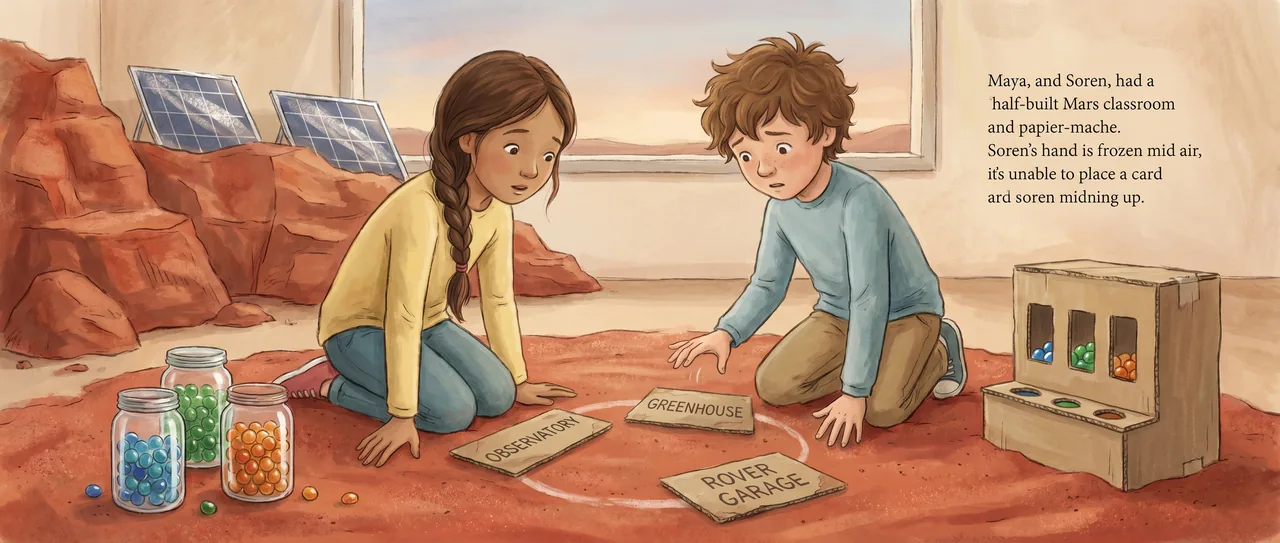
He arranged the three option cards on the floor. Observatory above Greenhouse. Greenhouse above Rover. Then he tried to put Rover above Observatory, and his hand stopped in the air.
“There isn’t an above for that,” he said.
Maya took the cards from him and placed them in a circle.
The circle sat there on the red sand floor.
For a while neither of them spoke.
Maya had seen impossible things before, but mostly they turned out to be small tricks. This was not like that.
The votes were not mistaken. The counting was not sloppy. Nobody had cheated. The corner table’s strange ranking was allowed to exist. Because it existed, the group’s answer could bend into a loop.
Soren reached for the library printout and smoothed it with both hands.
“It says no method can keep all the promises every time,” he said.
Maya did not say impossible. The word felt too flat for a thing with this many edges.
“Maybe our promises are too greedy,” she said.
“They sound basic.”
“That’s worse.”
Soren nodded. “We can choose which promise to break.”
Maya picked up the corner table’s ballot again. Rover Garage. Observatory. Greenhouse.
“If we throw this one out, the machine gets easier,” she said.
“We can’t.”
“I know.”
The way he said it made her look up.
Soren was not looking at the winning jars now. He was looking at the dark pencil marks from the corner table, the ranking that had made the neat answer come apart. He touched the edge of the paper carefully, as if it were thin glass.
“If a fair machine only works when nobody has that order,” he said, “then it only works for people who already fit inside it.”
Maya grinned at him.
“That goes on the machine.”
“No slogans,” Soren said.
“Not a slogan. A warning label.”
He considered this. “A useful warning label.”
They took apart the bead tubes. They untaped the jars. They stopped trying to hide the cracks.
On a fresh piece of cardboard, Maya drew three boxes.
One box said, If everyone agrees, follow it.
One box said, Do not let one person always rule.
One box said, Extra choices should not change old battles.
Soren added a fourth line underneath, in smaller letters.
Pick which promise this vote is allowed to bend.
The printer coughed in the hallway. Their teacher called, “Did you two get a winner?”
Maya looked at Soren.
Soren looked at the circle of cards on the floor.
“Not exactly,” he called back.
The classroom door opened. Their teacher came in with silver paper stuck to one sleeve and a tired, hopeful face.
Maya slid the jars aside. Soren set the five ballots in a row, including the one with the hard pencil marks.
Then Maya placed the three promise cards in a triangle on the red sand, and Soren put the circle of choices in the middle.
Read the interactive version, listen to the narration, and earn a gold star →
A science-verified short story for curious kids · Curiosity Land