The Earth-Sized Eye
The photograph did not look like enough.
That was Soren's first problem with it.
It was printed on a magazine page that had been folded twice and shoved under a stack of grocery coupons. The page showed a dark middle with an orange blur around it, like someone had taken a picture of a bagel through a rainy window.
Under it, the caption said: First image of Sagittarius A*, the black hole at the center of the Milky Way, released in two thousand twenty-two.
Soren held the page closer.
The center of the Milky Way deserved more than orange fuzz.
His mother came through the kitchen carrying a laundry basket against one hip and a cracked mixing bowl full of paper clips against the other.
“Recycling by dinner,” she said. “Keep three things. Three. Not three piles.”
Soren looked at the table. The table had disappeared under magazines, maps from old vacations, instruction sheets for appliances they no longer owned, and a booklet titled Your Dishwasher and You.
“This is a black hole,” he said.
His mother glanced at the page without stopping. “That one looks like breakfast.”
“It is the one in our galaxy.”
“Then keep it if it beats the dishwasher booklet.”
She vanished down the hall. A sock fell out of the laundry basket and stayed in the doorway.
Soren put the black hole page in the keep pile. Then he took it out again.
He had seen better space pictures. Nebulas like colored smoke. Jupiter with storms big enough to swallow Earth. The Pillars of Creation, which looked like the universe had grown fingers.
This picture looked as if the camera had trembled.
He found the article continuation three pages later, between a recipe for lemon cake and an advertisement for a folding exercise bike. He flattened the pages with his elbows and read.
The black hole was called Sagittarius A star when people said it aloud. It was about twenty-seven thousand light-years away. It had the mass of about four million Suns. No light came from the black hole itself. The orange ring was gas around it, heated and bent by gravity, surrounding a central shadow.
Soren read that paragraph twice.
Then he searched for the name of the telescope.
Event Horizon Telescope.
He expected a mountain. A huge white dish in a desert. Something with a door at the bottom and warning signs around it.
Instead, the article named places.
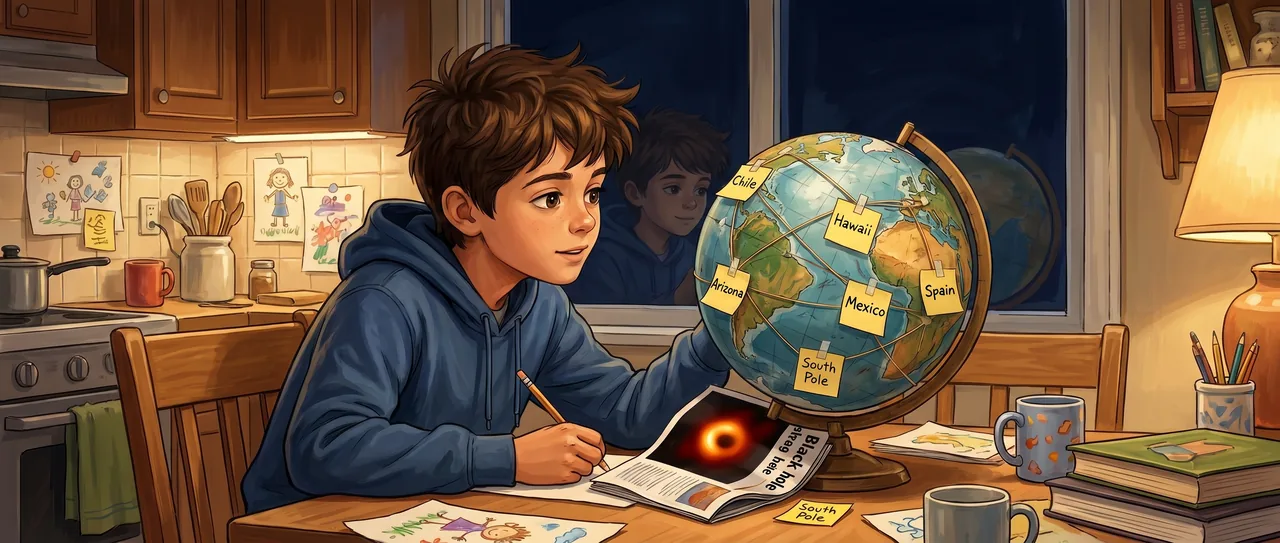
Chile. Hawaii. Arizona. Mexico. Spain. The South Pole.
Soren frowned.
He got his notebook, not to finish the story in it, but because the table was too full and his head had become worse. He wrote the place names down the left side of a page. Then he drew a telescope beside each one.
Six telescopes did not make one photograph.
He crossed out the telescopes and drew one giant telescope across the bottom of the page. It looked like a soup bowl with legs.
That was wrong too.
His mother came back for the fallen sock. “Dinner in forty minutes. Also, if that is math, do not let it spread to the chairs.”
“It is not math yet,” Soren said.
“That sounds dangerous.”
She picked up the sock and left.
Soren went to the hall closet and brought back the old globe. It had a dent in the Indian Ocean from the time it had rolled down the stairs. He set it on the kitchen table and turned it until South America faced him.
Chile was easy. A torn corner of a sticky note became a yellow square on the globe.
Hawaii took longer because the islands were tiny and his pencil point covered them. Arizona and Mexico crowded together. Spain went near the edge of Europe. For the South Pole he had to tilt the globe until it nearly slipped off its stand.
The dots looked lonely.
He stretched thread from Chile to Hawaii. From Chile to Spain. From Arizona to Mexico. From Hawaii to the South Pole. The thread slid at first, so he taped it down. Soon the globe looked less like a school globe and more like something caught in a spiderweb.
Soren sat back.
The dots were not lonely anymore.
The article said the observatories had not taken a normal picture. Each one had recorded radio waves from the direction of the black hole, with extremely exact time marks from atomic clocks. Later, the data had been carried on hard drives and combined by computers.
Soren tapped the word carried.
Not sent through the internet. Carried.
He pictured boxes of hard drives traveling by airplane from mountains, deserts, and ice. Pieces of a black hole moving through airport scanners. A person lifting a suitcase that held a tiny part of the center of the galaxy.
He turned the globe slowly.
If one dish was here and another was there, the distance between them mattered. The article called it a baseline. The farther apart the dishes were, the finer the details they could catch together. As Earth turned, the pairs swept different lines through the radio signal, like fingers crossing a surface in the dark.
He moved one thread from Chile to Hawaii and then from Chile to Spain. The globe pulled against his hand.
The telescope was not sitting on Earth.
The telescope was Earth, with holes in it.
Soren took his hands away.
The kitchen clock clicked. The refrigerator hummed. Outside the window, someone rolled a trash bin down the alley, wheels knocking over cracks in the pavement. No one place held the image. No one dish could be the eye.
Soren looked at the orange ring again.
It was not blurry because nobody had tried hard enough.
It was there because they had tried from everywhere they could.
He went back to the article. The image was not a single snapshot like a phone picture. Sagittarius A star changed quickly, because it was much smaller than the black hole in galaxy M eighty-seven that had been imaged first. The scientists had compared many possible images with the data and found the ring shape that kept appearing.
Soren placed the magazine page in the center of the webbed globe.
The black middle stared through the threads.
At school, people sometimes asked why he wrote down things that were not homework. They asked why he kept bus schedules from trips already over, why he copied numbers off elevator inspection certificates, why he wrote weather words in the margins of math worksheets.
The article did not say, Soren was right to keep odd pieces.
It said something better.
It showed hard drives full of scattered records, each one useless by itself for making the picture, each one necessary because it had been made in its own place at its own exact time.
His mother returned and stopped in the kitchen doorway.
The table was worse than before. Thread ran from continent to continent. Tape stuck to the salt shaker. The dishwasher booklet had migrated to the floor.
“I said three things,” she said.
“This is one,” Soren said.
He pointed to the globe, the threads, the article, and the notebook page of place names.
His mother opened her mouth, then closed it. She came closer and bent over the globe.
“What am I looking at?”
Soren tried the answer he had started with. “A black hole.”
It was not enough.
He tried again. “The center of the Milky Way.”
Still not enough.
His mother waited. She was not patient in the gentle way teachers were patient. She was patient in the way of someone holding a laundry basket who had decided not to put it down.
Soren touched the dot for Chile, then Hawaii, then the South Pole.
“We made the whole planet into the camera,” he said.
His mother looked at the orange ring for a long time.
Then she reached past him, took the dishwasher booklet off the floor, and dropped it into the recycling bin.
Soren carried the globe to the dark kitchen window. In the glass, his face floated over the Pacific, cut by threads from Hawaii to Chile. He lifted the pencil and touched its point to the empty blue between them.
Read the interactive version, listen to the narration, and earn a gold star →
A science-verified short story for curious kids · Curiosity Land