The Door That Wasn't a Hole
Mr. Pruitt said they had forty minutes, one plastic tray, and absolutely no vinegar on the carpet.
He said this while carrying a stack of returns under his chin and kicking the maker-room door open with one foot. He was not unkind. He was just a person who believed every spill became his problem eventually.
Maya set the tray on the table. Soren lined up their failures.
Coffee filter, blue all the way through.
Paper towel, blue puddle.
Plastic wrap, nothing through, which was almost worse.
Aluminum foil, torn by the rubber band.
The cup of water was not dangerous. It had salt, blue food coloring, and a pinch of dirt from the library planter because Maya said a purifier that only worked on clean water was bragging.
Soren had written FILTERS ARE JUST DOORS WITH RULES at the top of his page, then crossed out JUST so hard the paper wrinkled.
Maya picked through the material samples left from last month's packaging workshop. There were squares of mushroom foam, clear film made from seaweed, copper tape, and a thin black sheet that looked like burned paper but did not leave soot on her fingers.
"This," she said.
Soren looked up. "That is paper. Paper has already betrayed us twice."
"It doesn't feel like paper."
"Things don't have to feel guilty to leak."
Maya held the black square by two corners. It sagged a little, but not like tissue. More like cloth pretending to be a shadow.
A small white label was stuck to its envelope. Graphene oxide paper, conductive grade.
Soren read it twice. "Paper that conducts electricity is not paper."
"Good," Maya said. "Our filter can't be a filter."
That was how they got to the backpack.
Soren did not mean to test strength first. He meant to hang one metal washer from a strip, because if it tore under a washer it would not survive a rubber band. But the strip held one washer, then three, then the little adjustable wrench from the tool drawer.
Maya clipped the strip to the table edge with two binder clips and hooked Soren's backpack to the hanging end.
"This is a bad test," Soren said.
"It's a fast test."
The strip stretched so slightly that Soren leaned close to see if it was moving at all. His backpack dangled from a piece of black paper narrower than his thumb.
The table creaked.
Maya put one hand on the tabletop. "The table is giving up first."
Soren unhooked the backpack quickly, then held the strip flat on his palm. It had a crease where the clip had pinched it, but no tear.
"Steel is strong," he said.
"Steel is heavy."
He weighed the strip in his fingers. It was almost nothing. That made the room tilt a little, not because anything had moved, but because something in his head had to make room for a new kind of strong.
Mr. Pruitt passed the door with a cart of books. "If anyone is about to say the word explosion, say it silently."
"No explosions," Maya said.
Soren reached for the coin cell battery, the green LED, and two strips of copper tape. "Conductive grade means we test it."
Maya grinned. She loved when Soren stopped arguing with her and started arguing with the universe instead.
They made a simple circuit, battery to copper tape, copper tape to LED leg, other LED leg to the black paper, black paper back to the battery. At first nothing happened.
"Maybe the label lied," Maya said.
"Maybe our contact is terrible," Soren said.
He pressed the copper tape flatter with the back of a spoon. Maya held the paper still with two fingertips.
The LED gave one green blink, then a steady small glow.
Maya whispered, "Paper wire."
"Carbon," Soren said. "Pencil lead conducts a little. Diamond doesn't. Same element. Different arrangement."
He stopped there because the green light was shining through his explanation like it had made its own argument.
Maya lifted the black square and looked at its ragged edge. "Carbon is showing off."
Their purifier was supposed to be simple. Dirty blue water on one side. Clean water on the other. The problem was that every ordinary door let the wrong things through or nothing through.
Soren stretched the graphene oxide paper over the mouth of a small jar and fixed it with a rubber band. Maya turned the jar upside down over the tray.
No blue water fell.
"So it's plastic wrap," Soren said.
Maya tapped the bottom of the jar. "Not sagging. Not leaking. Not soaking."
"Still maybe plastic wrap."
Maya opened the jar again, dipped one finger in the blue water, and touched the wet finger to the outside of the black paper.
The drop sat there, round and stubborn.
"Liquid water doesn't want it," she said.
"Or it doesn't want liquid water."
Soren drew two boxes on his page, then did not write anything inside them. His pencil hovered. He hated when categories looked ready before the facts did.
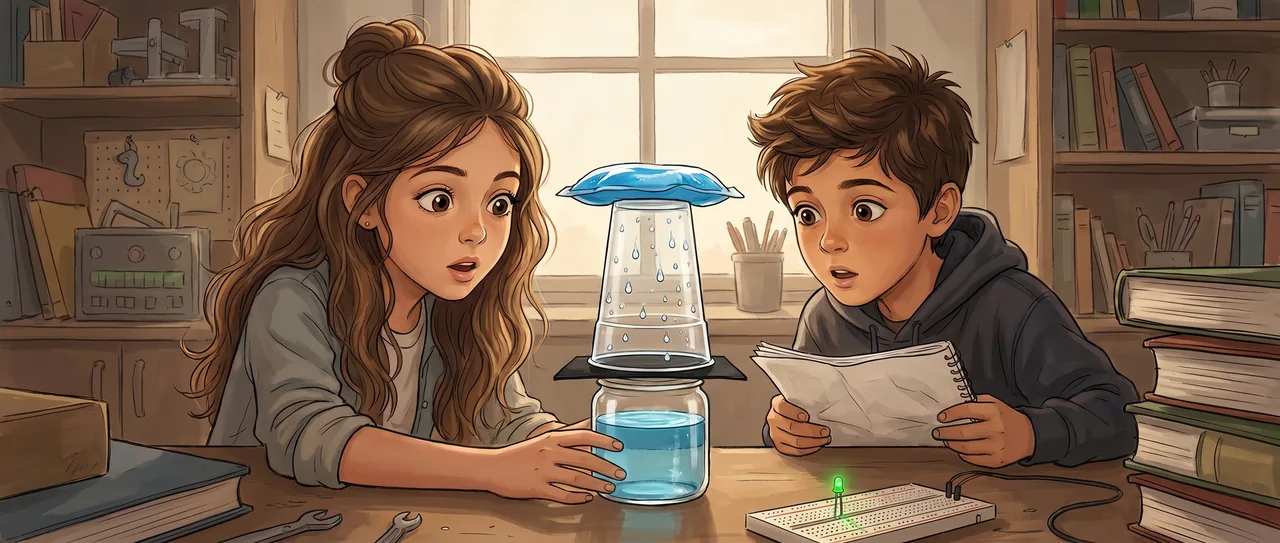
Maya had already moved on. She poured warm blue saltwater into a second jar, stretched the black paper over the top, and placed a clear plastic cup upside down above it like a little roof. On top of the cup she balanced the cold gel pack from her lunch.
"If nothing goes through, nothing happens," Soren said.
"If everything goes through, blue happens," Maya said.
They waited.
Waiting in the maker room was louder than working. The clock ticked. The radiator knocked. Mr. Pruitt muttered to a printer in the office as if it had personally disappointed him.
A fog appeared inside the upside-down cup.
Soren leaned closer.
The fog thickened into tiny beads on the cold plastic. They were not blue.
Maya's face changed first. Not a smile exactly. More like she had heard someone call her name from a place that had never had people in it before.
"Water vapor," Soren said.
"Not liquid."
"Not salt."
"Not dirt."
"Not dye."
The first clear drop slid down the inside of the cup and hung from the rim.
Soren flipped back to the crossed-out sentence in his notebook. FILTERS ARE DOORS WITH RULES.
He did not cross out anything else.
Maya picked up the sample envelope. On the back, in print so small it seemed designed to annoy eleven-year-olds, it said the paper was made from stacks of sheets only one atom thick, carbon sheets carrying oxygen groups. It said gases could not pass through. It said even helium, which was tiny, was blocked. It said water vapor passed.
Soren read the helium sentence aloud.
Maya frowned. "Helium is smaller than water."
"Yes."
"So holes isn't the answer."
"No."
"But water gets through."
"Yes."
They stared at the black paper stretched over the jar.
For a moment the maker room was too small for the fact sitting on the table. Carbon could be soft enough to smear across a page, hard enough to cut glass, thin enough to vanish into a single layer, strong enough to tug against a backpack, dark enough to look like trash, and arranged in a way that made a door that was not a hole.
Mr. Pruitt appeared in the doorway. "I smell no vinegar, which I appreciate. Why is there a lunch ice pack on a cup?"
"We're making clean water," Maya said.
He looked at the blue jar, the black membrane, the clear drops, and the glowing LED still clipped to the scrap.
"With paper?" he asked.
Soren said, "Not exactly paper."
Mr. Pruitt opened his mouth, then closed it. He checked his watch. "Ten more minutes. Do not invent plumbing."
When he left, Maya whispered, "Plumbing is later."
Soren tore a fresh label from the masking tape roll and stuck it to an empty jar. He wrote POND WATER, then added a question mark after it. Maya filled the jar from the bottle they had brought from the park, the one with green threads of algae turning slowly inside.
They cut the remaining graphene oxide paper in half. Soren stretched one piece over the new jar. Maya clipped the other piece into the circuit.
The green LED lit again, small and steady, beside the jar where clear drops gathered under the cold plastic cup.
Read the interactive version, listen to the narration, and earn a gold star →
A science-verified short story for curious kids · Curiosity Land