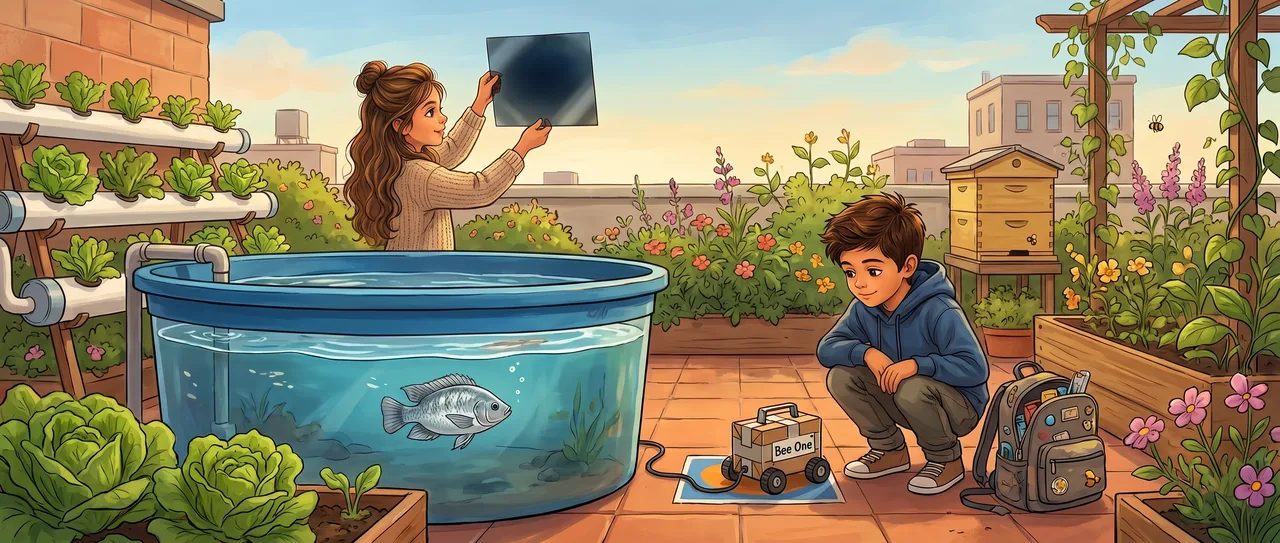
The Direction in Blue
Bee One failed by driving straight into the basil.
It was not a dramatic crash. It was a soft, leafy shoving. The little rover bumped the planter, reversed, bumped it again, and sat there with its cardboard wings trembling from the motor.
Maya crouched beside it. "It hates basil."
"It hates my steering circuit," Soren said.
He picked Bee One up carefully, like it might be embarrassed. The rover was the size of a lunch box. It had bottle-cap wheels, a solar cell taped to its back, and two light sensors on the front that Soren called eyes. Maya had painted yellow stripes on the sides, then added tiny black legs because six legs made the name less of a lie.
They were on the roof of Soren's building, where Mr. Toma grew lettuce in pipes and tomatoes in sacks and tilapia in a round blue tank. The tank gurgled under shade cloth. Bees moved in and out of a hive box near the mint.
Bee One was supposed to cross from the charging flower, which was really a painted plate with a lamp over it, to the tomato sacks, then back again. No remote control. No phone. No GPS. Soren said tiny farm robots should not need satellites to find basil.
So far, the basil disagreed.
Mr. Toma came past with a hose over one shoulder and mud on both knees. He had the expression of a man who was late for every plant at once.
"Use the compass app," he said.
"No phones," Maya said.
"Use a real compass."
"It points at the water tank," Soren said.
Mr. Toma glanced at the old steel beams under the tank and made a face. "Roof is full of metal. Bad place for delicate truth."
"Then we need a different truth," Maya said.
Mr. Toma laughed once, already walking away. "As long as your different truth does not squash my seedlings."
Soren set Bee One back on the tile. Its light sensors were separated by a cardboard wall. If the left sensor saw more light, the rover turned left. If the right sensor saw more light, it turned right. In full sun, it could aim itself. But the afternoon sun had slid behind the square bulk of the elevator room. The roof was bright, the sky was bright, and Bee One could not find the lamp unless it was almost touching it.
Maya stood very still.
Soren noticed. Maya's stillness was not rest. It meant something had snagged.
"What?" he asked.
"The sun is gone," she said.
"Behind the elevator room."
"But the bees aren't confused."
A honeybee lifted out of the mint, hung for a second, then flew in a clean line over the roof wall. Another returned with yellow lumps on its legs.
Soren looked from the bees to the sky. "They don't need to see the sun exactly. They can use polarized light."
"Say that again slower."
"I know the sentence," Soren said. "I don't know if I understand it."
He dug in his backpack. Soren's backpack always sounded like a drawer full of almost-useful things. He took out a bent plastic square, smoky gray, with tape stuck to one corner.
"Dead calculator screen," he said. "Polarizing film. I was saving it."
"For what?"
"For this, apparently."
Maya took it and held it up. The roof turned dimmer through the square. The white cloud edge stayed white. The tomatoes stayed tomatoes.
"Rotate it," Soren said.
She turned the square slowly.
The blue sky above the water tank deepened, as if someone had poured ink behind it. A quarter turn later, it brightened again. Maya stopped breathing for half a second, then turned the square back. Dark. Blue. Dark.
"It's not changing the sky," she said.
"No," Soren said. His voice had gone careful. "It's choosing which direction of light gets through."
"Light has a direction?"
"Not where it travels. The other direction. The way it wiggles."
Maya turned the square toward the elevator room. Nothing much happened. She turned toward a patch of sky away from the hidden sun. The blue blinked dark again.
Soren took the film and did the test six times. He faced different parts of the roof. He rotated the square until the dark came and went. Then he pulled his notebook out, not to finish anything, but because his face looked crowded.
"The sky is not just bright," he said. "It has patterns. Bees can see the pattern."
Maya looked up without the film. Plain blue. Empty blue. The kind of blue everyone walked under without ducking.
She held out her hand. "Give it back."
The roof changed in pieces. The shine on the greenhouse plastic went black, then silver. The puddle near the hose vanished, then returned. At the fish tank, a tilapia rolled beneath the surface like a coin. Through the rotating film, its side flashed hard, then dulled to gray.
"Fish too?" Maya asked.
Soren came beside her. " "
"So the tank is talking in a kind of light we mostly don't get."
"Not talking," Soren said.
Maya waited.
"Maybe talking," he said.
The tilapia turned again, silver, gray, silver.
Soren took another thing from his backpack, wrapped in tissue. It was a clear crystal, lumpy and slanted, from the museum shop bin where everything cost less if it had a chipped corner.
"Calcite," he said.
He set it on top of his notebook, over the word Bee. The word split into two Bees, one pale and one dark, sitting slightly apart.
Maya bent close. "You have been carrying a rock that makes extra words?"
"Only on important days."
He put the polarizing film over the crystal and turned it. One Bee faded. The other sharpened. A quarter turn later, they traded places.
Maya's grin came fast. "The crystal is sorting the wiggles."
"Bending them differently," Soren said. "But yes. Sorting."
Bee One sat beside the basil with its ordinary eyes, waiting for ordinary brightness.
Maya looked at the rover. Then at the film. Then at the cardboard wings.
"Its eyes are wrong," she said.
Soren did not answer right away. He was already peeling tape off a spare sensor hood.
They worked on the tile with the afternoon warming their knees. Maya cut two small windows from the polarizing film. Soren taped one over Bee One's left light sensor, with the darkening direction sideways. He taped the other over the right sensor turned a quarter around. They did not make the rover see like a bee. Soren said that would take more than tape and hope. But they could give Bee One two different windows into the same sky.
When the rover faced one way, the left eye got more sky light. When it faced another, the right eye did. The difference was tiny. Soren adjusted the cardboard wall between the sensors. Maya shaded the lamp with her hand, then moved it. They tested near the mint, then near the tank, then beside the dangerous basil.
Bee One spun in a slow circle.
"Too much," Maya said.
Soren switched two wires.
Bee One spun the other way.
"Too honest," Maya said.
Soren smiled without looking up.
They turned the sensor hood by little amounts. The rover twitched, rolled, paused, corrected, and drove past the basil without touching a leaf.
It crossed the tile in a wavering line toward the painted charging flower. The sun was still hidden. The lamp was off. The magnetic compass lay useless beside the water tank, its needle admiring the steel.
Bee One reached the plate and stopped with its cardboard nose over the center.
Maya made a sound that startled a bee out of the mint.
Mr. Toma looked over from the tomatoes. "Did it finally learn?"
"Not exactly," Soren said.
Maya held the smoky square up to him. "The roof had more directions than your compass."
Mr. Toma squinted through it, turned it the wrong way, then the right way. His eyebrows rose despite himself.
"Huh," he said. "Bad place for simple truth."
Then the hose slipped from his shoulder and sprayed his boot, and he hurried away muttering at the water pressure.
The sky above the roof kept being blue. The bees kept leaving and returning. The fish turned beneath the round tank lid, silver and gray and silver.
Maya lifted the polarizing ring to the sky. Soren set Bee One on the tile beside her shoe. A honeybee crossed the dark circle above the water tank and kept going.
Read the interactive version, listen to the narration, and earn a gold star →
A science-verified short story for curious kids · Curiosity Land