The Blank Color
Captain Punch lived in the tank nobody tapped twice.
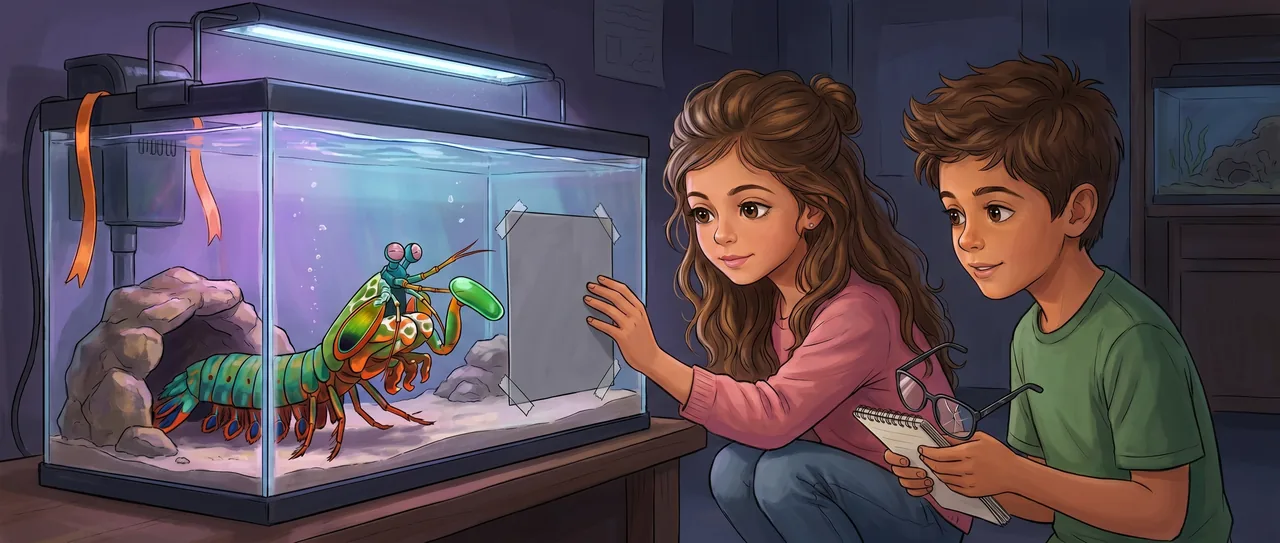
His home was in the back room of Coral Street Aquatics, behind the buckets of salt mix and the refrigerator labeled Not Snacks. He was the length of Maya’s hand, green and orange and electric blue, with eyes on stalks and front claws folded under him like secret tools.
Aunt Lio called him a peacock mantis shrimp. She also called him the tiny boxer, the glass tester, and, when she was carrying a mug, sir, please do not.
That Saturday, the shop was full of people buying snails and asking if clownfish were lonely. Aunt Lio had one sleeve wet to the shoulder and a phone trapped between her ear and chin.
She pointed at the mantis tank with her elbow. “I need him at the back feeding cup, not the front glass. No fingers in there. No tapping. If you two can make a target he cares about, there are broken sunglasses, bottle caps, old coral labels, and my eternal gratitude in the drawer.”
“Does gratitude buy frozen yogurt?” Maya asked.
“Small,” said Aunt Lio, and hurried away before the phone fell into a bucket.
Soren already had his notebook open on an overturned salt tub. “Mantis shrimp have sixteen kinds of photoreceptors,” he said.
“Humans have three,” Maya said. “So make it colorful.”
“That was my first plan.”
“It’s a good first plan.”
“It might be a too-human first plan.”
They made it anyway.
They cut circles from red, blue, yellow, and green plastic lids. Soren taped them to a square of acrylic. Maya made the pattern uneven because even patterns looked like homework. They suction-cupped it to the back wall of Captain Punch’s tank, beside the feeding cup.
Captain Punch stayed in his rock tunnel.
Only his eyes moved.
Each eye turned on its stalk, separately, like two tiny satellites disagreeing about Earth.
Maya crouched until her nose almost touched the glass. “He saw it.”
“He didn’t care,” Soren said.
“That’s worse.”
They tried brighter. A neon orange coral tag. A blue bottle cap. A strip of shiny gift ribbon from the counter.
Captain Punch came halfway out for the ribbon, then struck the sand beside it with a crack that made both of them jump backward.
From the front of the shop, Aunt Lio called, “Everybody still has all their fingers?”
“Yes,” Soren called.
“Emotionally?”
“Mostly,” Maya said.
The ribbon drifted away from the glass. Captain Punch followed the flash on it, not the blue, not the orange, not any color they had chosen.
Maya stood very still. Then she pulled the ribbon up and down.
Captain Punch did not follow.
She twisted it.
Both eyestalks snapped toward the tank wall.
“Again,” Soren said.
Maya twisted it again. A bright streak of ceiling light slid across the ribbon and vanished.
Soren dug through the drawer and found cracked sunglasses with one lens missing. He held the remaining lens over the tank light and turned it slowly.
The glare on the water went dark, then bright, then dark again.
Maya took the lens. “The light has directions.”
“Polarization,” Soren said. “Like the waves are wiggling one way, and the lens only lets some through.”
Maya rotated the lens. The room changed without changing. The white bucket stayed white. The tank stayed glass. But the shine on the water vanished as if someone had erased it with a thumb.
Captain Punch came out another step.
Soren stopped writing in sentences. He drew boxes instead. Color. Brightness. Ultraviolet. Polarization. Angle. Movement. He kept adding boxes until the line ran off the page.
At school, people told him to make his charts simpler. Use the main idea. Pick what mattered. But Captain Punch had eyes built like the opposite of that advice.
Maya leaned over the notebook. “Sixteen boxes still isn’t enough.”
Soren looked up.
She was smiling at the tank.
The back room lights hummed. Beyond the doorway, customers talked about fish flakes and heater sizes. In the coral tray, violet lamps made brown lumps bloom green and orange. Aunt Lio used those lamps to check coral health, but Maya and Soren could only see the glow the corals gave back. The ultraviolet itself stayed outside their eyes.
Soren held up the cracked sunglass lens in one hand and Aunt Lio’s small violet coral flashlight in the other. On the table lay their bright caps, their shiny ribbon, their failed rainbow.
Maya lowered the lens. Raised it. Soren clicked the violet flashlight on. Off. On.
Every tool gave them one extra scrap of the room.
Captain Punch stood in the open sand with no tools at all. “Okay,” Maya said softly. “Not colorful. Specific.”
Soren tore a clear sheet from an old packaging box. “We need a thing that looks boring to us.”
“Rude, but yes.”
They found two pieces of polarizing film in the drawer, leftover from Aunt Lio’s broken sunglasses display. To Maya, both pieces looked smoky gray. To Soren, through the sunglass lens, one piece went almost black when he turned it sideways. The other stayed pale until he turned the lens again.
“Different directions,” he said.
Maya placed them side by side on the clear sheet, then frowned. “Too obvious. He likes edges. The ribbon flashed at the edge.”
She cut the film into thin strips. Soren laid them in alternating directions, careful as roof shingles. Gray, gray, gray, all the same to bare eyes. Through the cracked lens, stripes appeared and disappeared.
Maya taped the square to the outside of the back glass beside the feeding cup.
Nothing happened.
Soren did not move. “Maybe the glass changes it.”
“Maybe the angle is wrong.”
“Maybe he needs motion.”
Maya slid the square one finger-width to the left.
Captain Punch’s eyes clicked toward it.
She slid it right.
He came out of the tunnel.
Soren held his breath so hard his shoulders rose.
Maya moved the square slowly, not toward the front glass, not toward her hand, but toward the back feeding cup. Captain Punch followed along the sand, claws folded, legs flickering beneath him. He stopped under the cup.
From the doorway, Aunt Lio said, “Did you lure my shrimp with a gray square?”
Maya did not look away from the tank. “It isn’t gray to him.”
Aunt Lio stepped closer, dripping a little saltwater from her sleeve. “What is it?”
Soren held up the cracked sunglass lens. “For us, it’s a gray square unless we cheat.”
Aunt Lio looked through the lens and turned it. The hidden stripes blinked into view. Her mouth opened, then closed.
Captain Punch struck the feeding cup once. Crack.
“Frozen yogurt,” Aunt Lio said. “Large.”
But Maya was already cutting a second square.
This time she did not make stripes. She made a shape with no name, pieces tilted every which way, a broken map of invisible directions. Soren added a tiny mark in the corner so they could tell which side was up. Without the lens, it looked almost blank.
“Not a target,” he said.
“No,” Maya said. “A question.”
They taped it to the glass lower down, near the entrance of Captain Punch’s rock tunnel. The room lights buzzed. Water pumps whispered. Somewhere in the shop, Aunt Lio laughed too loudly at a customer’s joke.
Maya held the gray square flat against the glass.
Inside the burrow, Captain Punch turned both eyestalks toward the blank square and lifted one glass-green club.
Read the interactive version, listen to the narration, and earn a gold star →
A science-verified short story for curious kids · Curiosity Land