No Islands
The first problem was that the Pacific Ocean had too much blue in it.
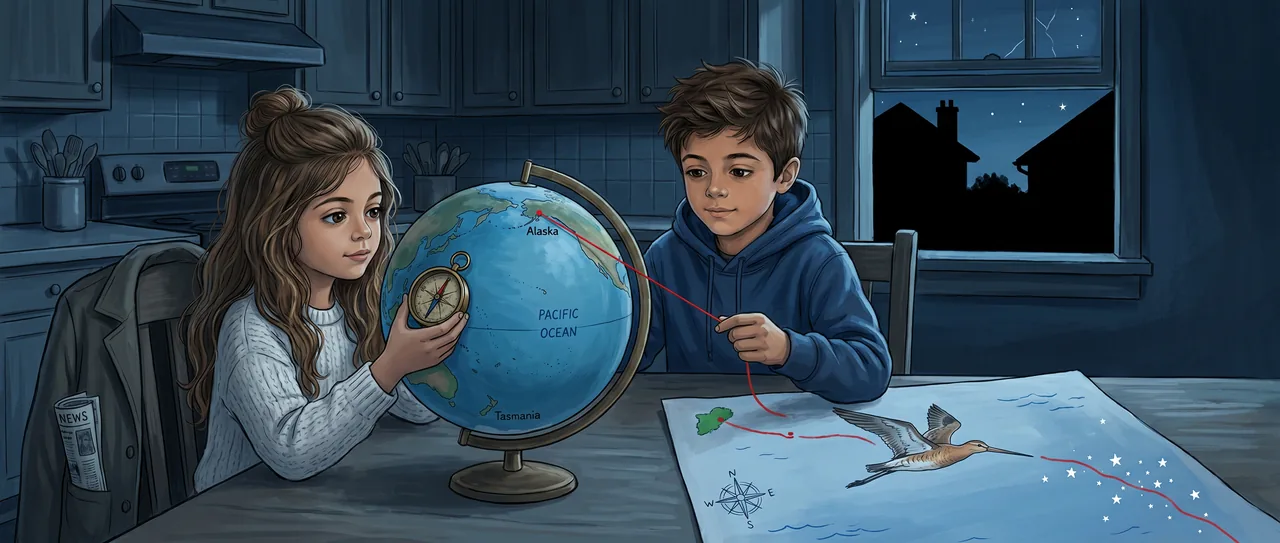
Maya had spread the atlas across the kitchen table and weighted the corners with a salt shaker, a mug, Soren's elbow, and one purple sneaker. Soren held a spool of red thread over Alaska.
The newspaper clipping lay between them, wrinkled from being carried in Soren's coat pocket all day.
A bar-tailed godwit, it said, had flown from Alaska to Tasmania in twenty twenty-two. Thirteen thousand five hundred sixty kilometers. Eleven days. No landing. No eating. No drinking.
Maya's mother had read the first two lines while stirring soup and said, "Then there must be islands. Everything lands. Don't get glue on the table."
Then she had gone back to the stove, where everything smelled like onions and her attention ended.
Soren did not glue anything. He was still on the first problem.
"If we put the route here," he said, lowering the thread from Alaska toward the map's bottom edge, "it goes through nothing."
"Ocean," Maya said.
"Ocean is not a landing place."
"For a fish."
"It's a bird."
Maya leaned in until her braid touched the Aleutian Islands. "Maybe it hopped. Alaska to here. Then here. Then somewhere tiny."
Soren moved the thread from dot to dot. The route bent west, then south, then east again, like someone trying to avoid a spill on the floor.
"That makes it longer," he said.
"Maybe godwits like longer."
He looked at her.
"Fine," Maya said. "Bad answer. Keep it. Bad answers point."
They had been asked to make a migration mural for the recycling center window, because the old one still had monarch butterflies flying the wrong direction in winter. Maya wanted one red line so sharp that people would stop walking. Soren wanted the line to be true.
The godwit was the size of a bird a person might almost overlook. In the clipping, it stood on long legs in shallow water, with a bill like a careful tool. It did not look like something that could cross an ocean. It looked like something that might step around a puddle.
Soren turned the atlas sideways. "Maybe the tracker made a mistake."
Maya pressed one finger on the printed words. "Satellite tag."
"Satellites can be wrong."
"For eleven days in a row?"
He did not answer. That was how Maya knew the answer had landed.
They tried the globe next. It had a crack down the Indian Ocean and a dent where Soren had once dropped it on his foot. Maya held Alaska under the ceiling light. Soren stretched the thread again.
On the globe, the route looked worse.
The blue did not sit flat and harmless, the way it did in the atlas. It curved away. Tasmania was not just down. It was around. The thread hovered over a round world with no shelves, no ladders, no little places for a tired bird to fold its wings.
Maya put her eye level with the globe. "If it landed, it would have to be hiding from the map."
"Maps are good at islands," Soren said.
"So no islands."
"So no landing."
They looked at the bird in the clipping again.
Maya's mother came by with bowls. "Did you find your islands?"
"No," Maya said.
"Then draw some waves," her mother said. "Waves are nice."
She put down the soup and left two spoons, both different sizes.
Soren took the smaller spoon without looking. He was reading the clipping for the sixth time. "It says it left from Alaska after feeding on mudflats."
"Mudflats are not soup," Maya said.
"They are if you have the right beak."
That sent them to the bird book on the shelf by the back door, the one with sand still trapped in its spine from a beach trip. They found godwits under shorebirds. Long bills. Long wings. Feeding in wet sand and tidal flats. Flying huge distances between breeding and wintering grounds.
Maya ran her finger down a paragraph and stopped.
"They get fat," she said.
"Lots of animals get fat."
"No. Listen. Before migration, they store enormous fat reserves. Their bodies change. Flight muscles. Heart. Some organs used for feeding can shrink because they won't be eating."
Soren set down his spoon. "They pack themselves into themselves."
Maya grinned. "Exactly."
He pulled his notebook from his pocket, then stopped before opening it. "If the fuel is inside, the landing places are inside."
Maya's mother called from the stove, "Eat before it gets cold."
Maya dipped her spoon, missed her mouth, and kept reading. "Fat can make water when the body uses it."
Soren looked at his soup as if it had become less important. "So no drinking does not mean no water. Not exactly."
"Not exactly," Maya said.
That was the first time the route did not look impossible. It looked severe. It looked like a promise made before takeoff.
Still, Soren would not let the red thread touch the glue.
"Fuel is one problem," he said. "Direction is another. If there is no land, what does it steer by?"
Maya went still in the way that meant several thoughts had collided and none had apologized.
"Not our map," she said.
Soren waited.
She took the compass from the junk drawer. It was scratched and cloudy, but when she set it beside the globe, the needle swung and settled.
"That," she said.
"Earth's magnetic field," Soren said.
"We don't feel it."
"Birds can. Some birds use it to navigate."
Maya turned off the kitchen light. The window became black, with their reflections floating in it. Outside, one early star showed above the neighbor's roof.
"Stars too," she said.
Soren nodded. "And the sun. Maybe wind. Maybe smells. I read that some birds use odors, but scientists are still figuring out how much."
Maya opened the window a crack. Cold air slid over the table, carrying wet leaves, car exhaust, and the sharp salt smell of soup cooling in bowls. The compass needle did not care about any of it. It held its slant. Soren touched the newspaper clipping. "If you only believe in roads, the bird is lost."
Maya picked up the red thread. "Good thing the bird doesn't."
They rebuilt the mural without islands.
Soren drew Alaska small and cold at one corner. Maya cut Tasmania from green paper no bigger than her thumbprint. Between them they left the Pacific wide and plain, except for one red thread.
It crossed the blue without stopping.
Under the thread, Soren printed the distance in careful letters. Maya added, No landing, no eating, no drinking, and then stared at the words.
"It sounds like a dare," she said.
"It sounds like a measurement," Soren said.
"Both."
He considered that. "Both."
They did not add a smiling sun. They did not add waves with faces. They added a tiny compass rose, a scatter of white stars, and, near the bird's head, three almost invisible lines for the senses people argue about because people cannot borrow them.
When Maya's mother came to clear the bowls, she stopped behind them.
"That is a very empty ocean," she said.
Maya and Soren looked at the thread.
"No," Soren said.
Maya set the compass on the globe's blue Pacific. The needle trembled north. Soren lifted the red thread from Alaska and pulled it tight toward the tiny island at the bottom edge, while above them the first stars came out one by one.
Read the interactive version, listen to the narration, and earn a gold star →
A science-verified short story for curious kids · Curiosity Land