Before Words
The first thing that worked was not a word.
Maya found that unfair, because she had spent the whole afternoon making words behave.
She had taped paper labels to everything in the community room. Door. Sink. Cups. Trash. More cups. She had drawn little pictures beside each word because pictures did not change their minds halfway through a sentence. A cup was a cup from any angle. Mostly.
Her mother carried in a tray of rice and beans and looked at the walls.
"Maya," she said, "this is either extremely helpful or we have been conquered by office supplies."
"Both can be true," Maya said.
Her mother set down the tray. She wore her Welcome Committee smile, which was bright and a little too tight at the edges. She had made a schedule, a seating chart, and three versions of the same soup because she did not know what the new family could eat. Her mother believed kindness could be organized if you had enough sticky notes.
Maya believed confusion could be organized if you had enough categories.
The new family had arrived that morning from far away. Maya knew this because the elevator had been full of boxes with airport stickers, and because the small boy in the blue sweater had stood beside them with both hands pressed flat against his ears.
No one in the building spoke the family’s language. The translation app on her mother’s phone was supposed to fix that. Maya did not trust it. Last week it had translated "laundry room" into "wet clothing cave," which was almost better but not useful.
So Maya made a wheel of pictures. Bathroom. Food. Water. Tired. Hurt. Happy. Scared. Stop. More. She punched a brass fastener through the middle so the pictures spun. It was beautiful. It was precise. It smelled like markers.
By six o’clock, the community room filled with neighbors and steam and the lemony cleaner the building manager used on Fridays. Chairs scraped. Plates clicked. Adults leaned toward one another and said things slowly, which never made unknown words less unknown.
The new family came in last.
The grandmother held a paper bag against her chest. The father carried a baby. The mother carried nothing, but she looked as if she were carrying all the noise in the room. The small boy in the blue sweater stayed half behind her leg.
Maya’s mother hurried over with her phone.
"Welcome," she said into the app.
The phone thought about it. Then it spoke in a cheerful voice that made everyone sound like a weather report.
The grandmother frowned.
The father answered carefully. The phone listened, flashed, and said, "The moon is hungry for carpet."
No one moved.
Maya put one finger on the picture wheel in her pocket.
Her mother laughed politely, but it was not real laughter. It had corners.
"Let’s try again," her mother said.
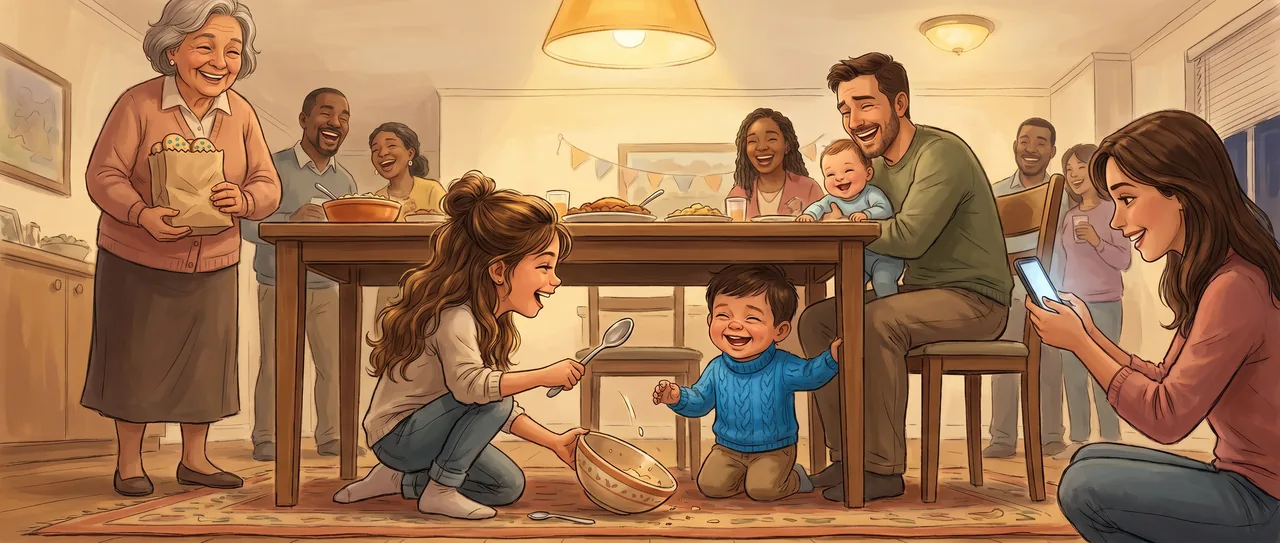
The small boy stepped backward. His shoulder knocked the table. A tower of paper cups leaned, shivered, and fell. Everyone turned at once.
The boy ducked under the table.
Adults began making the sounds adults make when they want a child to feel better. Soft, high voices. Too many words. The mother crouched, speaking fast. The father rocked the baby. Maya’s mother whispered to her phone as if the phone might get smarter if she sounded worried.
Maya took out her picture wheel and crouched on the other side of the table, not too close.
Underneath, the boy’s shoes pointed toward the wall.
Maya slid the wheel across the floor until it stopped near his knee. She pointed to the picture of Scared. Then Stop. Then Water.
The boy stared at the wheel. His face did not change.
Maya added the picture of Happy, because sometimes people wanted to know what you wanted them to want.
Nothing.
The wheel, perfect and useless, lay between them.
Maya sat back on her heels.
There were too many words above the table. They fell through the air like socks from a dryer, soft and smothering. The boy could not catch any of them. Neither could she. Now the boy under the table made a tiny sound, not a cry exactly. More like a breath that had caught on a thorn.
Maya reached for the picture wheel, but her sleeve caught the tablecloth. A spoon slid from a bowl, hit the edge of a chair, spun twice on the floor, and landed with a ringing ping.
Maya froze.
The boy looked at the spoon.
It wobbled in a smaller and smaller circle.
Maya did not move. The wobble became ridiculous. The spoon fought the floor and lost.
The boy made one sharp sound.
It was not loud. It was barely even a laugh. But it had no corners.
Maya looked at him. He looked at her. His eyes widened, as if he had not meant to let that sound escape.
Above them, the adults went quiet.
Maya picked up the spoon. Slowly. Carefully. She held it up where the boy could see.
Then she let it fall.
Ping.
The spoon spun, tilted, clattered, and lay still.
This time the boy laughed twice.
Maya’s mouth answered before she planned it. A laugh jumped out of her, small and surprised. The boy’s grandmother laughed next, a warm crackling sound. The baby squealed. Someone near the soup table snorted and tried to hide it, which made it worse, which made it better.
Maya picked up the spoon again.
Her mother whispered, "Maya, don’t throw utensils."
Maya did not throw it. She raised one eyebrow at the boy and placed the spoon on the edge of the upside-down bowl. She breathed in, waiting.
The boy leaned forward.
The spoon slid by itself and dropped.
Ping.
The room broke open.
Not into chaos. Into rhythm.
The grandmother’s laugh came first each time, low and crackly. The baby answered with squeaks. Maya’s mother covered her mouth, then gave up. The boy under the table laughed with his whole face, knees pulled to his chest, blue sweater shaking.
Maya felt it in her own ribs. The same little leap. The same loosening. The hot knot in the room softened, person by person. Shoulders dropped. Hands unclenched. The father sat on the floor beside the table, still holding the baby, and tapped one finger on the tile in time with the spoon.
Maya had spent years being told to wait until people finished talking. Now talking was the noise on top. The useful thing was underneath it.
She changed the experiment.
Spoon on bowl. Ping.
Spoon on cup. Tock.
Spoon sliding down a paper plate ramp. Skitter, flap, ping.
Each sound made a different laugh. The baby liked the plate. The grandmother liked the bowl. The boy liked the pause before the fall, when Maya held very still and everyone’s breath gathered in the same invisible place.
Soon the new mother was laughing too, one hand pressed against the table leg, her forehead resting there as if she needed the furniture to hold her up. Maya’s mother stopped using the phone. The phone lay on the table with its app open, listening to laughter it could not translate.
The boy crawled out from under the table.
He picked up a plastic fork and looked at Maya.
Maya pointed to the upside-down bowl.
He set the fork on the rim. It slid at once, too fast, and dropped with a flat little tap.
Everyone laughed because it was terrible.
The boy laughed hardest.
Maya laughed with him, and the bright feeling shot through her chest again, not like a joke, not exactly. More like a signal that had found its answer.
The grandmother opened her paper bag. Inside were round cookies dusted with sugar. She offered one to Maya, then said a word Maya did not know.
Maya took the cookie. She pointed to herself.
"Maya," she said.
The grandmother touched her own chest and said her name. Maya could not hold the sounds yet, but she held the shape of them, the lift and fall.
The boy touched his chest and said his name too.
Maya repeated it badly.
He laughed.
She repeated it worse on purpose.
He laughed so hard he had to sit down.
Maya’s mother picked up her phone, then paused. Her Welcome Committee smile had come loose and turned into the regular kind.
"May I record this?" she asked, gesturing to the phone, to the spoon, to the bowl.
No one understood the sentence.
Maya held up the phone, pointed to its little red record button, then pointed to the spoon. She made her eyebrows ask the question.
The new mother looked at the boy. The boy looked at the spoon. Then he nodded.
Maya set the phone beside the bowl, tapped record, lifted the spoon, waited for the boy’s eyes to find hers, and let it drop.
Read the interactive version, listen to the narration, and earn a gold star →
A science-verified short story for curious kids · Curiosity Land