Any Two
The first impossible thing was that nothing happened.
There were twenty-three students in Maya’s class. The teacher had given each of them a blue card and said to write down a birthday, month and day only, no years, because the class birthday calendar had fallen behind again.
Maya had stopped writing halfway through April.
Twenty-three.
She knew that number. It had been sitting in her head for three weeks, annoying and shiny, like a bead under a sofa. In a group of twenty-three people, there was a better than half chance that two people shared a birthday.
Not the same age. Not the same year. Just the same square on the calendar.
Maya put down April ninth and waited.
The cards went to the teacher’s desk. The teacher had one hand full of blue cards and the other hand full of curled posters from the morning assembly about passwords and digital fingerprints. She was trying to keep the posters from rolling shut with her elbow.
January. February. March. The teacher pinned the cards in rows.
No match.
April. May. June.
No match.
By September, half the class had turned around to look at Maya, because she had said the twenty-three thing at lunch. She had said it too fast. She had used her hands. Someone had asked if that meant two people in their room had to match, and Maya had said, almost.
Almost was a dangerous word. It sounded like yes until it did not.
October. November. December.
No match.
The teacher smoothed the last card onto the board. Twenty-three blue cards. Twenty-three different days.
A few kids laughed, not cruelly exactly. More like a door had stuck and then popped open.
The teacher smiled in the tired way adults smiled when they wanted a subject to be finished. “Probability is slippery,” she said. “Maybe your book meant a bigger group.”
Maya looked at the board.
The cards looked too separate.
That was the problem. They looked like twenty-three small things.
After lunch, the class went to music. Maya stayed behind because she had been chosen to help take down the digital safety posters. Chosen meant she had reached for the tape before anyone asked. The teacher was at her desk, answering messages with the focused frown of someone trying to make a machine stop asking questions.
“Two minutes,” the teacher said without looking up. “Then music.”
Maya pulled a poster from the wall. It showed a padlock made of ones and zeroes. Under it were words from the assembly: A digital fingerprint is a short mark for a larger message.
A smaller poster had slipped behind the radiator. Maya tugged it free. Dust came with it. Across the top, in block letters, it said: COLLISIONS.
Below that: When two different messages have the same fingerprint, cryptographers call it a collision. Some old systems have been broken by birthday attacks.
Maya stared at the words birthday attacks.
The poster did not have cakes on it. It had two envelopes, different sizes, stamped with the same tiny black square.
The teacher’s keyboard clicked.
Maya put the poster on the floor and went to the birthday board.
Twenty-three cards. No twins.
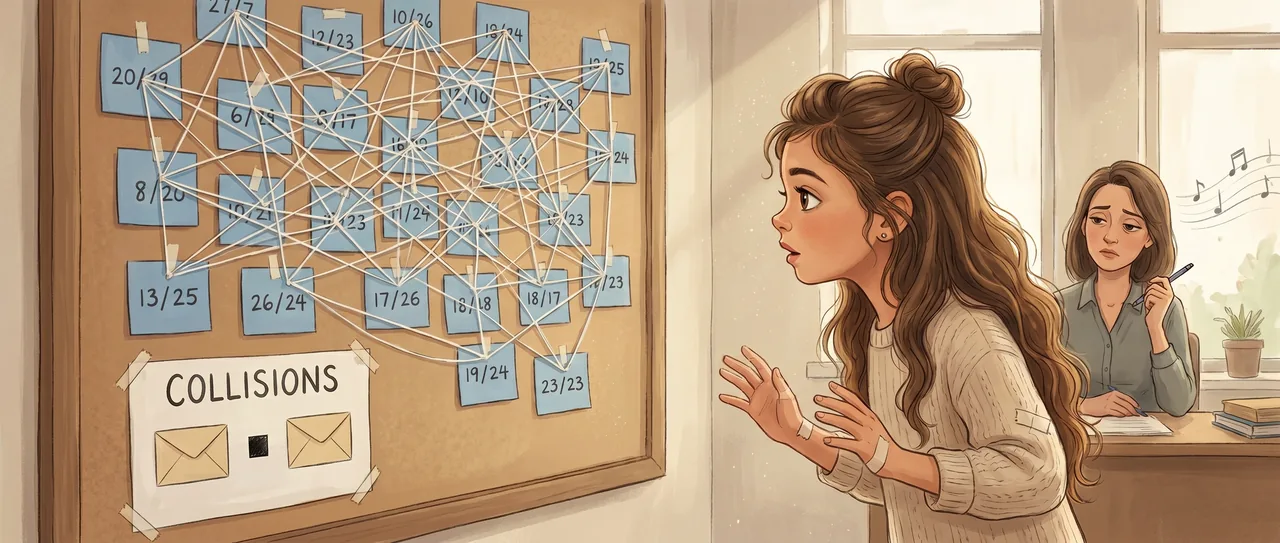
She took the roll of white string from the supply shelf. It was the string they used for hanging paper planets in February. She cut one piece and taped it from her card to the January fourth card.
Then from her card to February seventeenth.
Then to March second.
The string crossed the board in clean pale lines.
“Maya,” the teacher said.
“I’m not done being wrong.”
The keyboard stopped.
Maya kept going. From April ninth to every other birthday. Twenty-two lines from one card. That was only Maya compared with everyone else.
She moved to January fourth. She did not connect it back to Maya, because that pair was already counted. She connected it to the other twenty-one cards.
The board changed.
It was not a calendar anymore. It was a net.
The teacher stood up, still holding a pen. “What are you making?”
“The room,” Maya said.
She moved to the next card. Twenty more lines.
The first few had been neat. Now the string crossed and crossed again, a pale crowd of almosts. The month labels disappeared behind it. Birthdays that had looked lonely were suddenly tangled together. Any two. Not Maya and someone. Not one chosen birthday and the rest. Any two people in the room.
Maya’s fingers got sticky with tape.
The teacher came closer. She was not smiling now. She was counting under her breath.
“Twenty-two plus twenty-one plus twenty,” Maya said. “Then nineteen. Then eighteen. It keeps going.”
“That is a lot of comparisons.”
Maya nodded. She did not stop.
At the eleventh card, the board was so full of string that she had to lift lines gently to slide new ones underneath. A piece of tape stuck to her sleeve. The room was quiet except for the heater ticking and the small rip sound of tape leaving the dispenser.
Twenty-three had been small enough to fit in one classroom.
The pairs did not fit on the board.
When she finished, the last card had no new lines to give. Every possible pair had already been made. The board held two hundred fifty-three white connections.
Maya stepped back.
The teacher whispered, “Oh.”
Maya liked that sound from adults. Not because it meant she was right. Because it meant something had moved.
The teacher touched one string with her pen. “So the question was never, does someone match you.”
Maya shook her head.
The birthday cards had not matched today. That part still bothered her, but differently now. A coin could land tails. That did not make it stop being almost half. A class could miss. Another class could hit. The chance was not hiding in any one card. It was spread across the whole web.
Maya picked up the collision poster from the floor.
Two envelopes. Same black square. But small meant there were only so many marks.
If someone looked for one exact message with one exact fingerprint, that was one kind of hard. If someone looked for any two messages that landed on the same fingerprint, the web woke up.
“Birthday attack,” Maya said.
The teacher looked at the poster. “That is the idea. Real systems use enormous fingerprints now. The good ones make collisions far, far too hard to find.”
“But people test them this way.”
“Yes,” the teacher said. “People test them this way.”
Maya looked at the words again.
Somewhere, grown-ups who built locks for messages had worried about the same sideways thing that made everyone laugh at lunch. They had not asked only about the obvious match. They had counted the invisible pairs.
The music room door opened down the hall. The class was coming back, loud and uneven.
The teacher glanced at the web, then at the doorway. “They are going to ask what happened to the birthday board.”
Maya held up the collision poster.
“Good,” she said.
The first students came in and stopped. One bumped another. Someone said, “Whoa.”
Maya taped the poster beneath the web, where the words birthday attack sat under two hundred fifty-three white lines.
Read the interactive version, listen to the narration, and earn a gold star →
A science-verified short story for curious kids · Curiosity Land