Where the River Kept the Wolves
The river failed before breakfast.
It was supposed to curve.
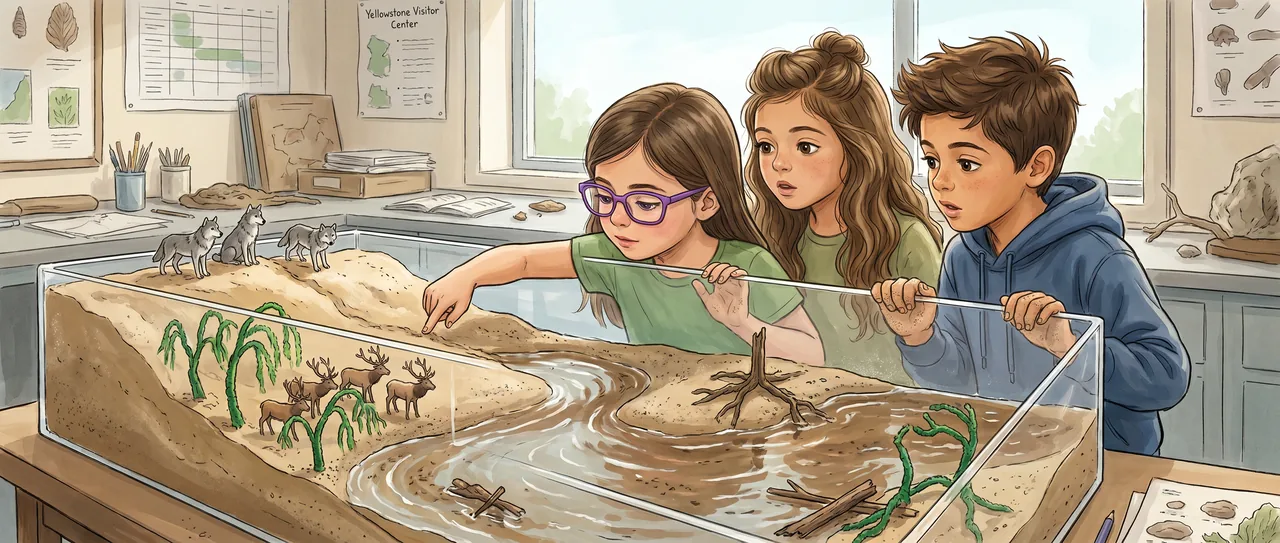
Maya had packed the sand tight against the sides of the clear plastic stream table. Soren had set the pump to a trickle, because real creeks did not arrive like spilled soup. The water came down from the little hose, silver and polite, and ran straight through the valley they had carved.
Straight in. Straight out.
On the workroom table beside them stood thirteen gray wolf figures, each no taller than Maya’s thumb. The old exhibit label in the box said the story began with thirteen wolves in nineteen ninety-five. Soren had already found three books that counted the first Yellowstone releases differently, depending on which winter and which pen. He had written, Numbers can be slippery, in his notebook, then shut it because they were not allowed to finish the display with a sentence that needed explaining.
Maya picked up one wolf and set it in the water.
It tipped over and floated away nose-first.
“That’s worse,” Soren said.
“I know.”
The ranger leaned through the doorway with half a bagel in one hand and a radio talking from her belt.
“Please tell me the wolves are not swimming,” she said.
“Not on purpose,” Maya said.
“The visitors arrive in two hours. Also, do not make the sign say wolves magically changed rivers. People love that sentence too much.”
The radio crackled. The ranger listened, frowned at the ceiling, and vanished down the hall with her bagel.
Maya stared at the floating wolf until it nudged the drain screen.
“They don’t touch the river,” she said.
“That is the problem.”
“No,” Maya said. “That is the shape of it.”
Soren waited. He had learned not to interrupt when Maya’s voice got smaller. It meant she was moving faster than words.
She lifted the wolf out, shook water from its paws, and set it on the sand ridge above the channel.
“Again,” she said.
Soren reset the stream table. Water slid down. The channel stayed straight.
“Still nothing.”
“Because the elk are missing.”
The elk figures were in a tin marked Ungulates, which Soren thought was a very good word and Maya thought sounded like coughing. They set a herd along the streambank. The elk were brown and stiff, heads lowered as if every plastic mouth were permanently hungry.
Maya broke green pipe cleaners into short stems and stuck them into the wet sand.
“Willows,” she said.
“Too tall.”
“They are symbolic willows.”
“Symbolic roots do not hold banks.”
Maya handed him the rest of the pipe cleaners.
“Then make them unsymbolic.”
Soren bent each one into a buried hook before pushing it into the sand. It took longer. His fingers got gritty. The stems no longer stood in neat rows. They leaned, snagged, crossed underground, and tugged at the sand when he pulled gently.
“That’s better,” he said.
Maya lined elk along one bank and pinched away the pipe-cleaner willows in front of their noses.
“Browsing,” she said.
“Eating young shoots,” Soren said.
“Chewing the river’s shoelaces.”
They turned on the pump.
The bare bank slumped first.
A small bite of sand fell into the water. Then another. The current picked up the grains and carried them downstream in a brown ribbon. The channel widened where the willows were gone. On the other bank, where Soren had anchored the green stems deep, the water slid past without taking much with it.
Maya leaned so close her hair almost touched the stream.
“There,” she said.
“It’s not the wolf yet.”
“It is getting ready to be.”
Soren placed the wolves on the ridge, not by the water, but near the open stretch where elk had been eating. He moved half the elk back toward the higher ground and left only two by the creek.
“That’s too simple,” he said.
“Yes.”
“Elk numbers changed. Elk behavior changed. Snow changed things. People argued. Beavers mattered.”
“Yes.”
Maya added a little pile of sticks across a side channel. “Beavers, then.”
Soren looked at it. “Beavers do not return because a child puts sticks in a stream table.”
“They return where willows can feed them.”
“That is annoyingly fair.”
They ran the pump again.
This time the water came down the valley and met the anchored bank. It pressed, curled, and turned. It found the little stick dam, slowed behind it, dropped its sand, then slipped around the side in a narrower thread. The channel did not stay where their fingers had drawn it. It began to choose.
Maya stopped breathing for three seconds.
The river was not obeying the wolves. It was answering the banks. The banks were answering the willows. The willows were answering the elk. The elk were answering the animals on the ridge that never got their paws wet.
Soren did not write anything down. He put both hands flat on the table edge and watched the current make a bend that had not existed a minute before.
The workroom door opened again. The ranger came in with a stack of laminated maps under one arm.
“Oh,” she said.
The word was small, but it changed her face.
Maya pointed at the table. “The wolf goes here.”
“On the hill,” Soren said.
“Not in the river.”
The ranger set down the maps. “Show me before the school group gets here.”
Soren shook his head. “We should not show it first. They should break it first.”
Maya grinned.
The ranger looked at the wet sand on the floor, the muddy fingerprints on the pump switch, and the wolf lying on its side near the drain.
“I am going to regret saying yes,” she said.
The fourth graders arrived loud and damp from morning rain. They expected wolves with teeth. They expected the river to do something dramatic, maybe leap, maybe glow. Maya gave them the elk first.
“Make a valley where elk eat every willow along the bank,” she said.
The children packed sand and yanked out green stems. Their river collapsed beautifully.
“It’s wrecked,” one child said.
“It’s wide,” said Soren.
“It’s messy,” said another.
“It’s honest,” Maya said.
Then Soren gave them the wolves.
“Put them where they can change the river without touching it,” he said.
The children argued. One put a wolf on the dam. One put all the wolves in a circle like a meeting. A quiet girl with purple glasses set three wolves on the open bank above the elk and moved the elk away from the youngest willows.
The ranger opened her mouth, then closed it.
Maya handed the girl more pipe-cleaner stems. “Here.”
The girl planted them carefully, each one with a buried bend.
When the pump started, the room went quieter than the machines.
The brown water pressed against the repaired bank and failed to take it. It curved around the willow roots. It slowed behind the beaver sticks. It left a tiny new bar of sand where there had been only moving water.
The quiet girl stepped closer until her glasses almost touched the clear wall of the table.
“They’re in it,” she said.
“The wolves?” asked the ranger.
The girl shook her head and pointed from wolves to elk to willow to bank to current, not skipping any step.
“All of them.”
After the school group left, the workroom smelled like wet sand and pipe cleaners. The ranger stood over the stream table, turning one wolf figure between her fingers.
“I was afraid of the magic version,” she said.
“So were we,” Soren said.
Maya looked at the little river. It had cut a narrow curve beside the willow stems. Nothing in the table looked finished. That was the best part. Beyond the path, real willows grew along a real creek, thin and bright and trembling in the cold air.
Soren crouched beside the damp ground. Elk tracks pressed deep near the mud, two long halves like opened seeds.
Maya picked up a twig.
She pressed its broken end into the mud above the elk tracks, once, twice, four times, making the small round marks of toes.
Read the interactive version, listen to the narration, and earn a gold star →
A science-verified short story for curious kids · Curiosity Land