Where the Floor Goes Down
The ocean floor was supposed to vanish.
Instead, it piled up in a blue rubber wrinkle at the edge of the cardboard continent.
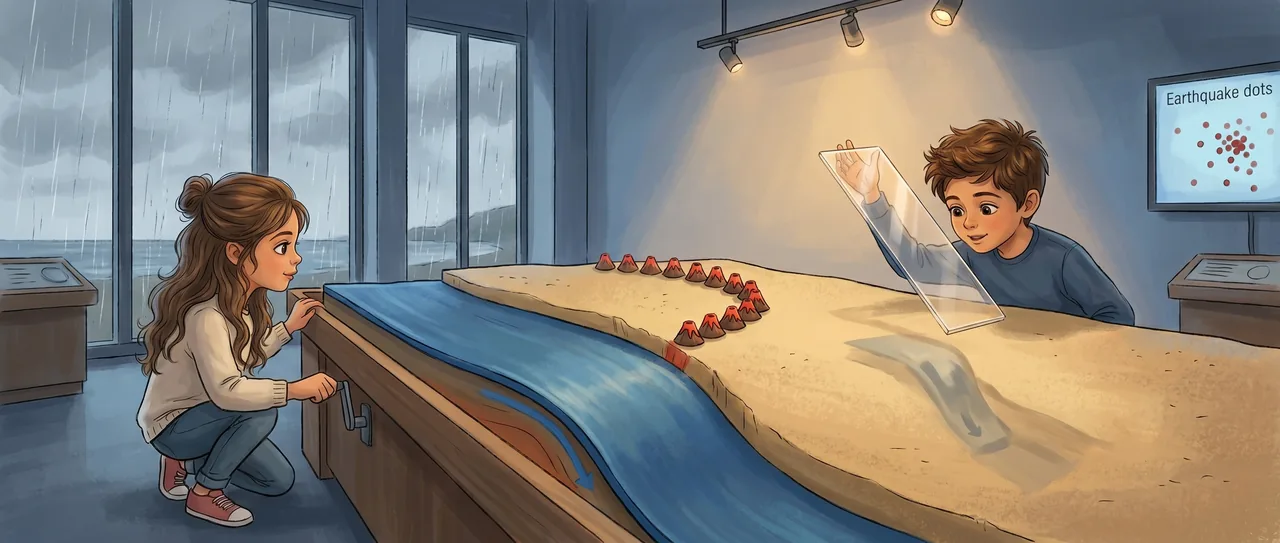
Maya crouched beside the exhibit table with one cheek almost touching the painted Pacific. Soren stood on the other side, turning the crank with two careful fingers. The blue rubber strip moved out from a long raised seam labeled MID-OCEAN RIDGE, crossed the table, reached the continent, and crumpled.
It made a little squeak.
“That is not recycling,” Maya said.
“It is traffic,” Soren said.
Ms. Ibarra, the science center director, hurried past with a roll of yellow caution tape over one shoulder and three marker pens in her mouth. She had silver hair cut very short and shoes that made quick, important sounds.
“Does it move?” she asked around the pens.
“It moves wrong,” Soren said.
“Wrong is still movement,” Ms. Ibarra said. “Families arrive in twelve minutes. If the plate jams, tell them continents are complicated.”
Maya looked at the rubber wrinkle. “That is not complicated. That is false.”
Ms. Ibarra took the pens out of her mouth. “The mayor is coming to see our new earthquake safety room. I need the tsunami route arrows straight, the volcano lights working, and nobody falling into the Mariana Trench.”
She pointed to a black painted groove on the far side of the table. It was so narrow and dark that Maya wanted to put her finger in it.
Soren had already put his pencil across it. “Deepest place in the ocean,” he said. “About eleven kilometers.”
“Not tonight it isn’t,” Ms. Ibarra said. “Tonight it is wet paint. Please do not touch it.”
Then she was gone, quick shoes clicking toward the lobby.
Maya kept staring at the blue wrinkle.
Soren turned the crank backward. The rubber unwrinkled and slid away from the continent.
“It could crumple,” he said. “Mountains crumple.”
“Not there,” Maya said.
“How do you know?”
She pointed across the painted Pacific. Pale stripes ran out from the mid-ocean ridge, matching on both sides like the ribs of a leaf. Near the trench, the stripes stopped.
“Pattern ends,” she said.
Soren leaned close. “Maybe paint ran out.”
Maya looked at him.
“I do not think paint ran out,” Soren said. “I am saying it out loud so it can be wrong properly.”
He took a strip of blue rubber from the model and laid it flat on the table. The underside had little metal washers taped inside it, making it heavier than it looked. The continent was tan foam, thick and light.
Soren pressed the rubber against the foam. It wrinkled again.
“Too stiff,” Maya said.
“It is also trying to go through a wall.”
“So do not make a wall.”
“There is a continent there.”
“Continents are not walls.”
Soren stopped. He looked at the foam continent, then at the slot cut in the table just in front of it. The slot was hidden by the crumpled rubber.
“Oh,” he said.
Maya smiled.
The model had not been built wrong. It had been assembled afraid.
Soren lifted the edge of the tan foam. Under it, someone had cut a dark sloping tunnel through the table. It disappeared toward the floor.
Maya took the heavy blue rubber strip in both hands and fed its end into the slot.
Soren turned the crank.
The ocean floor moved from the ridge. It crossed the Pacific. At the continent, the blue strip bent downward and slid beneath the tan foam. The edge dipped into a sharp groove.
A trench opened.
The room went quiet, though the lobby was still noisy and Ms. Ibarra was still calling for someone to find more tape.
The blue floor kept going down.
Not breaking. Not stopping. Leaving.
Maya put her hand under the table. The rubber strip slid past her fingers into the darkness below.
“It goes under,” Soren said.
Maya nodded once. “It gets eaten.”
“Recycled,” Soren said. “Ocean floor into mantle.”
“Eaten sounds older.”
The crank clicked. The painted stripes traveled toward the trench and vanished one by one.
Soren reached for a tray of small red beads that had been left beside the volcano sign. “Where do these go?”
Maya looked at the map. The red volcano symbols were not on the trench. They stood inland, in a curve, like someone had copied the trench but moved it back.
“Not at the bite,” she said. “Behind it.”
Soren frowned. “Why behind?”
Maya lifted the foam continent again. The blue strip sloped under it. “The down-going plate is there.”
Soren followed the slant with his pencil, not touching the wet paint. “Water in the ocean plate goes down too. Minerals carry it. Then water helps hot rock melt above the slab.”
Maya picked up one red bead and set it on the continent above the hidden blue strip.
Soren set another bead beside it. Then another.
A red arc grew across the tan foam.
The Ring of Fire sign, which had been lying upside down on the floor, suddenly belonged somewhere.
Ms. Ibarra came back carrying a stack of evacuation maps. She stopped so fast the maps slid forward in her arms.
“You fixed the jam,” she said.
“We made it worse,” Maya said.
Soren turned the crank. The blue floor slid down. The trench deepened at the bend. The red beads waited above the hidden slope.
Ms. Ibarra’s face changed. The hurried part of it stayed, but something else arrived, something younger and not in charge.
“The old version just shoved the ocean into the continent,” she said.
“It wanted the visible part to be the important part,” Soren said.
Maya moved one bead a finger-width to match the painted curve. “It wasn’t.”
The first visitors came in, shaking rain from their jackets. Ms. Ibarra turned toward them, then back toward Maya and Soren.
“Can you run this station?” she asked. “No speeches. Just show them.”
“Yes,” Maya said.
Soren said, “We need one more thing.”
He went to the supply box and pulled out a roll of clear plastic. He cut a narrow strip, then taped one end to the blue rubber where it entered the trench. The plastic rose at an angle under the tan foam, almost invisible unless the light caught it.
“What is that?” Ms. Ibarra asked.
“The part nobody sees,” Soren said.
Maya placed the red beads above it again. “Now they can almost see it.”
Ms. Ibarra looked as if she might argue that invisible things were bad for exhibits. Then the floor gave a soft mechanical thump, and the earthquake table across the room began to rattle for its scheduled demonstration.
A little girl laughed. A man grabbed his coffee. The hanging lights trembled.
On the wall screen, a map of recent earthquakes blinked with small yellow dots around the Pacific. Japan. Alaska. Chile. New Zealand. Curves and edges and arcs.
Ms. Ibarra put down the evacuation maps beside the model. “The strongest quakes we know come from places like this,” she said to the gathering visitors, then stopped and looked at Maya.
Maya shook her head.
Ms. Ibarra stepped back.
Maya turned the crank.
The blue strip crawled across the table.
“This is new ocean floor,” she said.
Soren placed his finger lightly on the ridge. “It starts here.”
The stripe moved.
“It does not get older forever,” Maya said.
Soren touched the trench without touching the paint. “Here it dives.”
The blue strip bent and disappeared under the continent. Several visitors leaned closer.
Maya tapped the red beads. “Volcanoes here.”
A boy in a raincoat pointed at the gap between the trench and the beads. “But nothing is there.”
Soren slid the clear plastic strip until it caught the ceiling light. A ghost of a plate appeared under the continent.
“There,” he said.
The boy bent until his nose nearly touched the model.
The crank clicked in Maya’s hand. The ocean floor kept going down, and the red arc sat above it like a row of small, hot secrets.
Behind them, the earthquake table stopped rattling. The room did not feel still afterward. It felt paused.
Ms. Ibarra handed out evacuation maps. Her quick shoes were quiet now.
Maya kept turning the crank until the last painted stripe vanished into the slot. Soren fed a new blue stripe from the ridge, and another began its slow trip across the Pacific.
Through the tall windows, rain slid down the glass. Beyond the parking lot, the dark shape of the coastal hills rose into cloud. Farther east, where the clouds had thinned, one snow-covered volcanic cone showed for a moment in the gray light.
Maya lifted one red bead from the tray and held it against the window. Beyond the glass, the white cone of the mountain sat exactly behind it.
Read the interactive version, listen to the narration, and earn a gold star →
A science-verified short story for curious kids · Curiosity Land