The Wall That Was Busy
The graph should have climbed.
That was the whole point of a graph in a glass room under a noon sun. It should have gone up in a brave red line while the roof baked and the visitors said ooh and Dr. Vale smiled like the future had arrived exactly on schedule.
Instead, the red line lay flat across twenty-three degrees Celsius.
Dr. Vale tapped the tablet with one fingernail. She had silver hair cut like a paintbrush and green dust on one knee from crawling under a planter. She had designed the rooftop greenhouse for the science museum, and she looked personally insulted by the number twenty-three.
“Humiliating,” she said. “The sensor has chosen opening day to become a ruler.”
Soren leaned closer. “Sensors can fail flat.”
Maya put her palm against the sunlit wall panel. The panel was pale gray and smooth, with a little round window set into it. Behind the window was a thumb-sized pouch, cloudy white at the bottom and clear at the top.
“Too flat,” Maya said.
“That is what broken means,” Dr. Vale said. She was already turning toward a cabinet full of wires. “I have eight minutes before the first group comes up. I can swap the probe if someone finds me the tiny screwdriver that looks exactly like all the other tiny screwdrivers.”
Maya did not move.
Soren did, but not toward the cabinet. He opened his paper notebook on a crate of seed trays. Dr. Vale had asked him once whether he really needed paper in a building with six wall screens.
“Yes,” Soren had said.
Now he wrote twenty-three, then pressed a handheld thermometer into the air above the basil.
“Twenty-three point one,” he said.
Dr. Vale stopped rummaging.
Maya touched the black metal frame of the window. “Hot.” She touched the wall again. “Not hot.”
“The wall is shaded inside,” Dr. Vale said.
Maya stepped sideways until sunlight from the roof glass fell straight across the panel. “This part isn’t.”
Soren measured there. “Twenty-three point zero.”
Dr. Vale’s eyebrows moved up, then down, as if she did not trust them yet.
The greenhouse smelled of damp soil, basil, warm plastic, and the sharp sweetness of new paint. Beyond the glass, the city flashed with solar windows. Inside, shelves of seedlings waited in their little squares of dirt. The museum had named the room Tomorrow’s Garden, which Maya thought was too smooth a name for a place full of hoses and screws and leaves that leaned wherever they wanted.
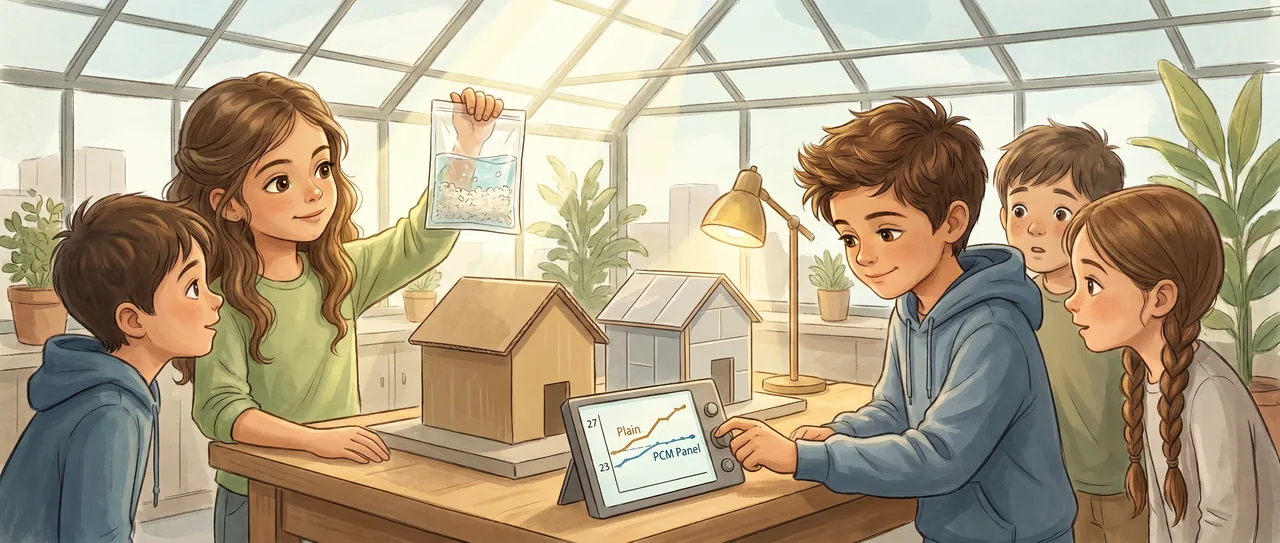
A row of model houses sat on the demonstration table, ready for visitors. One had plain cardboard walls. One had removable gray panels like the real greenhouse. Beside them lay two small lamps, two temperature probes, and a box of flat pouches labeled twenty-three degrees Celsius.
Maya picked up one pouch. It bent in the middle. Inside, white grains slid slowly through clear liquid.
“This one is half melted,” she said.
Soren took another from the box. It stayed stiff in his hand, white all the way through. “This one’s solid.”
“They were in the cool storeroom,” Dr. Vale said. “Charged overnight. They should absorb heat during the day, then release it when they solidify again after sunset.” She pointed at the flat red line. “But visitors do not trust a miracle that looks like a malfunction.”
“It’s not a miracle,” Soren said.
“I know that,” Dr. Vale said. “They do not.”
Maya set the bendy pouch beside the stiff one. “Make it show the wrong way first.”
Soren looked at her. “Plain house?”
“Plain house gets hot. Quiet house stays.”
Dr. Vale glanced at the door. Voices were rising from the stairwell, a class coming up two floors below. “You have seven minutes. I will be over here pretending I am calm.”
She went to straighten signs that were already straight.
Maya and Soren took the two model houses. The plain cardboard one had a clear roof. The other had slots in the walls where the gray panels slid in with a soft click. Soren fitted temperature probes through both roofs and made sure the tips hung at the same height.
“Air, not wall,” he said.
Maya nodded and placed a square of black paper on the floor of each house. “So the light has somewhere to land.”
“Same distance from the lamps,” Soren said.
They pushed both houses until their front edges lined up with a scratch on the table. Maya clicked four solid white pouches into the panel house. Soren turned on the lamps.
The bulbs made two bright circles. The plain house smelled faintly of warming cardboard almost at once.
Dr. Vale came back, pretending badly. “If this catches fire, I am changing my name.”
“It won’t,” Soren said.
“It had better not,” Dr. Vale said.
The first visitors entered in a river of shoes, backpacks, whispers, and chaperone warnings. The children spread across the greenhouse. Some went straight to the misting fern wall. Some pressed noses to the glass floor section that showed the street far below. A boy in a blue hoodie pointed at the big display.
“Your temperature graph is broken,” he said.
Dr. Vale opened her mouth.
Maya stepped to the demonstration table. “That’s what we thought.”
Soren turned the small display around so the group could see both model houses. The plain house line was already climbing, twenty-five, twenty-six, twenty-seven. The panel house line held near twenty-three.
“It’s also broken,” the boy said.
Maya picked up the half-melted pouch and held it against the light. “Look inside.”
The children leaned in.
At the bottom of the pouch, white bits rested like tiny pieces of moon. Around them, clear liquid shivered when Maya moved her hand.
“The lamp is putting heat in,” Soren said. “In the plain house, the air gets hotter. In this one, the heat is melting the stuff in the walls first.”
“So the number waits,” Maya said.
A girl with two braids frowned at the big greenhouse wall. “But waiting is not doing anything.”
Maya turned the pouch upside down. A white piece slid slowly through the clear part and stopped at the seam. “It’s doing this.”
The girl watched it. “Oh.”
Dr. Vale said nothing. She had both hands pressed over her own mouth, which made her look like she was holding in either a laugh or a sneeze.
Soren pointed to the model house line. “It will not stay flat forever. When all the wall packets finish melting, the temperature can climb. Tonight, when the roof cools, the packets can turn solid again and give the heat back.”
The boy in the blue hoodie stared at the little house. “So the wall remembers the afternoon?”
Soren considered that. “In a heat way.”
Maya liked that better than Tomorrow’s Garden.
The visitors moved closer to the real wall. Fingers touched the panels. Not pushing, just checking. Outside, clouds uncovered the sun. Light flooded through the roof. Leaves flashed green. The plain model house climbed past thirty. The panel house stayed at twenty-three.
Dr. Vale finally lowered her hands. “Would either of you like a job?”
“We’re eleven,” Soren said.
“I meant for the next ten minutes.”
Maya was looking at the box of spare pouches. Some were marked eighteen degrees Celsius. Some were twenty-eight. Some were thin enough to tuck inside fabric. A photo on the box showed wallboard. Another showed a shipping liner around medicine. Another showed a jacket sleeve cut open to reveal silver packets stitched flat as scales.
Soren followed her gaze. “Different melting temperatures.”
Maya picked up the eighteen-degree pouch. It was hard and white from the storeroom cold.
Dr. Vale noticed. “Those are for the packing demo downstairs. Chocolate, vaccines, strawberries, all the things that complain if the truck gets too warm.”
Maya put the pouch on her wrist. “Clothes could do it.”
“They do,” Dr. Vale said. Then she caught herself and pointed to the models. “But you two are currently hired for greenhouse work.”
The girl with braids had not left. She was watching the small panel house as if it might speak if everyone got quiet enough.
“What if you put that in a roof tile?” she asked.
“People have,” Soren said.
“What if you put it in roads?” the boy in blue asked.
Dr. Vale inhaled in the pleased, panicked way adults did when questions began multiplying faster than answers.
Maya smiled. “Make a list.”
Soren did not reach for his notebook. He slid the eighteen-degree pouch into an empty slot in the model house, beside the twenty-three-degree panels.
“That one will melt sooner,” he said.
“Or already did, if the room is warm,” Maya said.
They both bent close. Through the little window, the pouch was cloudy at one end and clear at the other.
The big greenhouse held its flat red line. The little houses glowed under their lamps. Around the table, children began passing pouches hand to hand, feeling for stiffness, softness, the secret border between solid and liquid.
Soren pressed the pouch flat against the little greenhouse wall. In the clear pocket near his thumb, a white island loosened, turned slowly, and floated free.
Read the interactive version, listen to the narration, and earn a gold star →
A science-verified short story for curious kids · Curiosity Land