The Teaspoon Planet
Soren arrived at the museum before the doors opened, carrying a shoebox against his chest and trying not to breathe too hard into the lid holes.
Nothing in the box needed air the way a hamster needed air. He had poked the holes anyway.
Inside were four jars. Rooftop compost. Soil from under the maple by the bus stop. Dry dirt from the path behind the apartments. One jar marked BAKED, because he had heated it in the oven last night until his father said the kitchen smelled like old rain and toast.
The exhibit hall smelled like new paint and plastic carpet. On the wall, huge green letters said, WHO LIVES UNDER YOUR FEET?
Below the letters was a sign Soren had read twelve times online before coming.
A healthy teaspoon of soil may hold up to one billion bacteria, several yards of fungal threads, and thousands of protozoa.
Beside the sign sat a giant plastic teaspoon filled with brown foam balls, pipe cleaners, and smiling cartoon microbes.
Soren stopped walking.
Ms. Vale, the exhibit manager, was kneeling under a table with a bundle of cords in one hand and a strip of tape stuck to her sleeve. She had silver glasses, red shoes, and the expression of a person who had already been interrupted by everyone in the building.
“You are early,” she said.
“You said eight.”
“I said around eight.”
“That means before eight or after eight?”
Ms. Vale looked at him over her glasses.
Soren set the shoebox on the table. “I brought the soil samples.”
Her eyes went to the lid holes. “Please tell me there are no insects in that.”
“I didn’t put any in.”
“That is not the same answer.”
“It is the answer I have.”
Ms. Vale stood up and wiped her hands on her black trousers. “We cannot have visitors handling unknown dirt. Allergies, mold, mystery eggs, parents with opinions. The model is safer.”
Soren looked at the giant plastic teaspoon. One foam ball had rolled out and was resting on the floor like a lost candy.
“That is not soil,” he said.
“It represents soil.”
“It represents somebody’s idea of soil.”
Ms. Vale sighed. “The museum opens in twenty-three minutes. I need clean science today.”
Soren opened his mouth, then closed it. His notebook was in his back pocket, but writing would not make the foam balls less wrong.
He lifted the jar marked BAKED. “This one is clean.”
“Wonderful.”
“It is also mostly dead.”
Ms. Vale paused.
Soren lifted the rooftop compost. Dark crumbs stuck to the glass. “This one is not clean. It is more true.”
From the lobby came the thump of a delivery cart and someone calling for scissors.
Ms. Vale pressed two fingers to the bridge of her nose. “Sealed slides. No touching. No spills. No creatures escaping onto my carpet.”
“Protozoa do not gallop,” Soren said.
“I do not know what protozoa do before coffee.”
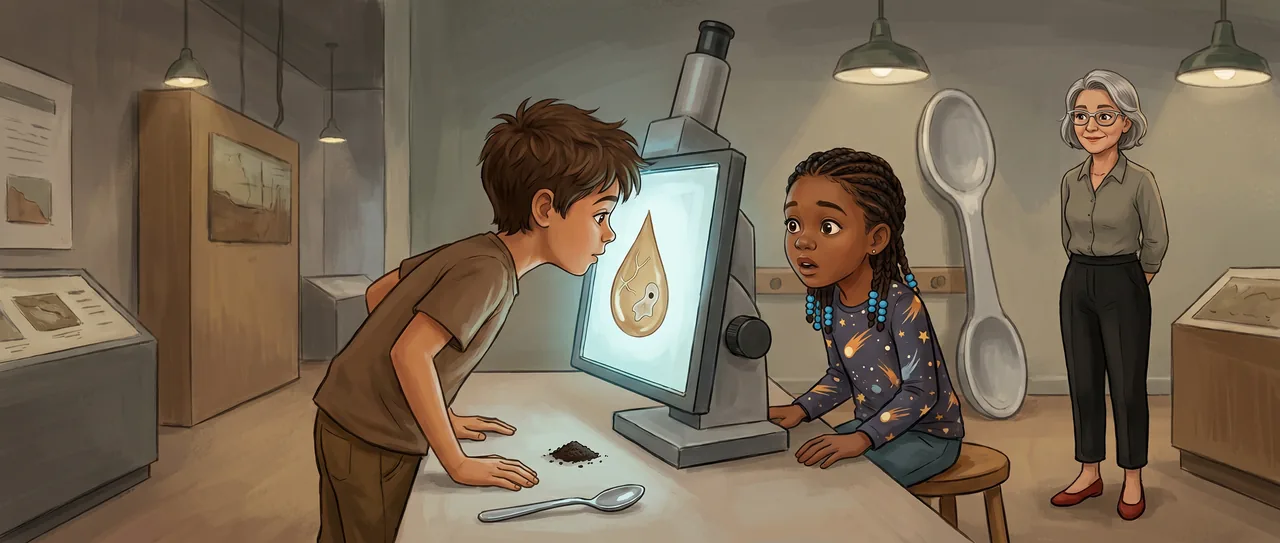
Soren unpacked the small digital microscope from the museum cabinet. He knew this microscope. It had a stiff focus knob and a light that flickered if the cord bent wrong. He plugged it in, clipped a slide onto the stage, and put a dry crumb of compost under the lens.
On the screen appeared a black mountain.
He turned the focus knob. The mountain became a blurry black wall.
He turned it again. The wall became a different wall.
Behind him, Ms. Vale dragged the foam teaspoon closer to the entrance.
Soren tried the maple soil. Another wall. He tried crushing the crumb thinner with a cover slip. The cover slip cracked with a tiny sound like a beetle shell.
He froze.
Ms. Vale looked over.
“I have more,” Soren said.
“Slides or time?”
“Both, if no one talks.”
She almost smiled, but the lobby doors rattled and she hurried away.
Soren stared at the black smear on the glass. He had thought the hard part would be magnification. The sign made it sound like the life was packed in there, waiting to wave. But soil did not open itself just because a person wanted to look.
He took a clean slide.
In his notebook, on a page already crowded with lists, he had written: bacteria small, fungi threads, protozoa need water films. He had copied that phrase from a book and not cared about it much. Water films had seemed like a detail. Now the detail stood in the middle of the table with its hands out.
He used the dropper to put one bead of water on the slide. Then he touched the bead with the tiniest pinch of rooftop compost, not even a pinch, more like the shadow of a pinch. The water turned tea-colored. He lowered a cover slip slowly so it did not smash everything flat.
The first thing on the screen was a brown fleck with ragged edges.
Then, at the edge of the fleck, something pale ran across the light.
Soren stopped breathing. Another thread forked away from it. Little bright dots clung nearby.
He leaned closer until his forehead nearly touched the screen.
The teaspoon on the table looked suddenly too small for what it was carrying.
A line had been printed on a sign. Several yards of fungal threads. He had read it. He had believed it the way a person believes the moon is far away while standing under a streetlight.
Ms. Vale came back with six children in yellow museum badges and one adult who was reading a message on her phone.
“Preview group,” Ms. Vale said. “Can your sealed universe behave for five minutes?”
Soren nodded without looking away.
The smallest child climbed onto a stool. She had a comet on her shirt and a blue bead in each braid.
“I thought dirt was ground-up rocks,” she said.
“That is part,” Soren said.
On the screen, a clear oval slid out from behind the brown fleck. It changed shape as it moved, slow and certain. It paused near the pale thread. Tiny specks jittered around it.
The child with the comet shirt whispered, “It’s eating the sparkle.”
“Maybe bacteria,” Soren said. “They are very small. The sign says a healthy teaspoon can hold up to one billion.”
The child turned from the screen to the giant plastic spoon, then back to the slide.
“One billion in that?” she asked.
“In a teaspoon. If the soil is healthy.”
She held up her thumb and finger, leaving a space hardly wider than a raisin.
Soren nodded.
The other children pushed closer. The adult with the phone lowered it.
“Is that animal?” a boy asked.
“Protozoan,” Soren said.
“Is that animal?”
“Sort of not exactly.”
The boy accepted this immediately.
Ms. Vale whispered, “Can we make it bigger?”
“It is already bigger,” Soren said. “On the screen.”
“I mean for the back row.”
“There is no back row yet.”
“There will be.”
Soren adjusted the cord so the light stopped flickering. Then he slid the baked soil sample under the lens.
The screen showed grains like broken glass and tiny stones. Beautiful, in a dry way. Nothing crossed. Nothing nosed along the edge. Nothing bent around anything else.
The children waited.
“Is it hiding?” asked the comet-shirt child.
“This one was baked,” Soren said.
“For cookies?”
“To see what changed.”
She looked at the blank screen. Then she looked at the sign. “So clean can be empty.”
Ms. Vale made a small sound in her throat, not quite a cough.
Soren switched back to the compost slide. The pale thread was still there. Another clear body moved near it, rounder than the first, with a dark spot inside. It turned as if the whole drop of water were a room and it had remembered another door.
The group went quiet in a way Soren knew. It was the quiet that happened right before people either laughed because they did not know what else to do, or stepped closer because they could not help it.
The comet-shirt child stepped closer.
“My class grew beans,” she said. “Mine were shortest. I kept looking at the dirt because it had white fuzz. Everyone said don’t stare at dirt.”
Soren moved the slide a little. The white thread crossed the screen again.
“That might have been the part to stare at,” he said.
Ms. Vale picked up the giant plastic microbe from the floor and turned it in her hand. “We could do a live sample station,” she said. “Sealed slides only. Soil from different places. Maybe a camera feed. Maybe people bring samples from home and we compare.”
Soren was already reaching for the jar from the dry path.
“Not all of them will look like this,” he said.
“Good,” Ms. Vale said. “Then they will have to look.”
The museum doors opened at the far end of the lobby. Voices spilled in. Shoes squeaked on the clean floor.
The comet-shirt child pointed toward the glass entrance. Outside, a planter sat beside the steps. Dead leaves had gathered under a little city tree. A strip of dark soil showed where rain had washed the dust away.
“What about that one?” she asked.
Soren looked at Ms. Vale.
She looked at the crowd, then at the shoebox, then at the sign on the wall.
“One teaspoon,” she said. “Sealed.”
Soren took the clean spoon from the table and ran to the planter. When he came back, he carried less soil than would fill a bottle cap.
He made the slide with one drop of water. He set it under the microscope. He lowered the lens.
On the screen, a pale thread crossed the circle of light, and a clear body bumped it, turned, and disappeared into black.
Read the interactive version, listen to the narration, and earn a gold star →
A science-verified short story for curious kids · Curiosity Land