The Star at Noon
At noon, the planetarium made a mistake.
Soren was the only person sitting under the dome when it happened. The room was supposed to be dark, but the exhibit director had turned on a test program that showed the sky outside as if the ceiling had become glass. Blue everywhere. A white Sun. A few pale labels waiting for the evening show.
Then a star appeared beside the Sun.
It was sharp and white and much too bright.
The exhibit director stood in the aisle with a tablet under one arm and a roll of tape in her teeth. She was hanging signs for donors, and every sign was slightly crooked because she kept answering messages while taping.
She looked up, frowned, and took the tape out of her mouth.
“That has to go,” she said.
Soren had already opened his notebook, not because anyone asked him to, but because the inside of his head had become crowded.
“Stars do not show at noon,” the director said. “Not like that. People will think the projector is broken.”
“Venus can,” Soren said.
“That is not Venus.”
The white dot trembled a little as the dome recalibrated. A label slid under it.
Eta Carinae.
Soren knew the name the way he knew the names of deep ocean creatures and old volcanoes. Not properly. Not enough. Just enough for the name to make a small hook in him.
The director tapped her tablet. “The script says future hypernova, possibly visible in daylight. It sounds like a movie poster. I am cutting it before the school group arrives.”
“Do not cut it yet,” Soren said.
She looked at him as if she had forgotten he was eleven.
“I mean, it might be wrong,” he said. “But it might be wrong in a useful way.”
The director checked the time on the wall. “You have until I finish the meteorite case. Do not change any passwords. Do not unplug anything that hums.”
She hurried away, carrying crooked signs.
Soren stayed under the false noon. The star was still there, bright as if the Sun had failed to win.
He did not like it. That was where he started. Not with belief. With a wrongness that had edges.
The side wall held a row of old observations printed on glass. Most visitors walked past them to reach the meteorite they were allowed to touch. Soren went to the glass.
Eta Carinae had a timeline.
For a long time, it had been a star people could see only from southern places. Then, in the eighteen hundreds, it brightened. In eighteen forty-three, during the Great Eruption, it became the second brightest star in the night sky. Only Sirius was brighter. Then it faded again.
Soren read the sentence twice.
The second brightest star in the sky, and then not.
He looked back at the dome. The noon star waited beside the fake Sun.
“You did not die,” he said quietly.
The timeline answered from its glass panel. Eta Carinae had thrown off a huge cloud of gas and dust, now called the Homunculus Nebula. The star had survived. It was massive. Unstable. More than one star, actually, a giant pair wrapped in violence and light.
Soren found the control console. He did not unplug anything that hummed. He only opened the brightness archive and set the dome for the southern sky in eighteen forty-three.
The blue ceiling dimmed. The Sun dropped away. Night climbed over him.
Stars came out in hundreds, then thousands. The Milky Way spilled like flour across black cloth. Near the dark shape of the Carina Nebula, Eta Carinae burned so fiercely that the other stars seemed to step back from it.
Soren forgot the console.
He had seen bright planets. He had seen the Moon make shadows. But this was a star behaving like a signal flare across thousands of years of space. People had stood under real skies and watched a star change its mind.
The notebook in his hand slipped shut against his thumb.
On the glass wall, under the timeline, were copies of old records. Small handwriting. Careful dates. Weather notes. Brightness compared to other stars. A ship’s observer. An astronomer at a southern observatory. Someone else who had written, in neat ink, that the star was brighter again.
Soren moved closer.
The handwriting was cramped and uneven in places, the way writing gets when a person is cold, tired, or trying not to miss the thing that is happening. None of them had known what Eta Carinae was. None of them had seen a space telescope picture of the nebula it made. They had only had their eyes, the sky, and the stubborn decision to write down something that did not fit.
Soren set his notebook on the ledge below the glass. His pencil columns lined up under theirs.
The director called from across the room, “Please tell me you are not proving the movie poster right.”
“Not right,” Soren said. “More careful.”
“That is a terrifying answer from a child with access to my console.”
He returned to the controls.
The archive had a distance marker. About seven thousand five hundred light-years. Soren typed the number into the dome program and watched the simulation draw a thin blue line from Earth to Eta Carinae. The line crossed the ceiling, crossed the wall, crossed the floor, and kept going past the doorway as if the room was too small to hold it.
Seven thousand five hundred years for light to arrive.
The eighteen forty-three eruption had not happened in eighteen forty-three, not at the star. It had happened long before, and the light had reached Earth when people in coats and boots and sailing ships were looking up.
Soren sat down on the floor because the room had changed size without moving.
If Eta Carinae became a hypernova bright enough to show in daylight, the explosion might not be waiting in the future the way a bus waits at a stop. It could already have happened out there. Its light could be crossing the dark right now, year after year, not hurrying, not slowing, carrying a noon star toward people who had not been born.
The director came back with a meteorite label stuck to her sleeve.
“Well?” she asked.
Soren stood up. “The daylight star is not the problem.”
“That is usually exactly the problem.”
“The words are the problem.”
He pointed to the script on the tablet. The line said, Eta Carinae will explode soon as a hypernova and shine in the daytime.
“Soon is wrong,” Soren said. “Maybe tomorrow. Maybe thousands of years. Maybe longer. Will is too hard. We do not know the clock. But it is massive and unstable. It already had the Great Eruption and became the second brightest star in the night sky. If the final explosion is bright enough, people on Earth could see it in daylight.”
The director looked from the tablet to the dome. “That is less punchy.”
“It is better.”
“For eleven-year-olds?”
“For anyone,” Soren said.
She studied him. She was not smiling in the polite adult way. She was actually considering the star.
“Show me,” she said.
Soren ran the program from the beginning.
First, ordinary night over the southern hemisphere. Eta Carinae was only one point among many.
Then, eighteen forty-three. The point brightened until the dome seemed to lean toward it.
Then the space telescope image of the Homunculus Nebula opened around the star, Then noon.
The Sun returned. The sky went blue. The stars vanished.
One white point remained.
This time, Soren had changed the label.
Eta Carinae. Someday, if its final explosion is bright enough, its light could place a star in Earth’s daytime sky. No one knows when. At its distance, the message may already be traveling.
The director read it without speaking.
From the lobby came the noise of the school group arriving, sneakers squeaking, voices bouncing, someone asking if meteorites were hot.
The director peeled the meteorite label off her sleeve and stuck it to her tablet by mistake.
“All right,” she said. “We keep the impossible star.”
“Not impossible,” Soren said.
“No,” she said. “Worse. Possible.”
She sent the corrected label to the printer.
The printer whispered and clicked. A clear sticker slid out, no bigger than Soren’s hand. The director gave it to him, and this time she did not tell him to hurry.
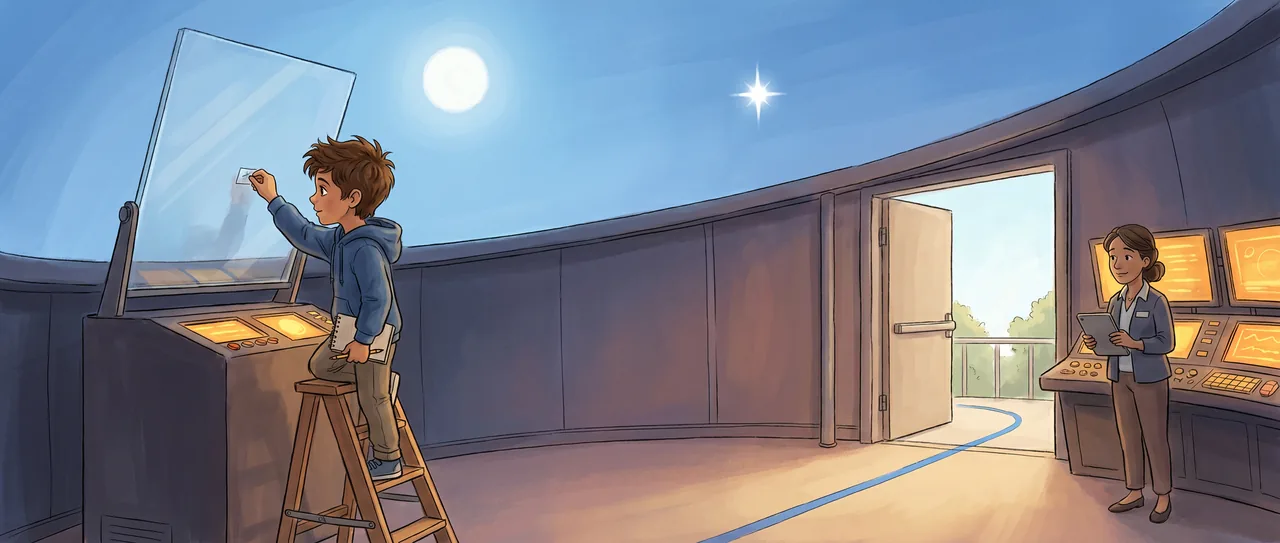
Soren climbed the short ladder inside the dome. The projector filled the ceiling with noon blue.
He smoothed the sticker onto the glass plate for Eta Carinae until the words caught the projector light: It may already be on the way.
Read the interactive version, listen to the narration, and earn a gold star →
A science-verified short story for curious kids · Curiosity Land