The Song With Too Many Doors
The song failed first.
It came out of the hospital speaker as a thin silver line, soft enough for a hallway and tidy enough for a grant demonstration. It had a piano in it. It had strings that sounded like they were apologizing. It had no corners anywhere.
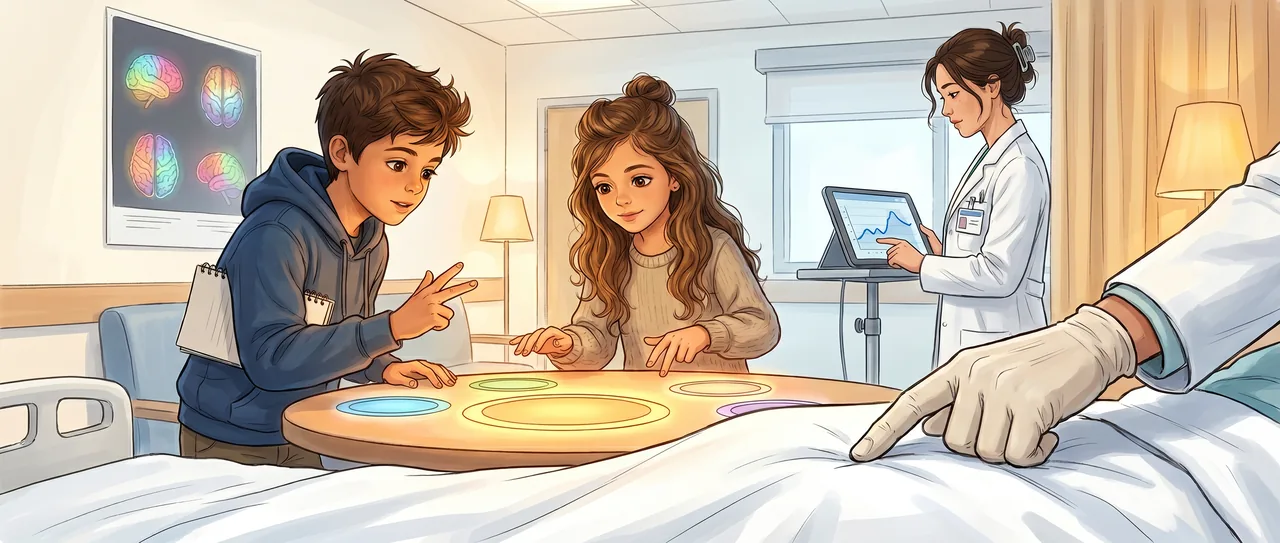
Mr. Calder lay in the bed with his eyes half open, looking past the ceiling lights. A soft glove covered his right hand. Wires from the glove ran to a tablet on a rolling stand, where a blue line waited for his fingers to squeeze.
Dr. Liao stood beside the tablet with a badge clipped sideways to her white coat. Her hair had escaped its clip in three places. She tapped the screen twice, then frowned at it as if the screen had personally disappointed her.
"Luis, if you can hear the music, squeeze your hand," she said.
The blue line did not move.
Maya stood very still. Stillness was the only polite thing she could do while her head ran ahead without asking permission.
Soren had his paper notebook open against his chest. The nurses had already looked at it the way people looked at a pigeon inside a grocery store. He had drawn the glove graph, the speaker, the bed rail, and a little box labeled wrong, though he had not decided which thing was wrong yet.
Their class had built the finger sensors for the hospital, flat threads inside soft fabric that changed their signal when pressure pressed them. Soren knew what an empty hand looked like on the graph. It looked exactly like this, a blue line with almost no weather in it.
"Again," Dr. Liao said, mostly to herself.
She restarted the song. Piano. Strings. A polite little rise. A polite little fall.
Nothing.
Behind Mr. Calder’s bed, a laminated card had been clipped to the wall. It said his name, the day, the weather, and three things staff were supposed to know about him.
Subway conductor. Timbales. Sunday dancing.
Maya read it once, then again, faster.
"That song is wearing hospital shoes," she said.
Dr. Liao looked up. "What?"
"It walks wrong. For him."
Soren’s pencil stopped. He looked at the card. "Timbales are drums. Bright ones. Metal shells. Salsa uses them."
Dr. Liao rubbed the side of her nose. "We use neutral music for the demonstration. Nothing startling. Nothing too busy. The board is already worried about noise."
Too busy landed in the room like a familiar shoe dropping. Maya heard that at school when she asked the second question before the first answer was finished. Soren heard it when a page in his notebook held a graph, a map, four words, and a drawing of a hinge because all of them belonged to the same problem.
On the wall above the sink was a poster with pictures of brains glowing in different colors. Speech made small islands. A hand movement made another island. Music looked as if someone had turned on a whole city at night.
Hearing. Moving. Seeing. Feeling. Remembering.
The tidy piano song kept walking nowhere.
Maya pointed at the tablet. "Can it play pieces?"
"Loops," Dr. Liao said. "But no improvising near the patient unless I approve it. Nothing loud. Nothing sudden. If his face changes badly, stop. I have to get this sensor log saved before the visiting committee arrives."
She said it like permission and warning had been folded into the same envelope.
Soren moved to the music table. It was not really a table. It was a flat screen with large colored circles labeled piano, bass, conga, timbales, horns, voice, strings. Each circle could be made louder or softer with one finger. Each could be turned on alone.
Maya touched timbales.
A bright crack rang out, quick and clean.
Mr. Calder’s face did not change.
"Too sharp," Soren said, watching the blue line. "But the graph twitched. Maybe from the speaker vibration. Do it again softer."
Maya did. Crack, crack.
The blue line shivered once, then settled.
"Could be noise," Soren said.
He did not say it was nothing. That was one of the useful things about him.
Maya added conga, low and round underneath. Then bass, not loud, just enough to make the floor seem to remember it had a bottom. Soren set the tempo slower than the machine wanted. He tapped the edge of the table with two fingers, counted, erased the count, counted again.
"Not like a clock," he said. "Like feet. There is a push before the step."
Maya moved the timbales slightly late, then early, then into the place where Soren’s tapping made his shoulders loosen.
The room changed.
It was still the same room. Same bed. Same wires. Same smell of clean plastic and orange soap. But the sound no longer came from one speaker. It seemed to find the metal rail, the water cup, the window glass, the soles of Maya’s shoes. Soren watched the graph.
"Again," he said.
Maya let the rhythm run for four measures. The blue line rose on the second beat, small as a breath under a door.
"Mute the drums," Soren said.
She touched timbales off.
The line flattened.
"Bring them back. Same volume."
She did.
One measure. Two.
The blue line rose again.
Dr. Liao had stopped typing.
"That might be artifact," she said, but her voice had gone careful.
"Then changing the tempo should change the artifact," Soren said.
He did not ask if he could. His hand was already on the tempo slider, but he moved it only a little. Slower. Maya matched the conga. The song took a wider step.
On the bed, Mr. Calder’s index finger bent.
Not much. Not like in movies. No gasp. No sitting up. The finger bent and released against the white sheet.
The blue line rose exactly where Soren’s pencil had marked the beat.
Maya’s mouth opened, then closed. Some things did not fit into talking right away.
Dr. Liao came to the other side of the bed. Her badge swung forward and back. She did not touch Mr. Calder. She did not touch the tablet. She looked from his hand to the graph to the music table.
"Luis," she said, softer than before. "If you want the music to continue, squeeze again."
Nothing happened.
The rhythm went on, warm and bright and walking.
Maya looked at Soren.
"Wrong question," she said.
Soren nodded once. "Too many words. Give him a place in the song."
He turned off the horns before they entered. He left conga, bass, timbales. Maya put her two fingers above the table but did not touch it yet.
Soren tapped three times on the table edge, then stopped. Tap, tap, tap, silence.
Maya answered with the timbales. Crack, crack.
They did it again. Soren made the space. Maya filled it.
Then Soren leaned toward the bed rail, close enough for Mr. Calder to hear but not close enough to crowd him.
"Your turn," he said.
Tap, tap, tap.
Silence.
Mr. Calder’s finger moved after the empty place had almost become too long. It pressed down once against the sheet.
The graph climbed in a blue hill.
Dr. Liao put one hand over her mouth. Her eyes were shiny, but her other hand was already reaching for the recording button, because she was a doctor and a scientist and a person all at once.
Maya did not look away from Mr. Calder’s hand. The card on the wall said timbales. It did not say where the music had been waiting. It did not say how much of a person could be quiet and still have a beat inside.
Soren slid his notebook under his arm without writing anything. The page could wait. The room could not.
He tapped three times again.
Maya lifted her hand from the table. No drum sounded. Mr. Calder’s finger came down by itself on the rail.
Read the interactive version, listen to the narration, and earn a gold star →
A science-verified short story for curious kids · Curiosity Land