The Shape of Wrong
The exhibit was supposed to open in forty-seven minutes, and it was lying.
That was the first thing Maya decided.
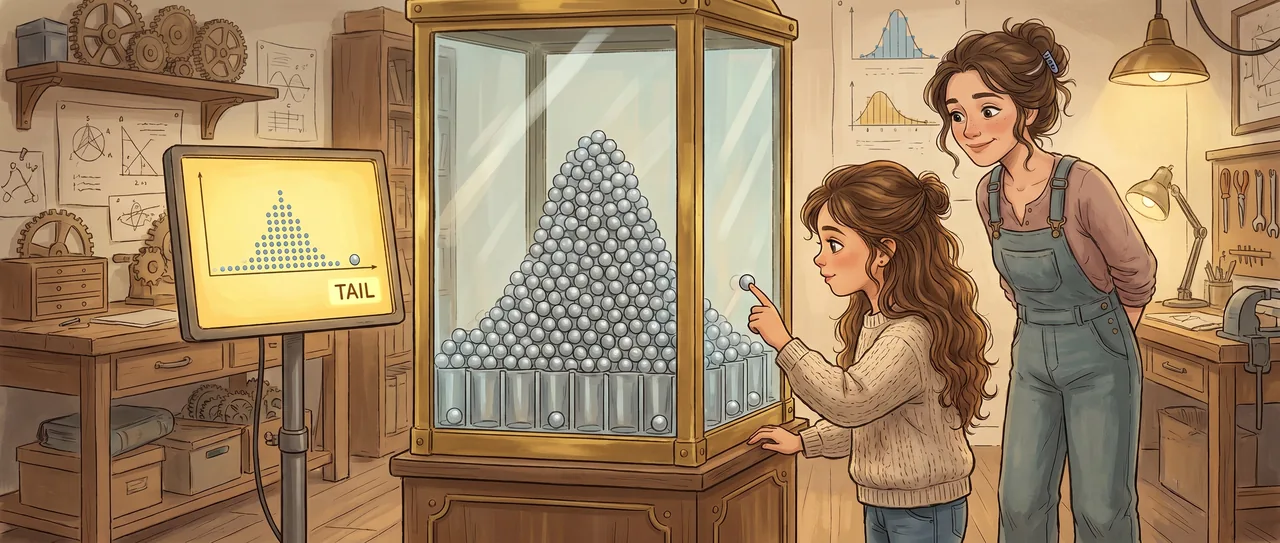
She stood in front of a glass wall taller than she was. Behind it, a thousand silver balls waited in a hopper above a triangle of brass pegs. At the bottom were narrow slots, each with a little cup. Above the whole thing, blue letters glowed on a screen.
THE THOUSAND MAYBE MACHINE.
Under that, in smaller letters, it said, FAIRNESS MADE VISIBLE.
Maya frowned.
Aunt Lila knelt beside the control panel with a screwdriver between her teeth and a smear of dust on one cheek. She designed exhibits for the museum and always looked as if she had been arguing with electricity.
“Don’t frown at my machine,” Aunt Lila said around the screwdriver.
“It says fairness,” Maya said.
“It is fair.”
Maya pointed at the cups. “Then why won’t the balls spread out evenly?”
Aunt Lila took the screwdriver from her mouth. “Because fair doesn’t always mean even.”
“That sounds like something adults say when the thing is broken.”
“It might be broken,” Aunt Lila said. “That’s the problem.”
She pressed a button. The hopper gate opened, and silver balls poured down.
They struck the pegs with a bright rain sound. Tick, tick, tick, tick. Each ball bounced left or right, left or right, choosing its way through the triangle. At the bottom, the center cups filled fastest. The cups beside them filled less. The outside cups hardly filled at all.
The screen flashed red.
BATCH FAILED. AVERAGE OFF CENTER.
Aunt Lila groaned. “Again. The donors arrive in less than an hour. If this keeps happening, I’m switching to the animation.”
Maya looked at the glass wall. “Animation is cheating.”
“Animation opens on time.”
Maya watched one late ball fall. It struck a peg, wobbled, struck another, and rolled into a cup just left of center. Nothing about it looked like a machine deciding. It looked like a tiny accident that had found a place to sleep.
“Run another batch,” Maya said.
Aunt Lila checked her watch. “Maya.”
“Please.”
Aunt Lila muttered something about children and certainty, then pressed the button again.
Another silver rain fell. The cups rose in a lumpy hill. Not a neat hill. The left side bulged. The right side had a gap like a missing tooth. The screen flashed red again.
BATCH FAILED. AVERAGE OFF CENTER.
Maya leaned closer to the screen. Beneath the red warning was a tiny graph labeled DEVIATION FROM CENTER. A blue dot had appeared one column left of zero. Another blue dot sat two columns right of zero.
“What is that part?” Maya asked.
“Diagnostics,” Aunt Lila said. “Each batch has an average landing spot. If the average misses the center by too much, the screen complains.”
“How much is too much?”
“Any much, today.” Aunt Lila tapped the panel. “It’s being fussy.”
Maya kept looking at the two blue dots. They were not in the main cups. They were a picture of how wrong the batches had been.
“Don’t clear it,” Maya said.
“I have to clear it.”
“Don’t.”
Aunt Lila sat back on her heels. Her hair had escaped its clip in three places. “You have four minutes before I make the cartoon balls save us.”
Maya opened the side cabinet. Inside were labeled switches, return motor, hopper gate, lights, sound, diagnostics, clear batch, clear all. The return motor had a green handle. She pulled it.
The balls in the bottom cups rattled backward into a hidden belt and climbed to the hopper again.
“Careful,” Aunt Lila said.
“I know what this part does.”
“You know what one label says.”
“Same thing, but shorter.”
Maya pressed the hopper button.
Silver rain.
The batch failed. A blue dot appeared one column right of zero.
Again.
Silver rain.
A blue dot at zero.
Again.
Two columns left.
Again.
Zero.
Again.
One right.
Aunt Lila stopped looking at her watch.
The cups at the bottom grew into the same kind of hill every time the totals were left alone. Ragged at first. Then steadier. The center rose high. The shoulders sloped. The far edges stayed low, but not empty.
Maya put her finger against the glass, over the farthest left cup. “To get there, a ball has to go left, left, left, left, left, left.”
“Pretty much,” Aunt Lila said.
Maya moved her finger to a middle cup. “But to get there, it can mess up in lots of ways.”
She did not say anything after that. She traced invisible paths down the pegs. Left, right, right, left. Right, left, left, right. Different crooked trips ended in the same middle cups. The machine had not been choosing the center. The center had more doors.
The next batch fell. The red warning flashed again, but Maya was watching the small diagnostic graph.
The blue dots were piling up.
Not evenly.
They made their own hill.
Most of the batch averages landed close to zero. Fewer missed by one or two. Almost none missed by more. The mistakes had shoulders. The wrongness had a center.
Maya felt the sound of the balls change. It was still random, still a storm of tiny accidents, but now the storm had edges she could see. The main cups showed where the balls went. The small blue graph showed how the batches wandered around where they were supposed to be.
Aunt Lila whispered, “Oh.”
Maya glanced at her. “The machine isn’t failing.”
Aunt Lila looked embarrassed, which Maya liked much better than when adults looked wise. “The test is failing.”
“It wants every handful to be the whole mountain,” Maya said.
She found the menu button and pressed it. The screen offered three choices.
CLEAR AFTER EACH BATCH.
SHOW RUNNING TOTAL.
SHOW DEVIATION HISTOGRAM.
Maya chose the last two.
The red warning vanished. The words changed.
KEEP GOING.
Aunt Lila laughed once. “That is not an official museum phrase.”
“It should be.”
Footsteps sounded in the hallway outside. Adult voices. The donors were early, or the clock was faster than Aunt Lila wanted it to be.
“One more thing,” Maya said.
“No more things,” Aunt Lila said, but she did not move to stop her.
Maya reached into the spare cup and took one silver ball. She dropped it by hand through the top funnel.
It hit a peg and went right. Then right. Then right again.
Aunt Lila leaned in.
The ball kept going right.
“Come on,” Aunt Lila said softly, as if she had picked a team.
The ball struck the last peg and jumped into the farthest right cup, alone.
At once, a yellow message appeared.
OUTLIER. REMOVE?
Maya’s hand was already on the panel.
“No,” she said.
She pressed the down arrow until the screen offered another word.
LABEL.
She pressed enter.
The yellow message changed.
TAIL.
The hallway doors opened. People in shiny shoes and museum badges came in, talking too brightly. Aunt Lila stood up fast and wiped her hands on her overalls.
“Welcome,” she said. “This is the Thousand Maybe Machine. It shows what happens when fair chances are allowed to happen many, many times.”
Maya stood beside the glass. No one asked her to move.
A man with a silver tie looked at the center cups. “Beautiful. Like a bell.”
A woman pointed at the lone ball in the farthest slot. “Is that one supposed to be there?”
Aunt Lila opened her mouth.
Maya answered first. “Yes.”
The woman looked down at her. “Even all the way out there?”
Maya pressed the hopper button.
The machine began again.
The room filled with ticking silver rain. The center cups climbed. The blue dots gathered near zero. A few wandered outward and took their places. The lone ball in the farthest slot shone under the exhibit lights.
Maya picked up one silver ball from the return cup, held it above the top funnel, and let go.
It struck peg after peg, ticking sideways through the triangle.
At the bottom, it clicked alone into the farthest slot.
Read the interactive version, listen to the narration, and earn a gold star →
A science-verified short story for curious kids · Curiosity Land