The Seventeen-Year Hallway
The hallway had seventeen doors.
They were not real doors. They were poster-board rectangles taped to the wall outside Conference Room C, each one with a black number written across the top in thick marker. Year One. Year Two. Year Three. All the way to Year Seventeen.
Soren stood in front of Year Seventeen with his notebook tucked under his arm and a green card in his hand.
The card said: Proven genomic finding. Useful for patient care.
Dr. Imani Vale clapped once from the doorway. She was a genomics doctor with bright orange glasses and a badge that had somehow twisted backward. She talked like she was always late for a train.
"All right," she said. "The genome is read. The finding is real. The evidence is good. Get it to the clinic before the pretend prescription goes through. Easy. This is why I asked for a young person. Adults overcomplicate everything."
Soren looked down the hallway.
At the far end, a pharmacist from the hospital staff held a yellow card that said: Medication ordered. Beside him, a nurse started a timer on her phone.
"How long do I have?" Soren asked.
"Three minutes," said Dr. Vale. "In real life, we have years. Today we have three minutes and stale muffins. Go."
Soren went to the first table. A sign said Laboratory.
A woman in a lab coat took his green card, stamped it, and handed it back.
"Where now?" Soren asked.
"Medical record," she said.
The second table had a laptop. Soren handed over the card. A man typed, frowned, clicked five times, and slid the card into a plastic sleeve labeled Genetics Reports.
"Is it in the medication screen?" Soren asked.
"It is in the chart," the man said.
"That is not what I asked."
The man blinked. "Then no."
The timer beeped from the end of the hall.
The pharmacist lifted the yellow card. "Medication ordered. Genomic result not seen."
Dr. Vale made a small wounded sound. "But it was in the chart."
Soren took back the green card. "In a closet is also in the building."
The nurse laughed into her paper cup.
Dr. Vale pushed her orange glasses up her nose. "Again. This time faster."
They ran it again.
Soren sprinted. The lab stamped. The man typed. The green card disappeared into Genetics Reports. The yellow card rose.
Again.
Soren skipped the lab table and went straight to the laptop.
"No stamp," the man said.
The yellow card rose.
Again.
Soren carried the green card directly to the pharmacist.
"I cannot use a loose hallway card," the pharmacist said. "It has to be in the order system."
The yellow card rose.
After the fourth failure, Dr. Vale grabbed a muffin and bit it like it had betrayed her.
"This is why genomic medicine takes so long," she said. "We can sequence a person's DNA faster than we can change a clinic habit."
Soren opened his notebook. On the left page he wrote, not fast, not slow.
Lab knows.
Chart stores.
Doctor orders.
Pharmacist checks.
Patient receives.
He drew arrows between them. Then he crossed out the arrow from Chart stores to Doctor orders.
"That arrow is fake," he said.
Dr. Vale leaned over his shoulder. "We have an electronic record."
"The record is not an arrow. It is a room with drawers."
The room went quiet in a way Soren knew. It was the quiet that happened when he said something that sounded strange before it sounded useful.
The nurse set down her cup. "He is not wrong."
Dr. Vale looked at the seventeen paper doors. "Implementation science," she said, more softly, "is supposed to be about the arrows. Not just the discovery. The path. The people. The places where the good idea gets stuck."
Soren looked at his notebook page.
There was a science for the broken part. He turned the page.
"Who is the first person who needs the result?" he asked.
"The ordering doctor," said Dr. Vale.
"When?"
"When choosing the medication."
"Where are they looking then?"
Dr. Vale opened her mouth, then closed it.
The man at the laptop said, "The medication order screen."
Soren drew a box around Doctor orders.
"Then the green card has to wait there," he said. "Not in Genetics Reports. It has to meet the yellow card."
Dr. Vale pointed at the laptop man. "Can the training system do that?"
"Not beautifully," he said.
"Good," said Soren. "Beautiful takes seventeen years. Do ugly."
The nurse tore a strip of blue tape from a roll and handed it to him. Soren taped the green card to the table where the medication order began.
"Pretend it is a message," he said. "A short one. Not a giant report."
Dr. Vale reached for a marker. "What should it say?"
Soren thought of every school instruction sheet that had hidden the important sentence in the middle of three paragraphs.
"Do not use this medication before checking the gene result," he said. "Then one button for why. One button for what to use instead."
The pharmacist nodded. "And it should say who agreed. Doctors ignore mystery warnings."
"And someone has to own it," the nurse said. "Warnings get old. Guidelines change."
Soren wrote another line.
Owner feeds arrow.
Dr. Vale stared at the words. Her orange glasses had slid down again. "You just made my grant proposal better and I am annoyed about it."
"Run it," Soren said.
The nurse reset the timer.
The lab stamped the card. The laptop man entered it, but this time he also placed a copy of the message at the medication order table. Dr. Vale played the doctor. She reached for the yellow prescription card and stopped when her hand touched the taped green message.
"Gene result present," she said. "Medication changed."
The pharmacist did not lift the yellow failure card.
The timer kept counting.
For a few seconds, nobody moved.
Then Dr. Vale walked to Year Seventeen and pulled the poster-board door off the wall. The tape made a ripping sound.
Behind it was not a wall.
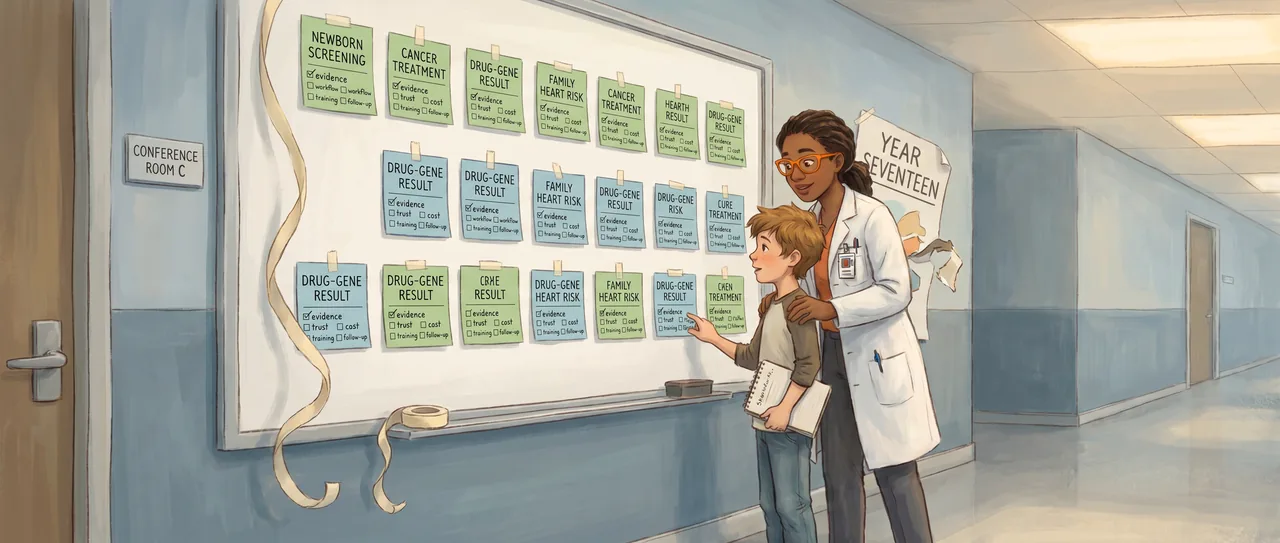
Behind it was a whiteboard Soren had not noticed because the paper doors had covered it. The board was packed with rows of cards. Some were green. Some were blue. Some had hospital names. Some had question marks. One said newborn screening. One said cancer treatment. One said drug-gene result. One said family heart risk. Each card had a small box beside it marked evidence, workflow, trust, cost, training, follow-up.
Only the evidence boxes were mostly checked.
Soren stepped closer.
The hallway with seventeen paper years had been the small version. This was the real one.
Dr. Vale did not clap this time. She stood beside him, chewing the inside of her cheek.
"We know more than we use," she said. "Not because people do not care. Because knowing is not the last step. We have to build the steps after it."
Soren ran his finger along the nearest row of boxes without touching the ink. Evidence. Workflow. Trust. Cost. Training. Follow-up.
His notebook suddenly felt less like a strange thing to carry and more like the right size for a hallway.
The laptop man wheeled over a cart with tape rolls, blank cards, and markers.
"We are meeting for another hour," Dr. Vale said. "If you are not busy."
Soren tore off a strip of blue tape, pressed one end beneath the first card, and pulled the roll across the floor toward the unmarked door.
Read the interactive version, listen to the narration, and earn a gold star →
A science-verified short story for curious kids · Curiosity Land