The Quiet Eye
The Eye failed by seeing everything.
That was Soren’s first sentence when the little rover rolled straight into the foam tree.
Its camera had worked. Its screen had worked. The wall of tiny lights behind it had worked too well. Every square flashed. Every artificial neuron shouted at once, red and green and blue and white, until the display looked like a thunderstorm trapped in a vending machine.
Maya stood with both hands in her hair.
“It is not blind,” she said.
“No,” Soren said. He was already crouched by the rover, checking the wheel marks in the dust. “It is overwhelmed.”
The rover was supposed to drive through a tabletop forest and find the silver door at the end. The museum called the exhibit How Machines See. Maya privately called it The Eye, because the camera was round and black and seemed offended when people waved at it.
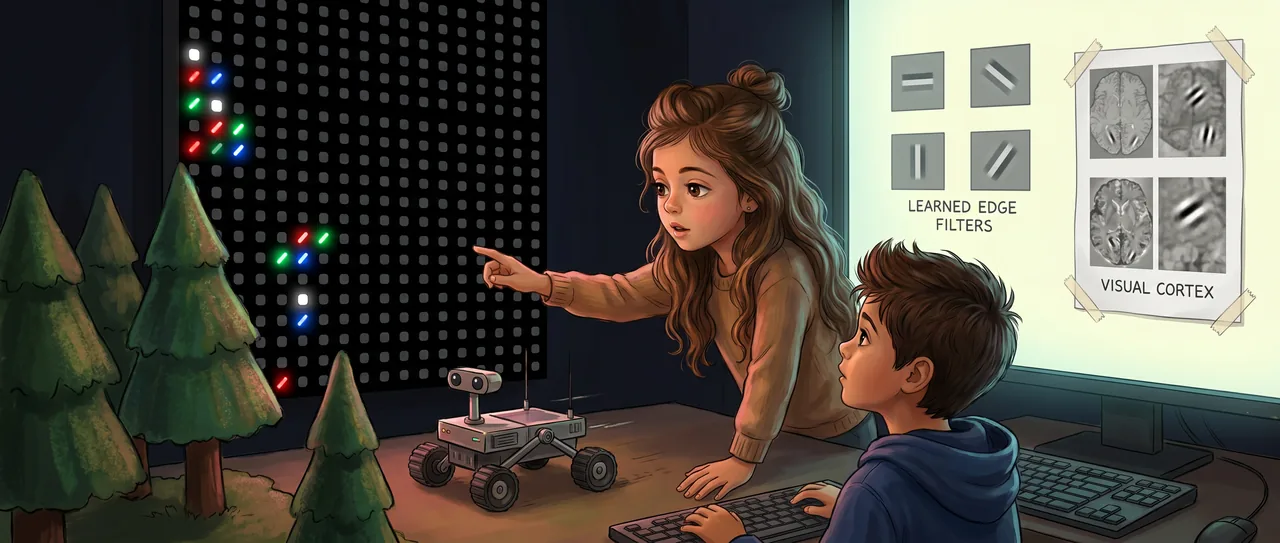
They had built the glowing wall so visitors could watch the machine think. Each light was one unit in their neural network. When a unit liked part of the picture, it lit up.
They had wanted a galaxy.
They had made soup.
Dr. Voss hurried in carrying a cardboard box of name tags under one arm and a half-eaten pear in the other hand. She was in charge of the weekend invention fair, and she moved as if all clocks were insulting her.
“Please tell me that crash was not the robot,” she said.
“It was the tree,” Maya said.
“The tree was standing still.”
“That is how it got hit.”
Dr. Voss looked at the flashing wall. Her face softened a little. “Well, that part is beautiful.”
“It can’t see through it,” Soren said.
“Visitors arrive in forty minutes,” Dr. Voss said. “Beautiful matters. Moving matters. Crashing into trees does not matter quite as much as you think it does, unless it keeps doing it.”
“It will keep doing it,” Maya said.
Dr. Voss glanced toward the hall, where someone had dropped a box of plastic planets. “Make it less crashy. But don’t make it look dead. People like lights.”
She left the pear on the workbench and hurried away.
The wall kept sparkling.
Soren unplugged the rover before it could attack the tree again. “We gave every unit permission to answer every patch.”
“Bad permission,” Maya said.
“It is the honest version.”
“Maybe honest is noisy.”
Soren tapped the keyboard. On the monitor, a square from the rover’s camera appeared, full of leaves, shadows, and one diagonal branch. Next to it came the network’s attempt to rebuild that patch from all its units. It was nearly correct, except it shimmered with tiny false edges, like fuzz on a peach.
Maya leaned closer. “It is adding things.”
“All the units are helping,” Soren said.
“They are not helping. They are interrupting.”
That made Soren stop tapping.
The network had a setting they had barely used because it made the display look empty. Sparse penalty. The label sat in the menu like a dare.
Soren clicked it open. “How empty?”
Maya looked at the wall. Hundreds of eager lights. “Almost empty.”
“That is not a number.”
“Ten.”
“Ten out of two hundred for each patch?”
“Try six.”
Soren’s eyebrows went up. Then he typed six.
The wall went dark.
For one second, the exhibit looked broken.
Then six lights blinked.
The monitor rebuilt the little patch again. The leaves were gone into smudges. The diagonal branch remained, thin and certain.
Maya pointed. “There.”
Soren changed to another camera patch. This one held the edge of the silver door. Five lights blinked. The rebuilt patch showed almost nothing except a bright vertical line and darkness beside it.
Another patch. The curve of a foam mushroom. Four lights.
Another. The corner where the path met shadow. Six lights.
The wall was not a galaxy now. It was a field at night, with fireflies deciding one at a time.
Soren opened the hidden panel they had made for debugging. It showed what each unit had learned to look for during training. Not pictures of trees or doors or mushrooms. Small gray squares filled the screen. One square had a bright slash leaning left. One had a dark slash leaning right. One had a short horizontal bar. One had a pale stripe with shadow on both sides.
Maya did not speak.
Soren scrolled.
More slashes. More bars. Different angles. Different places in the little squares.
“All week it looked at forest photos,” Soren said. “And it made an alphabet of edges.”
Maya took the camera from the rover and aimed it at her own hand. On the wall, only a few lights answered. On the monitor, her fingers became strips of brightness where skin met air. The middle of her palm almost vanished.
She curled one finger.
A different set of lights fired.
Soren reached past her and opened a file from the museum archive. It was not part of their exhibit. He had saved it two days ago because the phrase had bothered him: receptive fields in mammalian visual cortex.
The image showed tiny patterns that real neurons in animal brains responded to. Little bars. Little slants. Bright beside dark. Dark beside bright.
Maya looked from the brain image to their network’s learned squares.
The room seemed to grow very quiet, even though the invention fair clattered all around them.
Their machine had not been taught the brain picture. It had not been taught bars. It had only been asked to use as few answers as it could while still keeping the important parts of natural images.
On one screen, learned squares from silicon.
On the other, measurements from living eyes and brains.
The same small slanted marks looked back from both.
Soren slowly moved his hand in front of the camera. The wall answered with a few bright taps.
“Again,” Maya said.
He moved it again, faster.
Different taps. Same edge.
Maya grabbed a striped scarf from the costume bin and dragged it across the camera. The wall woke in thin diagonal bands, then went quiet wherever the cloth was flat and unchanging.
“It likes changes,” Soren said.
“It likes borders,” Maya said.
“It ignores the middles.”
“The middles are expensive.”
They both looked at the rover.
Soren set the network to sparse mode. Maya lowered the camera back onto its bracket and turned the rover toward the foam forest. The wall stayed mostly dark.
“People will think it is off,” Soren said.
Maya put the silver door at the far end of the path. “Then it can surprise them.”
They ran the rover.
It rolled forward. At the first tree, a handful of lights blinked along the tree’s left edge. The rover turned right. At the mushroom, three lights flashed low and curved. The rover slowed, edged around it, and followed the pale line of the path. The wall remained mostly black, with brief constellations appearing and vanishing.
At the silver door, a vertical row of lights fired. The rover stopped with its bumper one finger’s width from the cardboard threshold.
Maya exhaled.
Soren did not. He set the rover back at the start and ran it again.
It stopped at the door.
He ran it a third time with the scarf hanging from a branch.
The rover hesitated, fired diagonal lights, turned around the cloth, found the door.
Visitors began to gather before Dr. Voss returned. A boy with a planet sticker on his cheek frowned at the dark wall.
“Is it broken?” he asked.
“No,” Soren said.
Maya handed him the scarf. “Wave this slowly.”
The boy waved it. Only a few lights blinked.
“Now wrinkle it.”
He wrinkled it into sharp folds. The wall sparked with slanted strokes.
“Oh,” the boy said. He did it again, carefully, making one fold at a time.
A smaller child pressed both palms together, then opened them like a book. The wall flashed at the separating edges and went dark inside the palms.
Dr. Voss arrived with her mouth open, ready to say something about attendance or safety tape. She looked at the quiet wall. She looked at the children leaning close to it.
“It is very dark,” she said.
“It is working,” Soren said.
Maya picked up the museum archive printout and taped it beside their learned squares. “This side is from brains. This side is ours.”
Dr. Voss stepped nearer. The pear was still in her hand, forgotten and browning at the bite mark.
“You made those match?” she asked.
“No,” Soren said.
Maya turned the camera toward the waiting crowd.
On the black wall, only a few scattered strokes fired at first, a cheek, an eyebrow, the edge of Soren’s upraised hand.
Read the interactive version, listen to the narration, and earn a gold star →
A science-verified short story for curious kids · Curiosity Land