The Long Parts
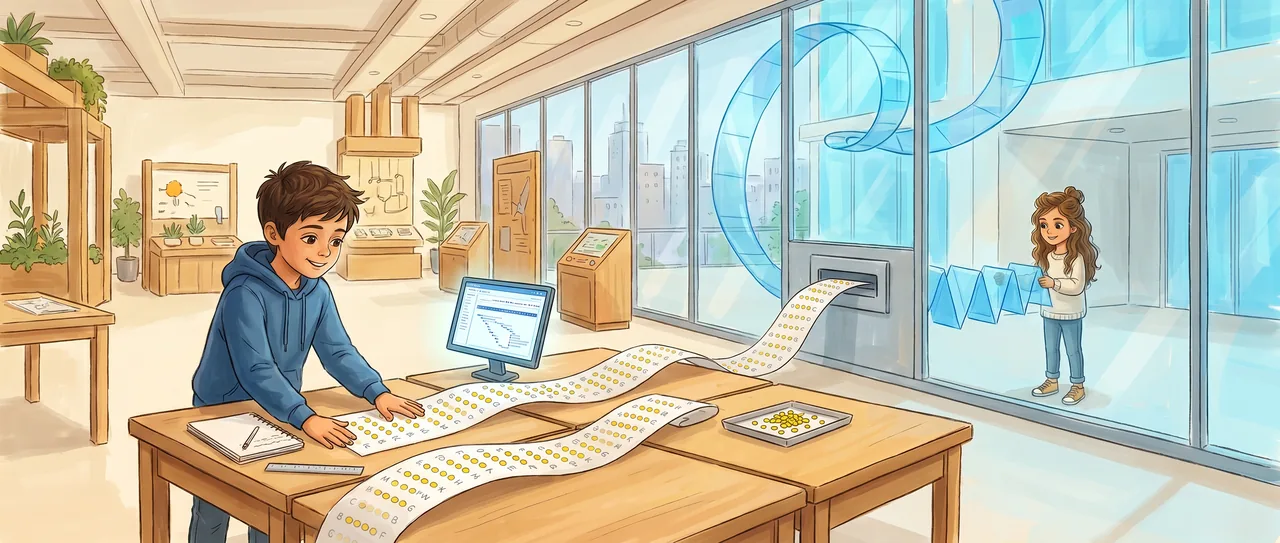
The lie was eight meters long and covered in yellow dots.
Maya stood on a rolling stool at one end of the paper chromosome while Soren crouched at the other with a ruler between his teeth. The chromosome ran across three worktables, dipped over a chair, and vanished under a box labeled CLEAN HANDS ONLY.
Every yellow dot was supposed to mean a single-letter difference in DNA. A changed A. A changed C. One tiny swap in the long instruction string of a person.
The exhibit director loved the dots.
"Visitors understand typos," she said, sweeping past with a coil of cable around one arm and a sandwich in the other hand. "Typos are friendly. Copies are messy. Opening is in forty minutes. Make it beautiful. Make it true enough."
Maya looked up. "True enough is not a kind of true."
The exhibit director did not hear. She was already arguing with a projector.
Soren took the ruler out of his mouth. "If this is true enough, why does the computer keep refusing our print?"
On the screen, the genome browser showed the same chromosome as the paper one, only straighter and colder. Most differences were little marks, like pepper. But across the middle ran a green bar so long it looked like someone had dragged a paintbrush through the data.
Maya tapped it. "That."
"Copy number," Soren read. He had written the words in his notebook already, then boxed them because boxes helped when his head got crowded. "Region duplicated. Estimated three copies."
"We usually have two copies," Maya said. "One from each parent."
"Usually," Soren said. He liked that word. It made room.
Maya pulled the paper chromosome toward her. Yellow dots skipped along it. The green bar on the screen covered a stretch from table leg to table leg. On the paper display, that space was empty.
"The dots are fleas," she said.
Soren measured the empty stretch. "This flea is seventy-six centimeters long."
"Not a flea."
"No."
They had been told to put the yellow dots everywhere the de-identified sample differed by one letter from the reference genome. The reference was printed in tiny gray letters down the paper strip, too small for visitors to read, which was part of the trick. A person could walk beside it and think a genome was a necklace with beads.
Soren scrolled. More bars appeared. Some green, for duplicated regions. Some red, for deleted regions. A few were short. A few were longer than his arm.
Maya went still.
The room did not actually get bigger. The tables stayed tables. The windows stayed windows. But the chromosome on the paper stopped being a line. It grew floors and trapdoors and rooms behind rooms. Human difference had been freckles a minute ago. Now it had hallways.
"We need scissors," Maya said.
"That sounds like deletion."
"Yes."
"We are not allowed to cut the main chromosome."
"Then we need another chromosome."
Soren looked at the clock. Thirty-six minutes.
They raided the craft drawer under the microscope bench. It held blue transparency sheets, binder clips, string, tape, three dried-out markers, and one excellent pair of scissors labeled PLEASE RETURN OR ELSE.
Maya cut a blue strip the length of the green bar. Then she cut a second one exactly the same.
"Duplication," Soren said.
She clipped both blue strips above the paper chromosome so they sat like extra balconies over the same gray letters.
Soren frowned at the red bar on the screen. "Deletion should not be red tape on top. That makes it look added."
Maya handed him the scissors.
He did not cut the chromosome. He cut a window in a sheet of clear plastic and laid it over the red region, so the gray letters underneath disappeared beneath a blank white flap.
"Missing from this sample," he said. "Not missing from the reference."
Maya smiled. "Reference is not boss."
Soren wrote that down, then crossed out boss and wrote ruler, then crossed out ruler too. Neither word was right. The reference genome was not a perfect person. It was a map made from people, useful because everyone had agreed to point at it.
On the wall above the tables, the old exhibit title waited in huge cheerful letters.
YOU ARE ALMOST THE SAME AS EVERYONE ELSE.
Below it, smaller letters said:
Most differences are single-letter changes.
Soren read the sentence twice. "Most, by count."
Maya looked at the yellow dots. There were hundreds of them. "But not by space."
They tested it.
Soren took a cup of yellow hole-punch circles and poured them into a measuring tray. The single-letter changes made a bright little heap. Maya laid the blue duplication strips beside them. The strips ran over the tray, over the table edge, and onto the floor.
"These few copy changes touch more DNA than all those dots," Soren said.
Maya was already pulling more blue sheets from the drawer.
"We cannot explain that with a heap," he said.
"We do not explain it," Maya said. "We make it trip people."
"Not actually trip."
"Almost trip."
They moved the tables.
The exhibit director turned from the projector at the scraping sound. "Why is my chromosome migrating?"
"Because it was lying flat," Maya said.
"Flat is how paper works."
"Not how genomes work," Soren said.
The director opened her mouth, saw the clock, saw the yellow dots, saw the blue strips hanging like folded ladders from the edge of the display. Her sandwich had collapsed in one hand.
"Visitors will not read all that," she said.
"Good," Maya said.
Soren clipped a sign over the old small sentence. He had printed it in large letters, plain and stubborn.
SINGLE-LETTER CHANGES ARE MANY.
COPY CHANGES CAN BE LONG.
Then, under that:
COUNT THE DOTS. THEN FOLLOW THE BLUE.
The director stared at the sign. "Copy changes?"
"Duplications and deletions," Soren said. "Regions with a different number of copies."
"Some harmless," Maya said. "Some important. Some we do not understand yet."
"We are not doing disease today," Soren added.
The director looked relieved and disappointed at the same time. She liked dramatic labels. She also liked not frightening parents.
"Five minutes," she said. "No one gets tangled. No one uses the word mutation in a scary voice."
"We do not have scary voices," Maya said.
Soren made his voice low. "Adenine."
Maya laughed so hard she dropped a binder clip.
The final problem was the longest blue strip. On the screen, one duplicated region was too long for the tables, too long for the wall, too long for the tidy space the exhibit had been given between the hand-washing station and the model cell.
"Fold it," Soren said.
Maya folded the blue plastic back and forth, accordion style, until the strip became a stack of shining pages. She clipped one end at the start coordinate and the other end at the finish.
It looked small again.
That was wrong in a new way.
Soren pressed the folded stack flat. "If we leave it like this, it hides the size."
Maya took the free end and walked backward. The plastic unfolded with soft clicks. It crossed the aisle. It crossed the taped line where visitors were supposed to stand. It reached the glass wall by the entrance and still wanted more.
There was a slot between two display panels, narrow as a mail drop.
Maya fed the strip through.
On the other side of the glass, the blue plastic spilled into the lobby in a bright loop.
The exhibit director stopped chewing. "Oh."
Soren held the chromosome steady. His palms were flat on the paper, one on each side of the duplicated region. Under his hands were gray letters too small to read and yellow dots too many to count one by one.
Maya stood in the lobby, seen through the glass, holding the end of the blue strip.
"Pull," Soren said.
She pulled.
The folded duplication opened longer, and longer, and longer.
The door motors hummed. Maya fed the strip forward, Soren held the slack, and the extra blue windows climbed the glass wall above their heads.
Read the interactive version, listen to the narration, and earn a gold star →
A science-verified short story for curious kids · Curiosity Land